


Elisity Palo Alto Networks Panorama Integration: Automated Firewall Policies
Elisity automatically populates Palo Alto Networks Dynamic Address Groups from identity-based device classification, so firewall policy stays accurate as devices join, move, and change risk status. Connect Elisity directly to your PAN-OS firewalls or to Palo Alto Networks Panorama™, and enforce campus policy through the network infrastructure you already own.
-
Demo
Automating Palo Alto Networks Dynamic Address Groups with Real-Time Device Intelligence
Watch Elisity product managers demonstrate seamless Palo Alto Networks Panorama integration, real-time policy group mapping to DAGs, and automated device classification that eliminates manual firewall address group maintenance. See live quarantine workflows and IoT Security enrichment in action.
Support Documentation
Palo Alto Networks Firewall Integration
Policy Group Derived Dynamic Address Groups (DAG)
Palo Alto Networks Panorama Integration
Policy Group Derived Dynamic Address Groups (DAG)
Challenge
Manual Firewall Address Group Maintenance
Security teams spend countless hours manually tracking and updating firewall address groups as new devices join the network, creating operational bottlenecks and increasing the risk of misconfigurations. Traditional firewall management requires administrators to continuously classify assets and maintain static IP-based policies, forcing valuable security resources to focus on administrative tasks rather than strategic policy development and threat response.
Elisity Solution
Automated Asset Classification and Dynamic Address Group Management
Elisity automates Palo Alto Networks Dynamic Address Groups (DAGs) end to end: Elisity IdentityGraph™ discovers and classifies every connected asset, assigns it to an Elisity Policy Group, and registers the matching tag on your firewalls or through Panorama, so DAG membership tracks the live network without an administrator ever touching an address object. This automated approach removes the operational burden of manually maintaining address groups while ensuring firewall policies always reflect real-time network conditions and device identities.
Challenge
Static Device Classification Creates Security Gaps
IP-based firewall policies fail to reflect real-time changes in device identity, role, or risk level, creating blind spots in security enforcement across multiple sites and network segments. Without automated device classification and dynamic address group updates, organizations struggle to maintain consistent security postures while devices move between network locations or change their operational status.
Elisity Solution
Identity-Based Policy Enforcement with Real-Time Classification
Elisity replaces static IP-based firewall rules with policy that follows device identity. IdentityGraph™ supplies granular context (device type, manufacturer, location, and trusted or quarantined status), and Elisity registers each device with the tag that matches its Elisity Policy Group, so Palo Alto Networks Dynamic Address Groups resolve membership in real time. Security teams write a least-privilege rule once against a DAG, and it keeps applying correctly as a device moves between sites, changes role, or is quarantined, with no rule edit and no configuration commit needed for the membership change.
Challenge
Scaling Firewall Management Across Enterprise Networks
As organizations grow their IT, IoT, OT, and IoMT environments, manual firewall policy management becomes unsustainable, leading to policy drift, security gaps, and compliance violations. Enterprise security teams need automated solutions that can discover, classify, and segment thousands of devices without requiring constant manual intervention or complex policy rewrites.
Elisity Solution
Enterprise-Wide Firewall Automation Through Panorama with Zero Disruption
Elisity scales firewall automation across the whole Palo Alto Networks estate through a single API connection to individual next-generation firewalls or to Panorama, with no network re-architecting and no VLAN redesign. When Panorama is the target, Elisity Policy Groups map to Dynamic Address Groups that Panorama distributes to its device groups, so one classification decision reaches every managed firewall instead of being re-entered site by site. The same Policy Group taxonomy drives enforcement through the network infrastructure you already own, keeping OT, IoT, IoMT, and IT devices categorized consistently at the campus edge and at the network boundary.
Resources
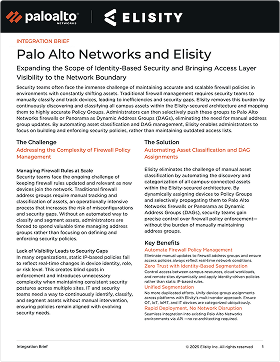
Read the Elisity + Palo Alto Networks Joint Solution Brief
Expanding the Scope of Identity-Based Security and Bringing Access Layer Visibility to the Network Boundary
Explore Our Integrations
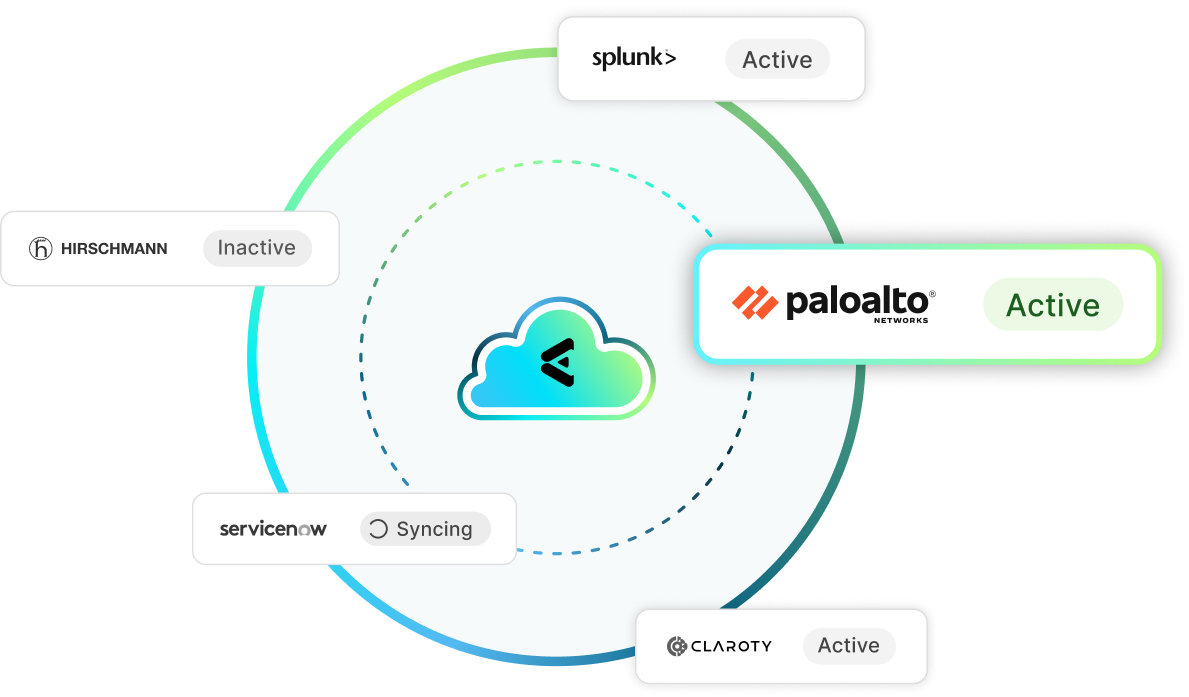
Elisity activates least privilege access by harnessing the tools you already trust. With deep API integrations and real-time data correlation, your existing stack becomes a powerful engine for intelligent, identity-aware policy enforcement.
Device Intelligence / Risk Status
EDR / Risk Status
CMDB
Network Enforcement Point
User Identity / Device Metadata
SIEM
Palo Alto Networks + Elisity Integration FAQ
Get answers to common questions about how Elisity integrates with Palo Alto Networks to automate Dynamic Address Groups and simplify firewall policy management.
Elisity IdentityGraph™ discovers and classifies every device on your network, then maps each device into an Elisity Policy Group. Elisity connects to your PAN-OS firewalls directly or to Palo Alto Networks Panorama through the Palo Alto Networks API and registers each classified device with a tag that matches its Policy Group. Dynamic Address Groups resolve those tags into live membership, so a firewall rule written once against a DAG stays accurate as devices join, move, or change risk status. Configuration takes minutes in the Elisity Cloud Control Center, and no agent is installed on the devices themselves.
A Dynamic Address Group is a Palo Alto Networks firewall object whose membership is defined by tag match criteria instead of a static list of IP addresses, so any rule referencing the DAG never has to be rewritten when membership changes. Elisity populates those tags from IdentityGraph™ classifications spanning IT, IoT, OT, and IoMT devices, which removes the manual work of tracking address objects site by site. Because DAG membership updates through tag registration rather than a configuration commit, policy stays aligned with the network in real time and routine device moves no longer need a change window.
No hardware changes are required. Elisity connects over the Palo Alto Networks API to your existing next-generation firewalls or to Panorama for centralized management, and it enforces campus policy through the network infrastructure you already own. There is no network re-architecture, no VLAN redesign, and no agent on the endpoint. Most teams complete the connection in minutes from the Elisity Cloud Control Center, then scope the first sync to a single Policy Group or site to validate DAG membership and rule behavior before expanding to the rest of the environment.
Yes. Elisity classifies unmanaged IoT, OT, and IoMT devices agentlessly, using network telemetry collected by the Elisity Virtual Edge and context ingested from device intelligence partners including Claroty, Armis, and Nozomi Networks. Attributes such as device type, manufacturer, model, and risk status land in IdentityGraph™ and drive Policy Group assignment. Those Policy Groups propagate to Palo Alto Networks as Dynamic Address Group tags, so an infusion pump, a building automation controller, or a programmable logic controller can be governed by identity-aware firewall rules without any software ever being installed on it.
Manual address group maintenance is a per-device, per-site task: someone has to notice a new device, work out what it is, find its IP address, and edit an address object or rule before policy is correct again. Elisity removes that loop. Devices are classified as they appear, Policy Group membership updates automatically, and the matching Dynamic Address Group tag is registered or withdrawn without a firewall commit. The practical results are fewer stale rules, less rule sprawl as the environment grows, and a policy set that describes device identity rather than a snapshot of addressing from the last audit.
Resources

How to Automate Palo Alto Networks Dynamic Address Groups with Identity-Based Classification

Modern vs. Legacy Microsegmentation: The Evolution of a Critical Zero Trust Requirement