


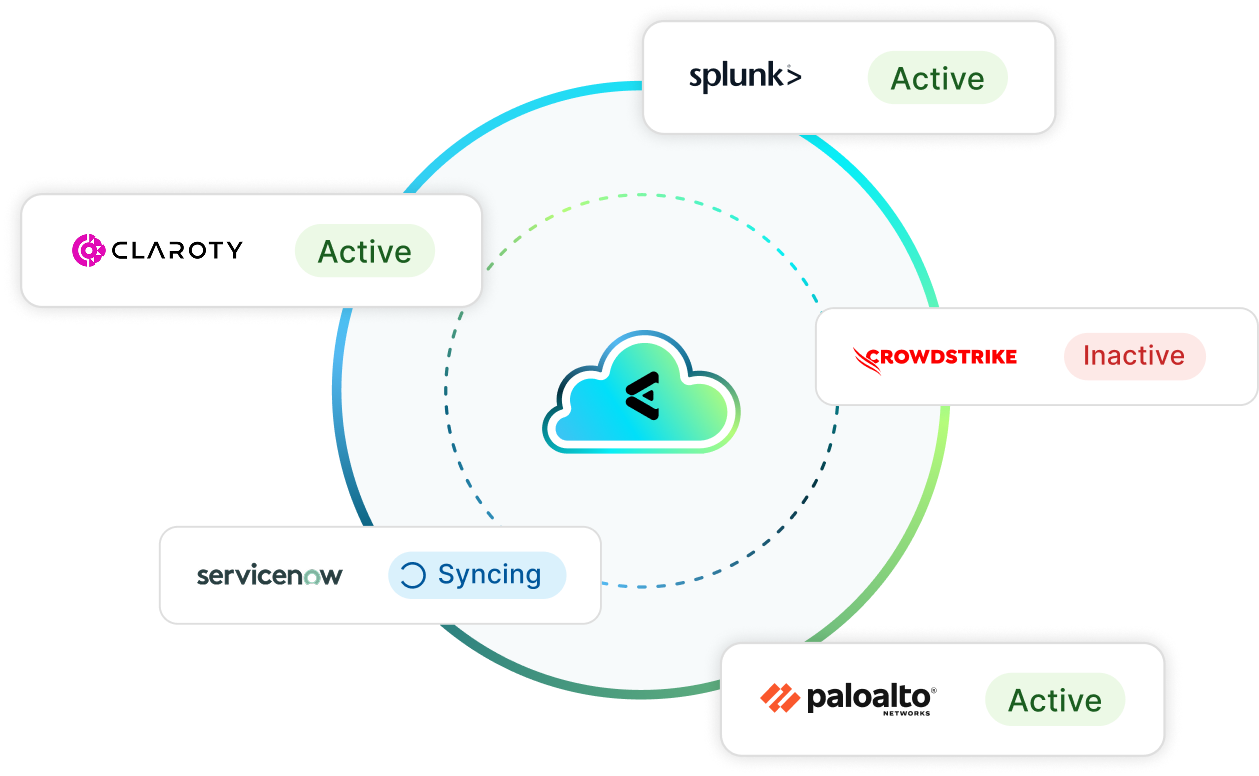

Enhance Your Security and IT Stacks Without Replacing Them
Elisity’s AI platform discovers, classifies, and monitors users, workloads, and devices, ingesting metadata via integrations and connectors from sources like Active Directory, CrowdStrike, and Armis to automate security policies across the network infrastructure you already own.
Elisity Integrations and Connectors Turns The Tools You Have Into What You Need
Elisity activates least privilege access by harnessing the tools you already trust. With deep API integrations and real-time data correlation, your existing stack becomes a powerful engine for intelligent, identity-aware policy enforcement.
Device Intelligence & Risk Status
Armis
Enhanced asset discovery enables dynamic microsegmentation policies. Automate IoMT/OT security with comprehensive device intelligence.
Claroty xDome
Claroty xDome integration delivers identity-based microsegmentation for OT/IoT/IoMT. Secure industrial & healthcare networks with Zero Trust via existing infrastructure.

Palo Alto Networks for IoT Security
Palo Alto Networks IoT Security: Enhanced device classification and risk scoring for precise microsegmentation policies across all IT/IoT/OT devices.

Dragos
Enriches IdentityGraph™ with Dragos OT intelligence for comprehensive device discovery and classification, enabling precise identity-based microsegmentation.
Nozomi
Nozomi Networks integration enriches Elisity IdentityGraph with critical OT/IoT device attributes, enabling granular least privilege policies for industrial environments.

Microsoft Defender for IoT
Elisity’s integration with Microsoft Defender enriches IdentityGraph™ with Defender’s device insights, enabling precise identity-based microsegmentation and dynamic Zero Trust policy enforcement across IT, OT, and IoT assets.
Microsoft Intune
Microsoft Intune integration enhances identity-based microsegmentation with real-time endpoint compliance data for automated, dynamic security policies.

Remedio
Remedio (formerlly GYTPOL) integration enriches Elisity IdentityGraph with endpoint compliance data for enhanced microsegmentation policies and comprehensive device visibility.

ORDR
Elisity integrates with ORDR through a native API connector to ingest rich device telemetry into IdentityGraph™, using attributes to classify unmanaged and agentless assets into policy groups.

NetBox
NetBox is the world's most widely deployed network source of truth for documenting and automating enterprise infrastructure.

Network Enforcement Point
Arista
Elisity integrates with Arista switches, transforming them into Elisity Virtual Edge Nodes for identity-based microsegmentation, enhancing Zero Trust security without rearchitecting the network.

Cisco
Elisity leverages Cisco Catalyst and Industrial Edge switches as policy enforcement points, enabling dynamic Zero Trust segmentation across IT and OT environments.

Palo Alto Networks Panorama
Elisity Integration converts Policy Groups into Dynamic Address Groups (DAGs) for centralized Panorama management, enabling automated firewall policy updates and enforcement.

HPE Aruba
Elisity supports Aruba CX switches as Virtual Edge Nodes, providing identity-based segmentation and policy enforcement without the need for Aruba Central or external controllers.

Juniper
Elisity integrates with Juniper EX4100 and EX4400 switches, enabling identity-based microsegmentation through direct or Mist-managed onboarding for dynamic policy enforcement.

Hirschmann
Elisity supports Hirschmann OS2x switches as Virtual Edge Nodes, facilitating identity-based segmentation and policy enforcement in industrial network environments.
EDR / Risk Status
Crowdstrike
Enriches Elisity IdentityGraph™ with CrowdStrike Falcon endpoint intelligence and ZTNA scores for enhanced device classification and dynamic policy automation.

Microsoft Defender
Microsoft Defender integration automates microsegmentation policies based on endpoint risk intelligence to prevent lateral movement and accelerate incident response.

SentinelOne

CMDB
Service Now
Elisity IdentityGraph™ ingests ServiceNow CMDB data to enrich device context and distinguish enterprise-managed assets, enabling precise microsegmentation policies.

User Identity & Device Metadata
Microsoft Active Directory
Active Directory integration powers Elisity IdentityGraph™ with user context for automated identity-based microsegmentation and least privilege access.

SIEM
Splunk
Splunk integration automatically ships Elisity Cloud Control Center audit logs to your SIEM platform for centralized compliance reporting and advanced security event analysis.

Cribl
Streams Elisity Cloud Control Center audit and event logs to Cribl's data engine for enhanced policy transparency, compliance reporting, and security analytics.

Microsoft Sentinel
Streams Elisity Cloud Control Center audit and event logs to Microsoft Sentinel's cloud-native SIEM for comprehensive SOC visibility and automated response workflows.

Stop East-West Attacks, Microsegment Your Networks
Elisity Integrations FAQ
Common questions about how the Elisity integration ecosystem works, what each connection requires, and how partner data becomes enforceable microsegmentation policy.
Elisity integrations are API connections that enrich the Elisity IdentityGraph with context from systems you already run. You enter the partner platform’s API credentials in the Elisity Cloud Control Center, and that platform’s device, user, and risk data begins flowing into IdentityGraph, where it is resolved against every other attribute Elisity holds for the same identity. Policy groups then reference those attributes (device type, manufacturer, firmware version, endpoint posture, business owner) instead of IP addresses or VLANs. Elisity enforces the resulting least-privilege policy through the network infrastructure you already own, with no new hardware and no endpoint agents required.
Each integration needs three things: network reachability between the Elisity Cloud Control Center and the partner platform’s API endpoint, a service account or API key with read permissions, and the partner tenant or appliance address. Elisity reads from these platforms and does not write configuration back into them, so the credentials you provision can be scoped read-only. Step-by-step connection guides for every supported platform are published at support.elisity.com. Most teams complete the credential exchange and watch partner data appear in IdentityGraph inside a single working session.
No. Elisity is a policy and enforcement layer, not a replacement for asset intelligence, endpoint detection, OT security, or IT service management platforms. Claroty, Armis, Nozomi Networks, ORDR, and Dragos remain your discovery and threat detection systems. CrowdStrike and SentinelOne remain your endpoint detection and response systems. ServiceNow and NetBox Labs remain your systems of record. Elisity consumes what those platforms already know and converts it into least-privilege policy enforced across your existing network infrastructure, which raises the return on the tools you have already bought.
Yes. IdentityGraph merges attributes from multiple sources onto a single resolved identity for each device and user. If Claroty classifies an infusion pump, CrowdStrike reports the posture of the workstation that programs it, and ServiceNow supplies the owning department and criticality rating, all three attribute sets attach to the same identities. Policy can then reference any combination of them. Adding a second or third source does not create duplicate records or competing policy, it increases the confidence and the granularity of the classifications Elisity already holds.
The API connection itself takes minutes. You add the partner platform in the Elisity Cloud Control Center, enter the credentials, and confirm the connection. Partner data begins enriching IdentityGraph immediately, and the first full inventory synchronization typically completes within the hour, depending on how many devices the partner platform tracks. From there, most teams move from connected integration to enforced microsegmentation policy in weeks, because policy groups are built from attributes that already exist rather than from a manual inventory or a VLAN redesign.
Elisity supports five categories. Asset intelligence and device visibility (Claroty, Armis, Nozomi Networks, ORDR) supplies device classification across IT, OT, IoT, and IoMT. Endpoint detection and response (CrowdStrike, SentinelOne) supplies posture and risk signals for managed endpoints. OT and industrial security (Dragos) supplies vulnerability and threat context for control system assets. IT service management and source of truth (ServiceNow CMDB, NetBox Labs) supplies ownership, criticality, and infrastructure records. Network enforcement (Palo Alto Networks) extends Elisity policy to firewall enforcement points.
No. Elisity is agentless. It learns about devices through the integrations listed on this page, through network telemetry, and through directory sources including Active Directory, and it enforces policy across the network infrastructure you already own rather than on the device itself. That matters for equipment that cannot accept software: legacy programmable logic controllers, imaging systems, building management controllers, and medical devices under vendor or safety certification restrictions. Where an endpoint agent such as CrowdStrike Falcon or SentinelOne Singularity is already deployed, Elisity reads its posture through the API instead of adding a second agent.
An integration is not required to deploy Elisity. IdentityGraph builds device and user identities from network telemetry, directory sources including Active Directory, and its own classification engine, so microsegmentation can be deployed with no third-party feed connected. Integrations make classification faster and more specific, which matters most in environments with large populations of unmanaged OT, IoT, or IoMT devices. Most teams start with the platforms they already own and add sources over time as coverage expands.