


.svg)
.png)




Short answer. Forescout alternatives in 2026 sort by what actually enforces. Cisco ISE, HPE Aruba ClearPass, Fortinet FortiNAC and Portnox decide admission. Armis, Claroty and Nozomi supply visibility and hand enforcement elsewhere. Elisity enforces identity-based policy at the access layer itself, with no agents and no new hardware, and publishes two weeks from deployment to first policy where legacy NAC rollouts are measured in months or years.
Every capability statement on this page, including every statement about Elisity, is drawn from the named vendor’s own current public documentation, and third-party sources are named and attributed wherever they are used. Elisity is scored in the same columns on the same criteria as everyone else. For the category boundary behind the split above, see network access control versus microsegmentation, compared dimension by dimension. Last reviewed 16 August 2026.
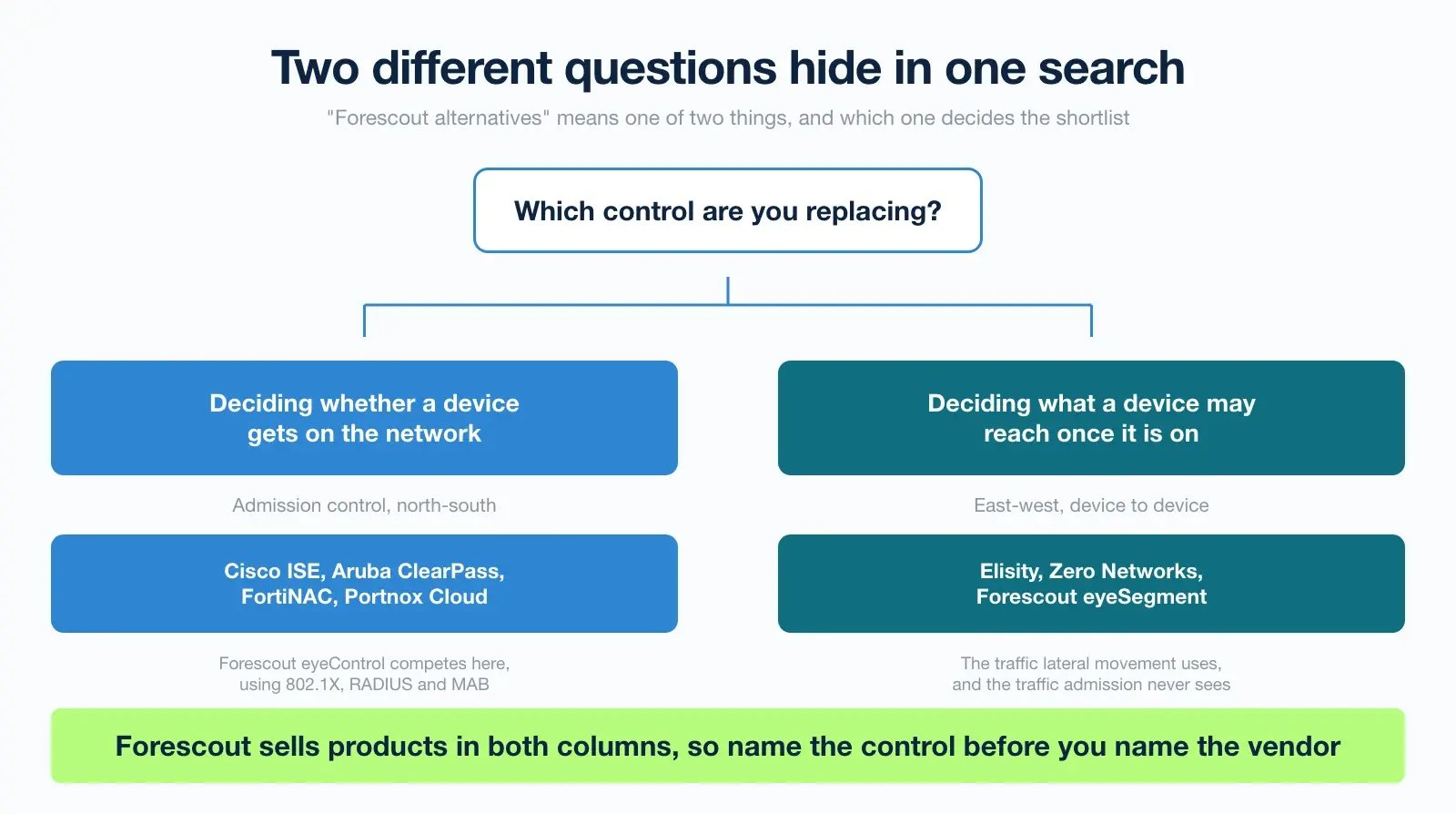
What are the best Forescout alternatives in 2026?
Buyers searching for Forescout alternatives in 2026 are usually comparing network access control products against microsegmentation products, and the two decide different things. Admission control decides whether a device gets on. East-west traffic control decides what an admitted device may reach, and whether lateral movement is possible once it is on. Sort the market on that mechanism question rather than on the feature list, and the shortlist falls out of it.
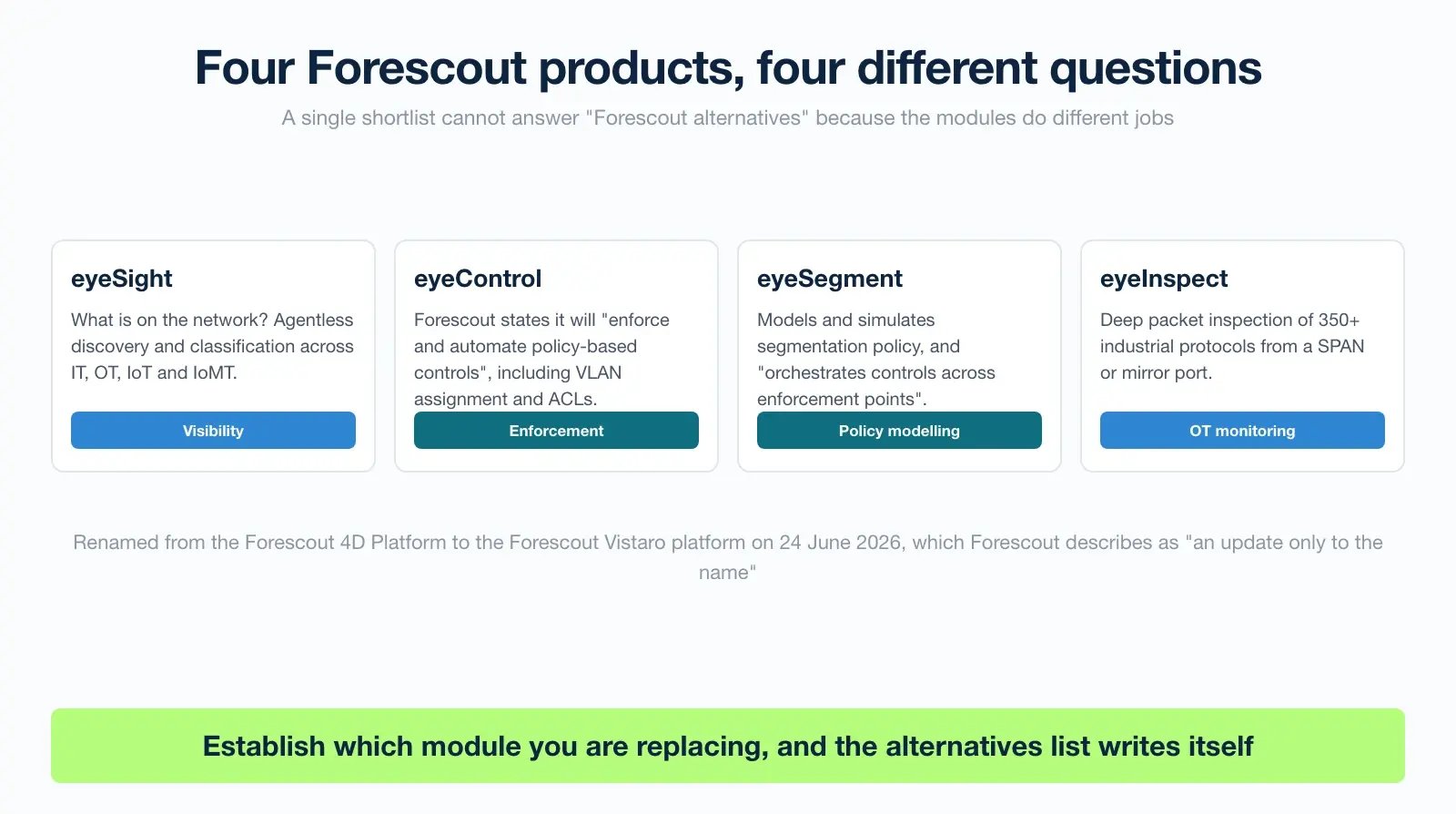
A naming note first, because it dates most of the pages competing for this query. Forescout renamed the Forescout 4D Platform to the Forescout Vistaro platform on 24 June 2026 and described the change as “an update only to the name”. Any roundup written before the Forescout Vistaro rename still carries the older name. Portnox’s Forescout comparison page, last modified 11 May 2026, labels its table column “Forescout Platform”, which was not Forescout’s own product name before the rename either, so read the label as a sign of the page’s age rather than as a record of what changed.
The module names did not change with the rename, and the roster is longer than most comparisons admit. Forescout’s current products overview lists nine offerings: eyeSight, eyeSentry, eyeSegment, eyeControl, eyeInspect, eyeFocus, eyeAlert, eyeScope and eyeExtend, alongside a Flyaway Kit. eyeSentry is the newest, announced on 4 November 2025. Four of the nine do the work this page compares: eyeSight, eyeInspect, eyeControl and eyeSegment. Two further strings recur in 2026 evaluations, and this page names both so it is findable on them: Universal Zero Trust Network Access, abbreviated UZTNA, which maps to a different product in every portfolio that uses it, and Cyber-Physical Systems Protection Platforms, the category covered by the 2026 Gartner® Magic Quadrant™ for CPS Protection Platforms.
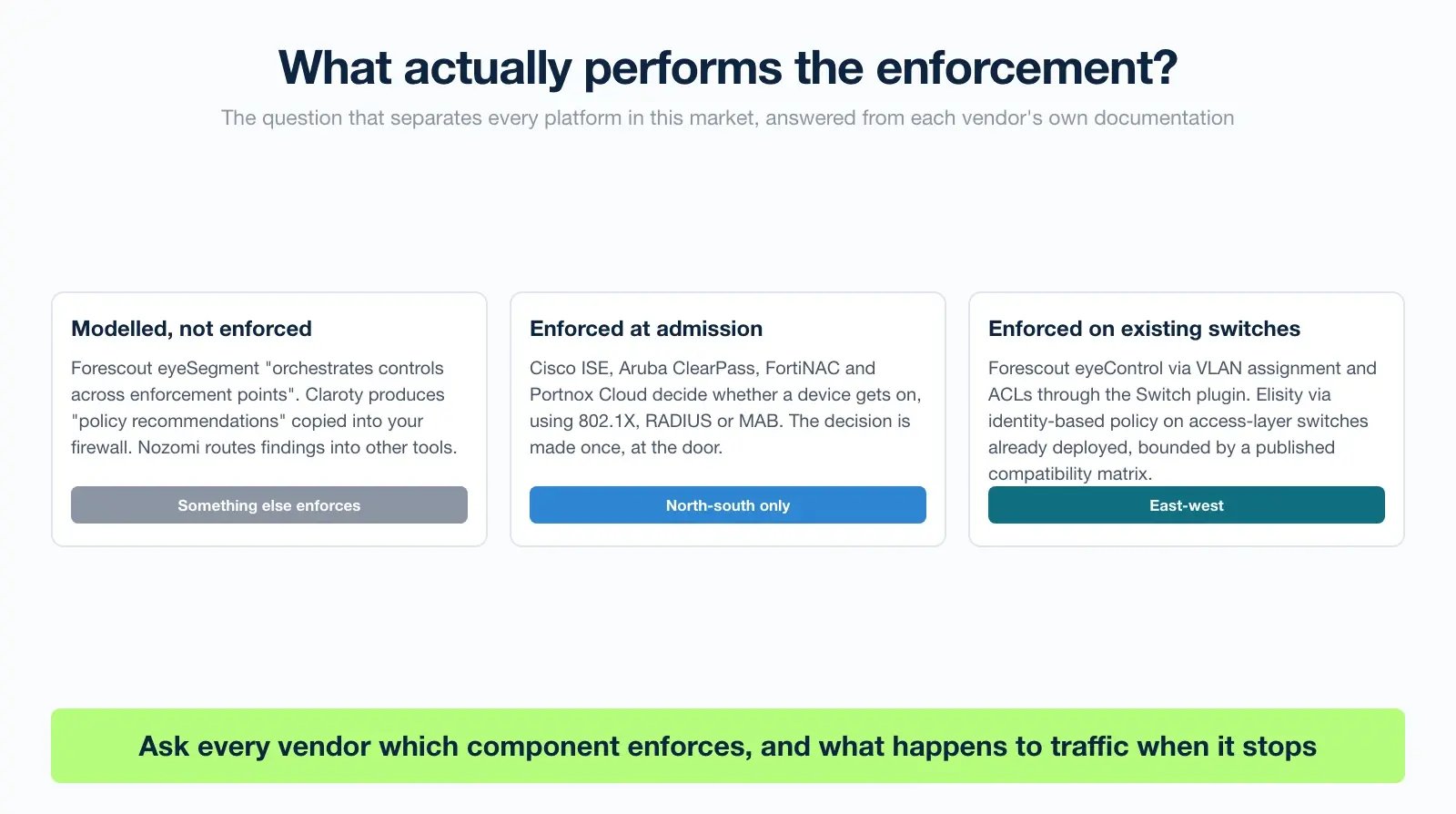
The shortlist, grouped by what performs the enforcement. Each description is drawn from the vendor’s own published scope language, listed alphabetically, with no ranking implied.
Forescout alternatives that perform admission control: nine products document it. Cisco Identity Services Engine (Cisco ISE), Extreme ExtremeControl, Fortinet FortiNAC, Genians Genian NAC, HPE Aruba ClearPass Policy Manager, Portnox Cloud, Juniper Mist Access Assurance, Ivanti Policy Secure and Belden NAC (former macmon NAC). Each documents deciding whether a device is allowed onto the network, using 802.1X, RADIUS, MAC Authentication Bypass (MAB) or profiling. Each enforces that decision on the network device the endpoint connects to.
Forescout alternatives that supply visibility and hand enforcement to something else: Armis Centrix, Claroty (CTD and xDome), Nozomi Networks (Guardian and Vantage), Palo Alto Networks Device Security and Tenable One OT Exposure document producing asset context and, in several cases, generating policy. Claroty’s own term for its policy output is “policy recommendations”, tested “before copying them into your firewall for enforcement”. Nozomi documents routing findings “into platform workflows, playbooks and integrated security tools”. Palo Alto Networks Device Security documents generating “security policy rule recommendations” that “Panorama or next-generation firewalls can then import and enforce”. In each case the documented output is an access control list, a recommendation or a workflow trigger that another product applies.
Forescout alternatives that enforce east-west traffic themselves: Elisity documents identity-based policy enforced by access-layer infrastructure already deployed, against a published compatibility matrix of specific hardware models and software versions. Zero Networks documents dividing the network “into smaller, isolated micro-segments via automated, accurate security policies”, and separately documents a Segment Server that observes connections for a learning period before applying rules to host firewalls on managed devices and to access control lists on the network infrastructure connecting unmanaged ones. This is the smallest group in the roster reviewed here, and it is the group a Forescout evaluation lands in whenever the unanswered control is east-west rather than admission.
Forescout itself spans two of those groups, which is why a single-line comparison of it is usually wrong. eyeSight and eyeInspect produce visibility. eyeControl performs admission-time and post-admission enforcement actions through plugins. eyeSegment models, simulates and, in Forescout’s own wording, enforces segmentation above those enforcement points. The next two sections take that apart in Forescout’s own words.
Table A. The main comparison, keyed on enforcement mechanism
| Vendor and product | What the vendor calls it, in its own words | Does it enforce traffic itself, per its own documentation | Documented enforcement point | Agent required | Documented device or protocol scope | Published limit from that vendor’s own documentation |
|---|---|---|---|---|---|---|
| Armis Centrix | Positioned to “augment your existing Network Access Control (NAC) deployments to enforce network segmentation based on policy”, under a heading “The NAC Gap” | No independent enforcement plane is documented. Armis “generate[s] and export[s] network Access Control Lists (ACL)” and quarantines devices on indicators of compromise. Quarantine on an indicator of compromise is documented as an action; sustained east-west policy enforcement is not | The customer’s existing NAC, and the network devices that consume the exported ACLs | Not documented | Not documented at protocol level on the cited page | Documented as augmenting existing NAC rather than performing admission control itself. Enforcement depends on the devices that apply the exported ACLs |
| Belden NAC former macmon NAC |
Base license of “7 modules - Topology, Advanced Security, Network Access Control, VLAN, 802.1X, Guest Service and Scalability” | Yes. “NAC enforcement based on changing VLAN assignments and port statuses are the standard scenarios” | Switch VLAN assignment and port status, plus RADIUS vendor-specific attributes | Not documented | Authentication via “MAB, 802.1X, RADIUS in general” | Not documented |
| Cisco Identity Services Engine ISE |
“Cisco ISE unifies identity, visibility, and enforcement”, positioned as going “Beyond static network admission control (NAC)” | Yes. “Enforce consistent identity-based access across wired, wireless, and VPN users while segmenting sensitive resources.” With Cyber Vision, “Cisco ISE denies all communication by default and uses Cyber Vision asset groups to allow activities only between assets that have explicit allow policies” | Network access devices under ISE policy. Asset context arrives over pxGrid. Cisco documents TrustSec enforcement as performed by the Cisco switches and routers in the domain | Not documented | Wired, wireless and VPN users and devices, with context shared with “more than 70 third-party security, identity, mobility, asset, and operations tools” | Capability is split across three license tiers (Essentials, Advantage, Premier). Evaluation is a “90-day evaluation license for up to 100 endpoints” |
| Claroty CTD and xDome |
“Claroty xDome provides full CPS visibility with risk context.” CTD “leverages the broadest and deepest industrial protocol coverage in the industry” | No. Virtual Zones “enable ... integrations with existing firewall and NAC solutions to enforce policy-based segmentation”, and xDome produces “automated policy recommendations that can be tested before copying them into your firewall for enforcement” | The customer’s firewall and NAC. Claroty’s own term for its output is “policy recommendations” | Not documented | “Support for over 450+ protocols ... ICS / SCADA, IIoT, IoT, IT, IoMT, and Serial Devices” | Passive Monitoring alone can be protocol-limited. Claroty gives Modbus as a protocol that “typically reveals very little about an asset”, so it “may not be able to pinpoint its vendor, firmware, or other details” |
| Elisity Identity-Based Microsegmentation | “Elisity transforms your existing network infrastructure into policy enforcement nodes through ... Elisity Virtual Edge” | Yes, at access-layer infrastructure already deployed | Cisco Catalyst and Industrial Edge switches, which Elisity describes as policy enforcement points, plus Arista, HPE Aruba CX, Juniper EX4100 and EX4400 and Hirschmann OS2x switches as Elisity Virtual Edge Nodes, and Palo Alto Networks Panorama via Dynamic Address Groups. All bounded by the published hardware compatibility matrix, which is the document to check for your models | No. Elisity states “No agents” | Campus, branch, clinical and OT device estates, using identity rather than address. No protocol count is published, because Elisity performs no deep packet inspection. Elisity classifies devices natively from network telemetry, and OT protocol-level identity specifically is consumed from the published integration list, which includes Armis, Claroty xDome, Nozomi, Dragos, Microsoft Defender for IoT, ORDR, ServiceNow CMDB, CrowdStrike and SentinelOne | Bounded by a published compatibility matrix of specific hardware models and software versions, and covers only the traffic that reaches that infrastructure, so two devices sharing a downstream unmanaged switch or a daisy-chained run are never evaluated against a policy. Elisity rates its own cloud and Kubernetes support “Limited”. Elisity states it “does not replace device admission”. Fail-open or fail-closed behavior and rollback duration: not documented |
| Extreme ExtremeControl | “An application available as part of ExtremeCloud IQ - Site Engine” giving “centralized in-depth visibility and control over all endpoints” | Yes. Administrators “centrally manage security access profiles which may encompass a combination of VLAN, Service Identifier (L2VSNs / L3VSNs), L2-L7 ACL, and L2-L7 QoS rules” | “Network devices and Wi-Fi controllers”, plus conversion of profiles to “downloadable Access Control Lists (dACLs) for installation on switches and routers” | Not documented | Not documented at protocol level | Not documented |
| Forescout Vistaro platform: eyeSight, eyeSegment, eyeControl, eyeInspect |
eyeSegment: “See, model, and simulate segmentation policies across your entire enterprise ... without agents, without disruption”, and, on the same page, “enforce segmentation that reduces your attack surface” and “automated enforcement across your hybrid enterprise” | Yes, through the platform. Forescout “ensures least privileged access by dynamically assigning devices to appropriate VLANs or applying access control lists based on predefined policies”. eyeSegment itself is described as “a unified policy layer across disparate enforcement points and network domains” that will “orchestrate controls across enforcement points” | Managed switches via the Switch plugin using CLI, SNMP or Netconf (Access Port ACL, Endpoint Address ACL, Assign to VLAN, Assign Security Group Tag, Switch Block); the RADIUS plugin, which “sends Change of Authorization (CoA) or other messages to network devices”; Virtual Firewall from an Appliance placed “Between segments or VLANs”; Cisco TrustSec enforcement performed by “authorized and authenticated Cisco switches and routers” | Discovery is agentless. SecureConnector is an optional endpoint agent deployed “by including the Start SecureConnector action in a policy” | IT, OT, IoT and IoMT. eyeSight is published with “over 20” monitoring techniques on its product page and “over 30” on the products overview, both undated. eyeInspect: “350+ industrial protocols”. Device Cloud: “over 12 million device fingerprints” | Access Port ACL: “trunk ports and uplink ports are not supported”. Pre-Connect Mode “is only available for use on managed Cisco switches”. “The action’s MAC ACL option cannot be used on Cisco Nexus switches”. ACL Actions are documented as “no support for Cisco Small Business 300 Series”. Generic switches: “Only the Switch Block and the Expedite IP Discovery actions”. Firewalls, routers and SD-WANs: “Only the Expedite IP Discovery action is supported”. eyeSegment “does not support Certification Compliance mode or Devices that do not have IPv4 addresses” and requires outbound access to two named Forescout cloud endpoints. Virtual appliances require “No CPU over-commitment”, and traffic monitoring on the extra-large virtual appliance is “Not supported”. Licensed “per 1,000 Endpoints”. Fail-open or fail-closed behavior: not documented |
| Fortinet FortiNAC | “A zero-trust access solution that oversees and protects all digital assets connected to the enterprise network” | Yes, as a zero-trust access solution. The specific enforcement mechanism is not documented in the retrieved Fortinet source | Not documented | No. “Agentless Scanning” is documented | “Devices ranging from IT, IoT, OT/ICS, to IoMT”, with “21 Profiling Methods” | “Each FortiNAC deployment requires both a Control and an Application Server” |
| Genians Genian NAC | “Monitor IP-enabled devices on your network in real-time using a non-disruptive Layer 2 based Network Sensor” | Yes. “Multi-layered Access Control 802.1x: Built-in RADIUS server DHCP: Built-in DHCP server Layer 2: ARP Enforcement (using Network Sensor)” | Layer 2 ARP enforcement via the Network Sensor, and 802.1X port-based access control on switch ports | Not documented | IP-enabled devices, classified by Device Platform Intelligence | Not documented |
| HPE Aruba ClearPass Policy Manager | “Role- and device-based network access control for employees, contractors and guests across multi-vendor wired, wireless and VPN infrastructures” | Yes, at admission. “Standards-based 802.1X enforcement for strong authentication” | Wired, wireless and VPN infrastructure via RADIUS and TACACS+ | Not documented | Employees, contractors and guests across multi-vendor wired, wireless and VPN | East-west enforcement after admission: not documented on the cited page |
| Ivanti Policy Secure | “A network access control (NAC) solution which provides network access only to authorized and secured users and devices” | Yes, via “virtual LANs (VLAN), filters, or access control lists (ACL)” | “At the edge of the network prior to granting an IP address using 802.1X, within the network on the firewall, or both” | Not documented. Posture assessment is “pre and post connection - 802.1x or non-802.1x” | Includes non-802.1X hosts such as VoIP phones “using SNMP enforcement and the Profiler” | Not documented |
| Juniper Mist Access Assurance | “An advanced, cloud-based network access control (NAC) service” | Yes, at admission | “802.1X authentication for 802.1-enabled devices and MAC Authentication Bypass (MAB) verification for non-802.1X devices” | Not documented | Wireless and wired identity-based network access | Not documented |
| Nozomi Networks Guardian, Vantage |
“NOZOMI GUARDIAN Passive Network Security Monitoring for OT and IoT Asset Visibility”. Nozomi Vantage is published as the central management console | No enforcement documented. Nozomi “route[s] detected vulnerabilities, anomalies or threats into platform workflows, playbooks and integrated security tools” | Not documented as an enforcement point. Nozomi lists Cisco ISE and Aruba ClearPass under “Asset Management & Access Control” integrations | Not documented as an agent requirement. Nozomi collects “passively or actively, using our wired, endpoint and wireless sensors” | Protocol total not documented. The “OT/ICS Interoperability” list names automation vendors including ABB, Allen-Bradley/Rockwell, Beckhoff, Emerson, GE, Honeywell, Mitsubishi, Omron, Schneider Electric, SEL, Siemens and Yokogawa | Publishes no protocol count. “This list is updated every 3 - 6 months. Please contact your Nozomi Networks representative for a complete and current list.” Only a “Partial ... Supported Protocol List” is offered |
| Palo Alto Networks Device Security formerly IoT Security |
“An on-demand cloud subscription service designed to discover and protect the growing number of connected things on your network” | No, not natively. It “automatically generate[s] security policy rule recommendations”, and “Panorama or next-generation firewalls can then import these policy rules and enforce them” | Panorama and next-generation firewalls | Not documented | Connected devices identified by machine learning and AI | Admission-time enforcement requires a separate documented integration with a third-party NAC such as Cisco ISE |
| Portnox Cloud | “A SaaS solution purpose-built for today’s hybrid and distributed networks” and “a cloud-native NAC platform purpose-built for SaaS delivery” | Yes, at admission. “Authentication, device posture assessment, certificate issuance, and policy enforcement all run through Portnox’s cloud control plane” | Portnox Cloud RADIUS: “Configure your network devices to authenticate through Portnox Cloud RADIUS” | Not documented | Not documented at protocol level. Portnox names no OT or medical device protocol anywhere on its Forescout comparison page | “There are no appliances to deploy, no virtual machines to size, and no local components to maintain at individual sites.” Portnox concedes that “Forescout has deeper OT discovery” |
| Tenable One OT Exposure formerly Tenable OT Security |
“Protects industrial networks from cyber threats, malicious insiders, and human error” via “threat detection and mitigation to asset tracking, vulnerability management, configuration control and Active Query checks” | No network admission control capability is documented in the product introduction | Not documented | Not documented | Industrial networks, ICS | Key features are visibility, threat detection, asset inventory, risk-based vulnerability management and configuration control. No admission-control function is documented |
| Zero Networks | “Network Segmentation: Divide your network into smaller, isolated micro-segments via automated, accurate security policies”, plus Identity Segmentation and Secure Remote Access | Yes, as segmentation: “blocking lateral movement and preventing ransomware” | Not named on the segmentation product page cited here. Zero Networks separately documents a Segment Server that observes connections for a learning period, then applies rules to host firewalls on managed devices and to access control lists on the network infrastructure connecting unmanaged devices | No, on the fully agentless model Zero Networks documents for unmanaged devices | Network segments and identity, including “non-human and AI accounts” | Enforcement for unmanaged devices depends on what the connecting network infrastructure supports. The segmentation product page cited here makes no reference to network access control or admission control |
Every “not documented” on this page means the statement was absent from the sources reviewed here. Those sources are each vendor’s own current product pages and data sheets; Forescout’s eyeSight, eyeSegment, eyeControl and eyeInspect pages; the Forescout Switch Plugin Configuration Guide, its Switch Vendor ACL Support matrix and its eyeSight and eyeControl capabilities summary; the OT Plugin Configuration Guide v3.0.0; the v8.4.2 administration and installation guides; the Forescout Product License Guide; Cisco’s Cyber Vision and TrustSec collateral; Claroty’s Passive Monitoring page and federal collateral; Nozomi’s technical specifications page; and Elisity’s own published pages. Absence is not evidence of bad behavior. It means the answer has to come from the vendor in writing, against your topology.
Forescout carries more entries in the limits column than any other vendor here, and the reason counts in its favor. Forescout publishes plugin guides, sizing guides, a license guide and a per-vendor ACL support matrix, and no other vendor compared here publishes that set at all. A shorter limits cell usually means less documentation, not fewer limits. Three east-west products are named on this page but not scored in Table A, because their own documentation was not reviewed for this comparison: Akamai Guardicore Segmentation, ColorTokens Xshield and Illumio. The sibling comparison on this site scores all three, and records one documented limit for every vendor, including Elisity, and what happens when the enforcement point fails.
Which Forescout product do you actually mean?
This is the question that decides everything downstream, and it is why a single ranked list cannot answer the query. Forescout is not one product. Under the Vistaro platform, eyeSight, eyeInspect, eyeControl and eyeSegment answer four different questions, and each one has a different set of competitors. A buyer who says “we are replacing Forescout” usually means one of them and inherits a shortlist built for another.
| The question a buyer is asking | Which product is documented against it | Does that product enforce device-to-device traffic itself, per its own documentation | What is still open afterwards | Where the alternatives come from |
|---|---|---|---|---|
| What is on my network, and what is it? | Forescout eyeSight | Not documented as an enforcement function. eyeSight is documented as agentless discovery and classification, with “over 20” monitoring techniques on the eyeSight product page and “over 30” on the products overview, drawing on a Device Cloud of “over 12 million device fingerprints” | Policy and enforcement | Armis Centrix, Claroty xDome, Nozomi Guardian, Cisco Cyber Vision |
| What is on my OT network, and what are those devices saying to each other? | Forescout eyeInspect | No. eyeInspect is documented as deep packet inspection of “350+ industrial protocols”, using a Passive Sensor on a SPAN or mirroring port and a separate Active Sensor that “remains inactive unless the eyeInspect operator issues a direct command”. Forescout separately states that eyeInspect “enables dynamic segmentation” and that “automated enforcement policies contain risks” | Which component applies the policy | Claroty CTD and xDome, Nozomi Guardian and Vantage, Cisco Cyber Vision, Tenable One OT Exposure |
| Should this device be admitted to the network at all? | Forescout eyeControl | Yes, at admission and afterwards. Forescout documents “dynamically assigning devices to appropriate VLANs or applying access control lists based on predefined policies”, delivered by the Switch, Wireless and RADIUS plugins | East-west traffic between two devices that were both correctly admitted onto the same VLAN | Cisco ISE, HPE Aruba ClearPass, Fortinet FortiNAC, Portnox Cloud, Genian NAC, Extreme ExtremeControl |
| What may an admitted device reach? | Forescout eyeSegment | Forescout says both. The eyeSegment page says customers “enforce segmentation that reduces your attack surface” and that the platform delivers “automated enforcement across your hybrid enterprise”. The same page also calls eyeSegment “a unified policy layer across disparate enforcement points and network domains” that will “orchestrate controls across enforcement points”. Forescout does not name, on that page, which component performs the enforcement | Which component enforces, whether you already own it, and which team owns its failure mode | Elisity and Zero Networks are the two scored in Table A |
| What may an admitted device reach? (the same question, answered by the publisher of this page) | Elisity Identity-Based Microsegmentation, which is not a Forescout product | Yes, at access-layer infrastructure already deployed, using Elisity Virtual Edge Nodes, bounded by a published compatibility matrix | Device admission. Elisity states plainly that it “does not replace device admission” | Cisco ISE, HPE Aruba ClearPass, Fortinet FortiNAC, Portnox Cloud and Forescout eyeControl all remain the admission options alongside it |
Why this matters for the shortlist. Replacing eyeControl and replacing eyeSegment are different purchases, with different competitor sets and different owners inside the organization. Establishing which of the four questions is currently unanswered in your estate is the step that makes the shortlist obvious. Most evaluations skip it.
Why do organizations look for a Forescout alternative?
Start with the honest credit, because it explains why Forescout is in the estate at all. Forescout is commonly chosen for agentless device visibility in healthcare and OT estates, and its own research is why many of these programs exist. In “An X-ray of Modern Networks”, dated 4 November 2025, Forescout Research Vedere Labs analyzed 10 million devices across more than 700 organizations active in October 2025 and reported that, in that dataset, two-thirds of devices are no longer traditional IT. Those devices run no supplicant and no agent, which is the same reason 802.1X rollouts stall. This site sets out why NAC projects stall on 802.1X, certificates and unmanaged devices in more detail.
Three situations produce the search, and they want different answers. The first is an evaluation that has not started, where the buyer wants a shortlist. The second is a migration, usually triggered by an estate that changed shape faster than the deployment did. The third is a renewal, where the question is not whether the platform works but what is being counted.
The renewal question is the most concrete, so start there. Forescout licenses “per 1,000 Endpoints”, and its Product License Guide counts an endpoint “when it is known to the Forescout platform by either its MAC address or IP address”. The counting rule is MAC or IP, so the count follows discovered inventory. Model it against your own estate before a renewal. The same guide, dated June 2024 and the newest retrievable version, adds structure for eyeInspect: a Base Flat Fee license requires an associated eyeInspect Endpoint license, an extra-large Sensor is documented at up to 10,000 assets, and Command Center tiers are documented at up to 5, up to 15 and unlimited sensors. Because the guide predates the Vistaro naming, confirm the current structure with Forescout rather than with this page.
Appliance sizing is the second concrete item. Forescout documents that virtual appliances require reserved CPU and memory with “No CPU over-commitment”, and that traffic monitoring on the extra-large virtual appliance is “Not supported”. Those two constraints together decide how many appliances a distributed estate needs, and they sit in the sizing guide rather than in the product pages most evaluations read.
Forescout publishes no price, no per-device rate and no total cost of ownership figure, and neither does this page. Cost narratives circulating on competitor comparison pages are those competitors’ arithmetic, not Forescout’s.
The migration question is about estate shape, and about which module was actually bought. The platform is modular, so an organization frequently owns one part of the answer and not the others. A team that bought eyeSight for visibility does not, by that purchase, have east-west enforcement. A team that bought eyeInspect for OT protocol depth does not, by that purchase, have policy. Elisity publishes a related figure, that NAC solutions can effectively secure only about 33 percent of devices on modern networks, and cites no external source for it, so treat that as Elisity’s published claim rather than as research. Forrester’s Business Technographics surveys record the share of security decision-makers implementing or expanding NAC at 59 percent in 2018, then 45 percent, 43 percent and 44 percent in 2020, 2021 and 2022, which Forrester describes as dropping but fluctuating rather than falling steadily.
The architecture note that most often triggers a Forescout evaluation in a mixed estate is a vendor-fit one, and it is Elisity’s own observation rather than a vendor statement. Elisity writes: “Cisco ISE works best with Cisco infrastructure, Aruba ClearPass with HPE equipment, and Forescout with its specific plugin architecture.” The next two sections are what that plugin architecture enforces, and on which models.
If Cisco ISE is the other product in the evaluation, the same three-way split applies to it, set out in our guide to which Cisco ISE job you are actually replacing, and what enforces once TrustSec no longer applies.
What does Forescout eyeSegment actually enforce, and what performs the enforcement?
This is the most consequential technical question on the page, and it deserves a precise answer. Forescout documents the mechanism down to the CLI string, which makes it possible to separate what eyeSegment does from what performs the enforcement underneath it.
Start with Forescout’s own eyeSegment language, all of it. The product page says customers “See, model, and simulate segmentation policies across your entire enterprise ... without agents, without disruption”. The same page says they “enforce segmentation that reduces your attack surface”, moves them to “adaptive, identity-driven enforcement”, and states that “The Forescout Vistaro platform delivers segmentation hygiene, unified policy management, and automated enforcement across your hybrid enterprise”. The same page also describes “a unified policy layer across disparate enforcement points and network domains” and says eyeSegment will “orchestrate controls across enforcement points”. Both registers are Forescout’s. What the page does not do is name the component that performs the enforcement. That is the gap a buyer closes in diligence, and it is not the same thing as a claim that eyeSegment does not enforce.
An earlier comparison on this site recorded eyeSegment as not enforcing traffic itself. That framing was drawn from the orchestration language alone. Forescout’s product page also says customers enforce segmentation, and this page records both.
The mechanisms are documented, in the plugins. The Forescout Switch plugin manages switches over CLI, SNMP or Netconf and exposes six Switch Restrict Actions.
| Forescout Switch plugin restrict action | What Forescout documents it doing |
|---|---|
| Access Port ACL | An ACL applied inbound on a switch access port, written as an inbound access group on the relevant interface VLAN. Forescout documents that “trunk ports and uplink ports are not supported” |
| Assign Security Group Tag | Assigns a Security Group Tag to detected endpoints connected to a managed Cisco switch in a Cisco TrustSec domain. The action is off until the operator enables it |
| Assign to VLAN | Moves an endpoint to a different VLAN. This is the mechanism behind VLAN quarantining |
| Endpoint Address ACL | Two mechanisms. An IP ACL instructs a switch to close or open “network zones, services or protocols” for specific endpoint IP addresses. A MAC ACL instructs a switch to “block all traffic sent from the affected, endpoint MAC address” |
| Switch Block | Blocks the endpoint at the switch. It is one of only two actions Forescout documents for switches outside the compatibility matrix |
| Virtual Firewall | Runs from a Forescout Appliance placed “Between segments or VLANs” |
Alongside those, the RADIUS plugin implements authorization by having the RADIUS server send “Change of Authorization (CoA) or other messages to network devices that are managed by the Switch plugin or the Wireless plugin”. Where Cisco TrustSec is in play, Forescout documents the domain as “a collection of authorized and authenticated Cisco switches and routers” and states that those switches and routers “secure and control the IP traffic within the domain ... to enforce the domain’s access control policy”. Forescout’s own contribution there is two things, not one: the Assign Security Group Tag action, and an SGT property that resolves an endpoint’s currently assigned tag.
The configuration surface is at the same level of specificity. Four strings are worth knowing before an evaluation:
- The Endpoint Address ACL action is enabled by adding
ip access-group forescout_acl into the ACL configuration on the relevant interface VLAN. - A separate
cisco_nexus_acl_syntaxflag has to be enabled before the IP ACL option works on Cisco Nexus switches. - The Security Group Tag action is carried by
assign_sgt, which Forescout documents as “disabled by default”. - Pre-authentication enforcement is configured as
Pre-Connect Mode, which in Forescout’s words “is only available for use on managed Cisco switches”.
eyeControl is the license those actions sit under. Forescout states that eyeControl “enforces and automates Zero Trust least-privilege access for managed and unmanaged assets” and that the platform “ensures least privileged access by dynamically assigning devices to appropriate VLANs or applying access control lists based on predefined policies”. Discovery is agentless, and Forescout also documents an optional endpoint agent, SecureConnector, deployed “by including the Start SecureConnector action in a policy”.
The one dependency Forescout does not state either way. Every documented ACL, VLAN, Security Group Tag, port-shutdown and Change of Authorization mechanism belongs to the Switch, Wireless or RADIUS plugin under an eyeControl license. Whether eyeSegment depends on those plugins to enforce, or whether they operate independently of it, is not documented in the sources reviewed here. Ask Forescout for the dependency statement in writing, because it decides what a segmentation project has to license and which team runs it.
The modeling layer is where Forescout is strongest, and its own words carry it. eyeSegment is documented with a “Simulate Before You Enforce” workflow, and the Administration Guide describes the plugin as follows: “Forescout eyeControl does not inspect and does not alter the provided content; the plugin’s role is one of delivery vehicle to provision a network switch.” Those two phrases describe the architecture accurately. Model centrally, provision the existing switch. Staged rollout is the right default in any estate where a wrong rule stops a production line or a clinical workflow.
Forescout publishes exactly one failure consequence. A full-text search of the v8.4.2 administration guide returns nothing on fail-open or fail-closed behavior. What Forescout does document is data staleness: “If traffic cannot be reported, the data shown in your matrix will not be up-to-date.” The v8.4.2 guides are the administration and installation guides reviewed here; Forescout has since published an 8.5.2 administration bundle, and the current release train is 9.1.6 with 9.1.7 release notes published, so re-check the wording against your own version.
The alternative mechanism, and the reason this distinction matters commercially, is to make the access-layer device itself the policy enforcement node rather than the thing being provisioned. That is the design behind identity-based enforcement on Cisco Catalyst, Juniper EX and Arista at the access layer, where Elisity states it “transforms your existing network infrastructure into policy enforcement nodes through ... Elisity Virtual Edge”, with “No agents. No hardware. No ACLs, VLANs, or re-IPing projects”. Both designs are legitimate. They differ in which team owns the failure mode and in how much of the enforcement path you already operate, and the second design has its own boundary, set out on the same terms further down this page.
Which switches and enforcement actions does Forescout document, vendor by vendor?
Forescout publishes a Switch Vendor ACL Support matrix. It is the most useful artifact on this page, because it converts an architecture question into an inventory question. Two separate Forescout tables are involved and they are frequently merged by mistake, so this page prints them apart. The first is the Switch Vendor ACL Support matrix in the Switch Plugin documentation, which has fifteen rows and gives an explicit value for each of three ACL actions. The second is the eyeSight and eyeControl capabilities summary, a much longer per-vendor table whose ACL Actions column names which ACL actions are available and by which management method. The Extreme, HPE-Comware and HPE-Provision entries exist only in the second table; Cisco Nexus is a comment inside the Cisco row of the first; and Forescout has one row for “Juniper switches and routers” in the first table but separate Juniper EX and Juniper MX entries in the second.
Table B. Forescout Switch Vendor ACL Support matrix, all fifteen rows
| Entry, as Forescout names it | Endpoint Address ACL based on IP | Endpoint Address ACL based on MAC | Access Port ACL | Forescout’s own comment |
|---|---|---|---|---|
| Arista | Supported | Not Supported | Supported | No comment published |
| Brocade | Supported | Not Supported | Not Supported | “Endpoint Address ACL: comprehensive ACL rule supported.” |
| Brocade IronWare | No Supported or Not Supported value is printed. The cell reads “Use Basic [IPv4 or IPv6] ACL on action failure option supported. ACL rule numbering not supported.” | Supported | Not Supported | IP and MAC ACL rules cannot be used simultaneously on the same port. For managed Brocade Layer 3 switches, stackable models ICX6430 and ICX6450 running IronWare OS version .07.4 and above, the plugin applies the Endpoint Address ACL action on the VLAN’s virtual routing interface instead of its Ethernet interface |
| Cisco switches (except for Catalyst 2950 switches and Small Business 300 Series switches) | Supported | Supported | Supported | “Comprehensive ACL rule supported”. “The action’s MAC ACL option cannot be used on Cisco Nexus switches”. On Cisco Nexus, the IP ACL option requires the “cisco_nexus_acl_syntax” configuration flag to be enabled first |
| Cisco Catalyst 2950 switches (Standard Image Software) | Not Supported | Not Supported | Supported | “ACL support is available for Cisco Catalyst 2950x switches that are limited to Standard Image (SI) support” |
| Cisco Catalyst 2950 switches (Enhanced Image Software) | No Supported or Not Supported value is printed. The cell reads “Use Basic ACL on action failure option supported. ACL rule numbering not supported.” | Supported | Supported | “Endpoint Address ACL: Cannot use IP and MAC ACL rules simultaneously on the same port.” |
| Dell EMC Networking OS10 switches | Supported | Not Supported | Supported | Permit rules are indexed by increments of 10 between 110 and 199990, with a final “permit ip any any” at index 300000, and deny rules between 200000 and 299990. If indexed application fails, the plugin re-applies the entire rule set |
| Dell Networking-DNOS v9.x switches | Supported | Not Supported | Supported | No comment published |
| Dell SONiC | Supported | Supported | Supported | No comment published |
| DNI | Supported | Supported | Supported | No comment published |
| Enterasys switches | Supported | Not Supported | Not Supported | “Endpoint Address ACL: Comprehensive ACL rule supported” |
| Hirschmann-HiOS switches | Supported | Supported | Supported | IP and MAC ACL rules cannot be used simultaneously on the same port. For the IP ACL option, permit rules are indexed by increments of 1 between 1 and 511 with a final rule at 1023, and deny rules between 511 and 1022 |
| HPE-ArubaOS-CX switches | Supported | Supported | Supported | No comment published |
| Juniper switches and routers | Supported | Supported | Not Supported | No comment published |
| Tejas switches | Not Supported | Not Supported | Supported | “Tejas switches do not support use of the keyword established in ACL rules.” Forescout notes this affects user-defined ACL rules in the Access Port ACL action and in the ACL Repository |
Read that table before reading any positioning claim about multivendor support. Eleven of the fifteen entries carry Access Port ACL as Supported, and four carry it as Not Supported: Brocade, Brocade IronWare, Enterasys switches and Juniper switches and routers. Endpoint Address ACL based on MAC is Supported on eight entries and Not Supported on seven. Two entries, Brocade IronWare and the Catalyst 2950 Enhanced Image row, print a configuration note in the IP column instead of a Supported value, which is Forescout’s formatting rather than an omission on this page.
Table C. Forescout eyeSight and eyeControl capabilities summary, ACL Actions column
| Network device vendor entry, as Forescout names it | ACL Actions documented | Documented method for Assign to VLAN, Provision VLAN and Switch Block |
|---|---|---|
| Cisco | “CLI Pre-Connect ACL(*) Endpoint Address ACL(*) Access Port ACL(*) (no support for Cisco Small Business 300 Series)” | SNMP/CLI, SNMP/CLI, SNMP/CLI |
| Arista | CLI: Access Port ACL, Endpoint Address ACL | CLI, CLI, SNMP |
| Dell SONiC | CLI: Access Port ACL, Endpoint Address ACL | CLI, CLI, CLI |
| Extreme | Empty. Forescout states that “An empty cell indicates that a feature/capability is not supported for that vendor/model” | SNMP, SNMP, SNMP |
| Extreme Fabric Engine | Empty. Forescout states that “An empty cell indicates that a feature/capability is not supported for that vendor/model” | CLI, CLI, CLI |
| Extreme K6 | Empty. Forescout states that “An empty cell indicates that a feature/capability is not supported for that vendor/model” | SNMP, SNMP, SNMP |
| Extreme X-series | CLI: Access Port ACL, Endpoint Address ACL. This is the only Extreme entry that carries ACL Actions | SNMP/CLI, SNMP/CLI, SNMP |
| Hirschmann-HiOS | CLI: Access Point ACL, Endpoint Address ACL | SNMP/CLI, SNMP/CLI, SNMP |
| HPE-ArubaOS-CX | CLI: Access Point ACL(*), Endpoint Address ACL(*) | CLI, CLI, CLI |
| HPE-Comware OS | Empty. Forescout states that “An empty cell indicates that a feature/capability is not supported for that vendor/model” | CLI, CLI, SNMP |
| HPE-Provision/ProCurve/Aruba OS | “Access Port ACL: CLI Endpoint Address ACL: CLI” | SNMP/CLI, SNMP/CLI, SNMP/CLI |
| Juniper EX | Netconf: Endpoint Address ACL(*) | Netconf, Netconf, Netconf |
| Juniper MX: Router | Netconf: Endpoint Address ACL(*) | Netconf, Netconf, Netconf |
| Tejas | CLI: Access Point ACL(*) | SNMP/CLI, CLI, CLI |
| Generic | Empty. Forescout states that “An empty cell indicates that a feature/capability is not supported for that vendor/model” | Assign to VLAN and Provision VLAN empty. Switch Block: SNMP |
Two notes on Table C. The asterisk is Forescout’s, and Forescout defines it as marking “exceptions to plugin IPv6 support of ACL-related functionality”. And Forescout writes “Access Point ACL” in several ACL Actions cells where the action is named “Access Port ACL” everywhere else in the same documentation set, so search on both strings.
Beyond the two tables, four scope statements from the Switch plugin documentation change what is enforceable. Generic switches, which is the fallback classification for hardware outside the matrix, get “Only the Switch Block and the Expedite IP Discovery actions”. Firewalls, routers and SD-WANs get “Only the Expedite IP Discovery action is supported”, and whether a separate eyeExtend module provides firewall enforcement was not reviewed for this page. Pre-Connect Mode “is only available for use on managed Cisco switches”. And the Access Port ACL action does not apply to trunk ports or uplink ports.
Two further notes that change how the matrix should be read. First, Aruba is documented only under HPE brand names. There is no standalone Aruba row: the entries are HPE-ArubaOS-CX, HPE-Comware OS and HPE-Provision/ProCurve/Aruba OS, so anyone shortlisting on the string “Aruba” will miss them. Second, the Forescout Compatibility Matrix, not any product page and not either table above, is the document that decides which specific models and operating system versions are validated in a given estate, and it is versioned. Diff it against your own switch inventory before an evaluation rather than during one.
This is where the multivendor question gets its answer. Forescout documents enforcement actions across a wide set of switch families, and the support is uneven by family and by action, which is a normal consequence of driving hardware you do not own through CLI, SNMP and Netconf. Any platform that provisions third-party switches inherits that unevenness, and every product that enforces on infrastructure already deployed is bounded by what that infrastructure supports, Elisity included. The alternative is not a platform that avoids the constraint. It is a platform that publishes its own matrix and is judged on it the same way.
What did Forescout announce in its March 2026 agentless segmentation launch?
On 23 March 2026, datelined March 23, 2026 in Forescout’s own release, Forescout announced “a new, agentless, cloud-native network segmentation solution purpose-built for hybrid IT, OT, IoT and IoMT enterprises to visualize and model zones from a single console”. The release was issued three months before the 24 June 2026 rename, and Forescout has since retitled the release page to the Forescout Vistaro platform naming. The 4D Platform name now survives only in the URL slug and in syndicated copies, so the launch should not be described in the present tense as a 4D Platform announcement.
In Forescout’s own words, the new capabilities “establish the architectural foundation for simulation-first validation, violation-aware enforcement, and AI-driven policy baselines, so customers can see everything first, model with confidence, then enforce with precision and reduce lateral movement risk”. Forescout describes a “visibility-first approach starting with device identification, behavior, and risk assessment” that “turns that context into an intuitive, matrix-driven view that helps teams confidently model device communication patterns before enforcing controls”, and states that the capabilities “provide identity- and attribute-driven zone modeling for managed, unmanaged, and unagentable devices”. It claims “With no network redesign or vendor lock-in, Forescout reduces onboarding from weeks to hours”, and restates the platform’s breadth as “more than 30 agentless discovery methods consolidated into one platform” and integration with “180+ security and IT products”. Justin Foster, Chief Technology Officer, and Paul Kao, Chief Product Officer, are the Forescout executives quoted. All of that is Forescout’s marketing language, quoted rather than restated as fact.
Network World covered the launch the following day, on 24 March 2026, under the headline “Forescout brings identity-driven segmentation to multi-vendor networks”, written by Sean Michael Kerner. Two details in that coverage are worth flagging, because they are frequently repeated as Forescout statements and are not: the figure of 1,200 device attributes, and the description of an enforcement path involving Arista CloudVision. Both appear in Network World’s characterization of the launch, not in Forescout’s release. Attribute them accordingly, and if either matters to your design, ask Forescout to confirm them in documentation.
Elisity documents the same three moves, under Elisity Intelligence, and the comparison is more useful on the specifics than on the category. An ML engine proposes a category for any device that reaches IdentityGraph without one, weighing evidence including MAC adjacency, observed traffic patterns and public IP ownership, and an administrator accepts or rejects each proposal before it changes anything. An insights engine recommends Policy Groups and Allow or Deny policies from observed behaviour, and every suggested policy is created in Simulation Mode by default and enforces nothing until it is explicitly promoted. Traffic Review then reads the traffic a simulated policy actually saw and advises whether to promote it or keep observing, on a timing profile the administrator sets from 30 minutes to 30 days. Inference runs on private LLM instances via AWS Bedrock inside a single-tenant Cloud Control Center, and customer data is not used to train the models. The stated rule is that AI recommends and humans decide, with no autonomous enforcement.
Source: Elisity Support, Elisity AI Capabilities Data Sheet, updated 29 April 2026.
What the launch changes for a buyer is the location of the argument. Simulation before enforcement and multi-vendor reach are now claims on both sides of this comparison, so the differentiator moves to a narrower question: which component actually applies the rule, and does the buyer already operate it. The two switch tables above are the documents to diff against your inventory, and the same matrix question belongs in front of every alternative.
How many OT protocols does Forescout eyeInspect support, and how does that compare with Claroty, Nozomi and Cisco Cyber Vision?
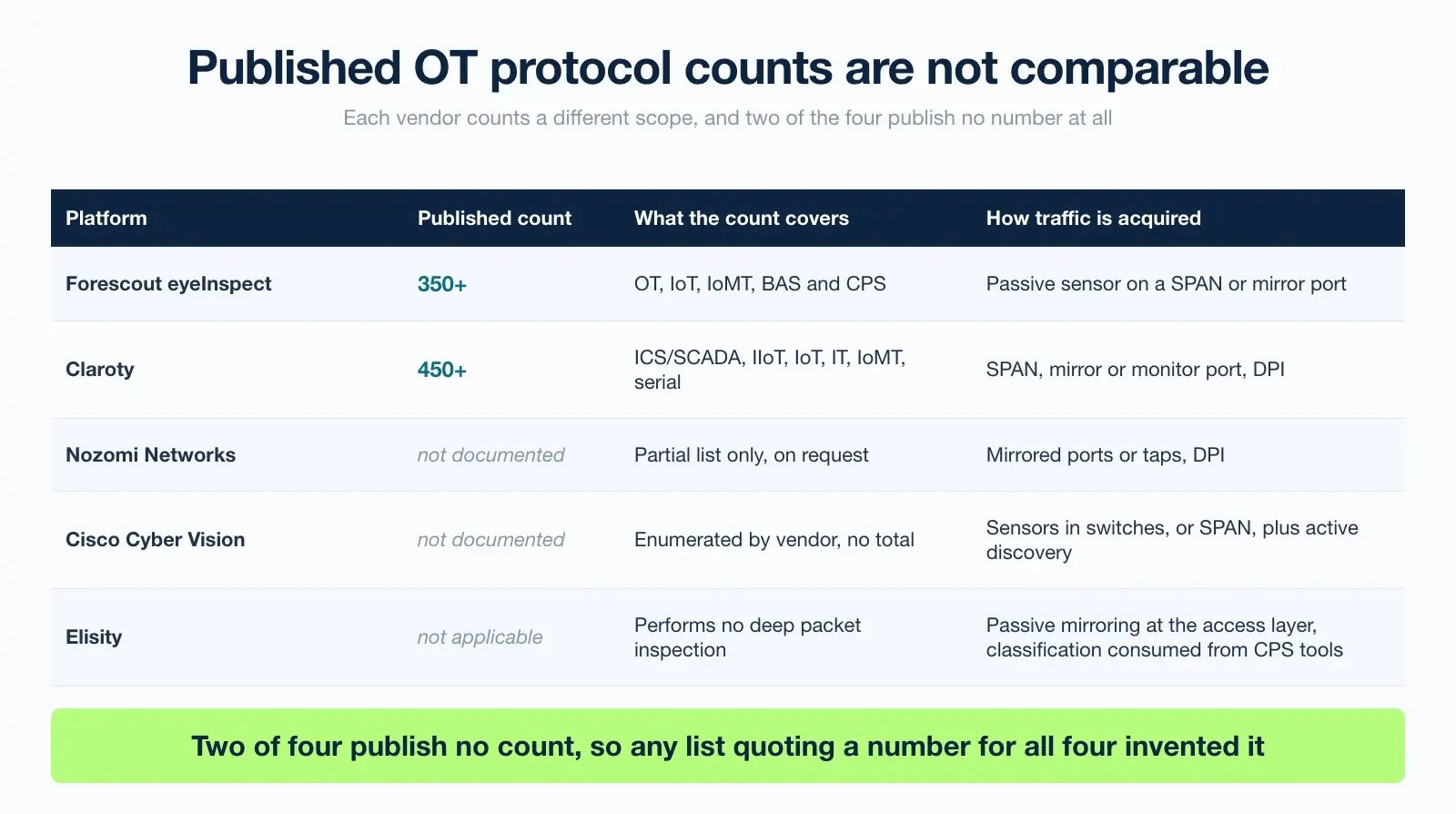
Two Forescout products get confused here, so separate them before the numbers. eyeInspect is the deep packet inspection product, published at “350+ industrial protocols”, and it is where the protocol count lives. eyeSegment is the policy layer above enforcement points and publishes no protocol count, because protocol depth is not what it does. The number of OT protocols a platform supports is a property of its DPI engine, and every one of these designs depends on getting a copy of the traffic first, from a SPAN or mirror port or a network tap. The table below reports what each vendor publishes about its own engine, in that vendor’s own words.
| Vendor and product | Published protocol figure | The vendor’s own scope wording for that figure | Traffic acquisition, per the vendor | Named protocols the vendor publishes | Source and date |
|---|---|---|---|---|---|
| Forescout eyeInspect | 350+ | “Deep packet inspection of 350+ industrial protocols”, with “30+ Discovery Methods” and “The Broadest Coverage Across OT, IoT, IoMT, BAS and CPS” | Passive Sensor “connected to the ICS / SCADA network via a SPAN / mirroring port to passively listen”, plus a separate Active Sensor that “remains inactive unless the eyeInspect operator issues a direct command”. Architecture is Passive Sensor, Active Sensor, Command Center and the Operational Technology Module | Partial. Forescout publishes no consolidated list of the 350+, and the OT Plugin guide describes a “Traffic Inspection Library” that is “updated periodically” with no parser count. Forescout does name individual protocols on solution and blog pages, including DNP3, IEC 60870-5-101/104 and IEC 61850 GOOSE/MMS for utility passive monitoring, and its OT threat research tabulates Modbus, BACnet, S7, OPC-UA, IEC-104, EtherNet/IP, DNP3 and Profinet | forescout.com/product/ and /product/eyeinspect/, both undated, observed 16 August 2026; forescout.com/solutions/power-utilities/; OT Plugin Configuration Guide v3.0.0 |
| Claroty (CTD, xDome) | 450+ | “An unmatched 450+ protocols ... OT, IoT, and other XIoT assets”. Federal collateral adds “ICS / SCADA, IIoT, IoT, IT, IoMT, and Serial Devices” | “Reconfiguring a switch in the OT network with a SPAN, mirror, or monitor port”, with analysis “via deep packet inspection (DPI)”. Five collection methods in total | Partial. Claroty names Modbus on the Passive Monitoring page, and IEC 60870-5-104 and DNP3 in rail material described as covering “hundreds of industrial and rail-specific protocols” | claroty.com/platform/passive-monitoring, 2026 footer, no page date; federal at-a-glance PDF is undated |
| Nozomi Networks (Guardian, Vantage) | Not documented | Nozomi publishes no total. “This list is updated every 3 - 6 months. Please contact your Nozomi Networks representative for a complete and current list” | Guardian sensors “connect to mirrored ports or taps and operate without interrupting operations”. “All Guardian models perform deep packet inspection”, and a passive-only mode exists for “NERC CIP, nuclear, defense”. Nozomi Vantage is the central management console | The wired list is gated behind a “Partial ... Supported Protocol List” download. Wireless sensor protocols are named: BLE, WIFI 802.11 a/b/n/ac/ax, IEEE 802.15.4, Z-Wave, LoRa and LoRaWAN, and cellular GSM, 2G, 3G, 4G and 5G | nozominetworks.com/platform/technical-specifications, 2026 footer, observed 16 August 2026 |
| Cisco Cyber Vision | Not documented as a total. Cisco enumerates protocols by vendor and says “Please ask us for the latest list” | The Protocols Data Sheet covers “protocols supported by Cyber Vision version 5.4 to gain visibility on your industrial network” | “Passively capturing and decoding network traffic using Deep Packet Inspection (DPI) of industrial control protocols”, plus “active discovery that sends extremely precise and nondisruptive requests in the semantics of the specific ICS protocol at play”. Sensors embedded in select switches and routers add “only 2% to 5% additional network traffic”, and SPAN is the brownfield alternative. Cisco Cyber Vision Center is the aggregation platform that “stores data coming from the sensors” | The fullest public list of the four. Named: IEC 104, IEC 101 over IP, DNP3, IEC 61850 (MMS, GOOSE, SV), C37.118, DLMS/COSEM, ICCP/TASE.2 (published by Cisco as ICCP (GRID)/TASE.2), EtherCAT, AMS, EtherNet/IP, CIP, Modbus ASCII, Modbus RTU, Modbus/TCP, XWAY, UNITE, UMAS, EthWay, Profinet, Profinet DCP, Profinet IO CM, S7, S7 Plus, Siemens LOGO!, BACnet, LonWorks, OPC-DA, OPC-UA, OPC-AE, OSIsoft PI-Connect and PcVue Solution. Active Discovery names 14: ABBNC, BACNet, Beckoff AMS, DNP3, EtherNet/IP, eWON, GE-SRTP, Melsoft, MMS, Modbus, Omron, Profinet, S7 and S7Plus | Cyber Vision Protocols Data Sheet, updated 18 December 2025; Cyber Vision Data Sheet, updated 14 April 2026 |
| Elisity | Not applicable. Elisity performs no deep packet inspection and publishes no protocol count | Not applicable. No figure is published, so there is no scope wording to report | “Elisity discovers assets and flows passively by mirroring traffic at the existing access layer. There is no scan that could disturb a fragile controller and no probe that an OT engineer has to approve”. Enforcement runs on the same infrastructure via Virtual Edge Nodes | None. Elisity names no protocol of its own. Protocol-level identity is consumed rather than derived: IdentityGraph correlates from Active Directory, CMDBs, EDR platforms and asset-intelligence tools including Armis, Claroty xDome and Nozomi | elisity.com/ot-security/segment-it-ot-without-downtime, /integrations-overview and the Claroty and Nozomi integration pages, all undated, retrieved 16 August 2026 |
These figures are not directly comparable. Forescout counts industrial protocols across OT, IoT, IoMT, BAS and CPS. Claroty counts protocols across ICS/SCADA, IIoT, IoT, IT, IoMT and serial devices. Nozomi and Cisco publish no count at all. No vendor documents whether protocol variants such as Modbus ASCII, Modbus RTU and Modbus/TCP are counted separately, so the numbers should not be normalized against each other. Figures observed 16 August 2026.
One figure on the Elisity row needs its provenance stated, because two rows of the same table would otherwise appear to disagree. Elisity’s Nozomi integration page states that Nozomi supports over 100 OT and IoT protocols including Modbus, BACnet, DNP3, EtherNet/IP, PROFINET and OPC UA. Nozomi itself publishes no count, as its own row records. That number is therefore Elisity’s characterization of a partner product, not a Nozomi figure, and it should be checked with Nozomi rather than quoted from here. Elisity also states that Claroty xDome passes eight attributes per device, including Purdue level.
The architecture behind the 350+ figure decides what an eyeInspect deployment costs to run. Forescout documents a Traffic Inspection Library inside an Operational Technology Module, a Passive Sensor on a SPAN or mirror port, a separate Active Sensor that stays inactive until an operator issues a command, and a Command Center that aggregates sensors. Licensing follows that shape, in the June 2024 license guide: an eyeInspect Base Flat Fee license requires an associated eyeInspect Endpoint license, an extra-large Sensor is documented at up to 10,000 assets, and Command Center tiers are documented at up to 5, up to 15 and unlimited.
Two structural points sit underneath the numbers. Deep packet inspection produces protocol depth, and none of the three DPI products above enforces device-to-device traffic on its own. Claroty issues policy recommendations for a firewall. Nozomi routes findings into integrated tools. Cisco documents Cyber Vision enforcement as performed by Cisco ISE over pxGrid or by Cisco Secure Firewall through the Secure Dynamic Attribute Connector. And if a vendor offers an active mode, ask specifically whether it is a safe active query against your controller models, in writing, with the query set named. Elisity sits on the other side of that line, as a consumer of this intelligence rather than a producer of it, which is why it publishes no count, and which is set out in more depth in OT protocol awareness and Claroty, Nozomi and Armis integration for industrial networks.
Is Elisity a Forescout competitor for network access control, or a different control entirely?
Forescout competitors in network access control are the products that decide admission and enforce that decision on the network device an endpoint connects to. They are Cisco Identity Services Engine, HPE Aruba ClearPass Policy Manager, Fortinet FortiNAC, Portnox Cloud, Genians Genian NAC and Extreme Networks NAC, which Extreme sells as ExtremeControl inside ExtremeCloud IQ Site Engine. Belden NAC (former macmon NAC), Ivanti Policy Secure and Juniper Mist Access Assurance appear regularly on third-party shortlists. Every one of them is scored in Table A.
Split the Forescout entity before answering, though, because that is what the question turns on. eyeControl is the network access control product. eyeSight and eyeInspect are visibility products. eyeSegment is the segmentation policy layer. Elisity competes with eyeSegment, consumes asset context from its own published integration list, and does not compete with eyeControl at all.
The mechanisms are standardized, and a NAC evaluation tests all seven: 802.1X for supplicant-capable devices; MAC Authentication Bypass (MAB) for devices without a supplicant; RADIUS as the authentication transport; TACACS+ for device administration; Change of Authorization (CoA) to move a session after the fact; downloadable ACLs (dACLs) pushed to the access device; and VLAN quarantining for devices that fail posture. Forescout enforces in the same idiom, with or without 802.1X, drawing on a Forescout Device Cloud of over 12 million device fingerprints.
| Control | Which Forescout product covers it | Does it enforce device-to-device traffic itself | What is still open afterwards |
|---|---|---|---|
| Device admission | eyeControl | No. eyeControl decides and enforces admission, and applies post-admission actions through the Switch, Wireless and RADIUS plugins | East-west traffic between two devices already admitted onto the same VLAN |
| Asset visibility and classification | eyeSight and eyeInspect | No. Both are documented as discovery, classification and deep packet inspection | Which component applies a policy to what they find |
| East-west segmentation policy | eyeSegment | Forescout says customers enforce segmentation and also describes eyeSegment as a unified policy layer that orchestrates controls across enforcement points. It does not name the enforcing component on that page | The enforcement point itself, whether you already own it, and which team owns its failure mode |
| East-west enforcement | Not a Forescout product. Elisity, the publisher of this page | Yes, on access-layer infrastructure already deployed, bounded by a published compatibility matrix | Device admission, which Elisity does not provide |
The boundary is narrower than the category label, and it is worth stating once and then leaving alone. Network access control and asset intelligence platforms largely answer what is on the network and whether it should be admitted. Segmentation answers what a thing may talk to once it is admitted. A device can be correctly identified, correctly admitted and still reach every other device on its VLAN. Put simply: NAC decides admission, microsegmentation decides what a device may reach.
Elisity’s own limit belongs in the same breath, in its own published words: “Elisity is not a replacement for device admission. It enforces identity-based least-privilege policy on the access-layer switches an organisation already operates, which is the control these products leave open.” If you need 802.1X, you still need a NAC, and Forescout eyeControl remains one of the products that provides it.
On replacement, the published position keeps its hedge attached, and the hedge is the honest part. Elisity states that it “can complement existing NAC initially, then replace it as your primary access control solution”, and immediately qualifies the arc: “Over time, organizations often find that microsegmentation subsumes the NAC function entirely because it provides everything NAC does plus granular east-west control, but that’s an evolution, not a day-one requirement.” Both sentences are Elisity’s, and the second is the one that decides what a first year looks like.
How do the alternatives compare on enforcement point, agents and published limits?
Read down the enforcement column of Table A and the market resolves into four mechanisms. Each one trades something, and the trade is usually the most useful thing to know about it.
Enforcement by the admitting network device. Cisco ISE, ClearPass, FortiNAC, Portnox Cloud, Genian NAC, ExtremeControl, Mist Access Assurance, Policy Secure and Belden NAC all put the decision at the port or the association, and Forescout eyeControl delivers the same control. It is the only mechanism that can stop a device before it gets an address. It is also the mechanism that depends on the device answering back, which is why supplicant-less equipment is where these projects stall. On post-admission east-west enforcement the group is not uniform: Cisco ISE documents least-privilege east-west control through TrustSec and Cyber Vision asset groups, ExtremeControl documents L2-L7 ACL profiles converted to downloadable ACLs for installation on switches and routers, and Ivanti Policy Secure documents enforcement “within the network on the firewall”. ClearPass documents none on the cited page, and for the rest it is not documented.
Enforcement by a firewall or NAC consuming exported policy. Armis, Claroty, Nozomi, Palo Alto Networks Device Security and Tenable produce context and, in several cases, generate rules. Claroty publishes 450+ protocols and Forescout eyeInspect 350+, which is the deepest published protocol context in this comparison for OT and clinical estates. The limitation is structural rather than qualitative: the enforcement point is a device these vendors do not own, so coverage, latency and failure behavior are inherited from it. That is a legitimate design, not a deficiency, but it decides what you are buying and which team owns the failure mode.
Enforcement by a third-party switch provisioned through a plugin. This is Forescout’s documented mechanism, and Cisco TrustSec is the other well-documented instance. It reaches devices that cannot run software and adds nothing to the traffic path. It is bounded by the two tables above, unevenly by vendor and by action, and every provisioned change lands on hardware someone else operates.
Enforcement by infrastructure already deployed, acting as the policy node itself. Elisity documents this against its own published compatibility matrix, with no agent and no new hardware in the path. Zero Networks documents a related model in which a Segment Server watches connections for a learning period, then writes rules to host firewalls on managed devices and to access control lists on the network infrastructure connecting unmanaged ones. The shared constraint is reach rather than capability: a policy can only be applied to a flow that arrives at the enforcing device, so a conversation that stays behind a downstream unmanaged switch never reaches one. Map the access-layer topology before an evaluation.
On third-party evidence, name the surface and the market before you quote the number, and check the date. Gartner® lists the Network Access Control market as “Network Access Control (Transitioning to Security Service Edge)”, so a NAC review page and a Security Service Edge review page can cover overlapping vendors under different criteria. Read the market definition before you read the score.
| Evidence surface | What it covers | Figures verified for this page |
|---|---|---|
| 2026 Gartner® Magic Quadrant™ for CPS Protection Platforms | Cyber-physical systems protection vendors, including Forescout | Placement not verified for this page, and none is stated here for any vendor. Forescout’s own site offers the 2026 Gartner® Critical Capabilities for CPS Protection Platforms reprint, by Wam Voster, Ruggero Contu, Katell Thielemann and Sumit Rajput, dated 9 March 2026, and states no Magic Quadrant position on that page. Treat any placement quoted elsewhere as a third-party summary until you have read the reprint |
| Gartner® Peer Insights™ | Buyer-submitted ratings, published per market. A vendor rated in one market is not comparable with a vendor rated in another, and vendors do not appear in every market | In the CPS Protection Platforms market, Forescout Vistaro Platform is rated 4.3 from 36 ratings; Elisity is not listed in that market. In the Network Security Microsegmentation market, which lists 37 products, the largest review bases are AlgoSec Horizon at 4.4 from 277 ratings, Akamai Guardicore Segmentation at 4.8 from 253 and Illumio Zero Trust Segmentation Platform at 4.8 from 228. Zero Networks Segment is rated 5.0 from 49 ratings, ColorTokens Xshield 4.7 from 64, Elisity Identity-based Microsegmentation 5.0 from 27, and Forescout 4.4 from 5. The two Forescout figures are different markets and different criteria, not one measurement. All observed on Gartner Peer Insights on 16 August 2026, and ratings move |
| PeerSpot | Practitioner reviews and head-to-head comparison pages | Not verified for this page |
| G2 | Buyer reviews by category, with category definitions that differ from Gartner’s | Not verified for this page |
| TrustRadius | Buyer reviews by category | Not verified for this page |
Reviewer prose on these sites is copyrighted text written by the reviewer, so read reviews by reviewer role, company size and date rather than quoting them. A 2023 review of a product that has since been renamed tells you less than a 2026 review from a company your size. One column decides more evaluations than the feature list does: what each vendor publishes about its own limits. Most comparison pages omit it.
Where does Elisity fit, and what does Elisity not do?
Elisity competes with eyeSegment, does not compete with eyeControl, and consumes the same class of asset context that eyeSight and eyeInspect produce, from its own published integration list rather than from Forescout. That three-way split is the whole position, stated in the same terms used for every other vendor on this page, and it is set out row by row in Table A.
What Elisity documents: identity-based least-privilege policy enforced by access-layer infrastructure already deployed, with the Elisity Virtual Edge turning existing network infrastructure into policy enforcement nodes, no agents, no new hardware, and no ACL, VLAN or re-IPing project. Elisity classifies devices natively from network telemetry, and OT protocol-level identity specifically is consumed from the published integration list, which includes Armis, Claroty xDome, Nozomi, Dragos, Microsoft Defender for IoT, ORDR, ServiceNow CMDB, CrowdStrike and SentinelOne. Forescout does not appear on that list.
Analyst standing, as published by Elisity and not upgraded. Elisity was named a Strong Performer in the Forrester Wave in the third quarter of 2024, and states that it “carried one of the highest strategy scores in that tier”. Elisity also publishes recognition as a Gartner® Cool Vendor™ in Cyber-Physical Systems Security 2025, a Representative Vendor in the 2025 Gartner® Market Guide for Network Security Microsegmentation, and a Sample Vendor in the Gartner® Hype Cycle™ for Enterprise Networking 2025. Every one of those is Elisity’s own published statement of its standing, and the underlying reports were not read for this page.
On scale, the figures are also Elisity’s published figures. MultiCare Health System secured 40,000 devices across 15 hospitals and 230 clinics. Elisity separately publishes a deployment at more than 350 sites and over 500,000 devices at one of the largest health systems in the United States; that customer is not named, so treat it as an unverifiable published figure. No named Elisity customer is documented as having replaced Forescout, and this page makes no such claim.
What Elisity does not do, in the same voice used above for Forescout’s gaps:
- Elisity does not replace device admission. In Elisity’s own published words: “Elisity is not a replacement for device admission. It enforces identity-based least-privilege policy on the access-layer switches an organisation already operates, which is the control these products leave open.” If you need 802.1X, you still need a NAC.
- Elisity is not a replacement for asset intelligence. It publishes no protocol count and performs no deep packet inspection. Where eyeInspect, Claroty or Nozomi are already deployed, Elisity is a consumer of their output, not a substitute for it.
- Enforcement is bounded by a published compatibility matrix of specific hardware models and software versions, and covers only the traffic that reaches that infrastructure. Two devices sharing a downstream unmanaged switch, or a daisy-chained run, are never evaluated against a policy.
- Cloud and Kubernetes coverage is rated Limited by Elisity itself, and Elisity states that organizations with primarily cloud-native workloads may need to pair it with a cloud-focused tool.
- Elisity publishes no residual classification figure for how many endpoints remain unclassified once its integrations are connected. Neither does any other vendor in this comparison.
- Fail-open and fail-closed behavior is not documented, and neither is rollback duration or procedure. That is the same gap recorded above for Forescout, and the verification table below sets out how to close it.
Where is Forescout still the right choice?
There are estates where the incumbent is the right answer and a switch is not worth the disruption. Elisity’s own analysis of stalled NAC projects puts NAC at its highest success rates in four cases: wireless-only deployments, greenfield installations with homogeneous infrastructure, limited-scope pilots in single buildings or departments, and compliance requirements that specifically mandate 802.1X. That is Elisity’s published assessment rather than third-party research, and the reasoning behind it is set out in where NAC still works: wireless-only, greenfield and 802.1X compliance mandates.
Two more cases favor keeping Forescout. If your requirement is agentless discovery depth across an OT or clinical estate, Forescout’s published breadth is real, and Portnox concedes it in writing on its own comparison page: “Forescout has deeper OT discovery”. And if the unanswered control is admission rather than east-west traffic, eyeControl is already the product for it, and nothing on this page argues otherwise.
Can Elisity run alongside an existing Forescout deployment?
Yes, and that is the more common outcome than replacement. Elisity states: “It runs alongside an existing ISE, Forescout or ClearPass deployment without changes to that configuration, and it is also the control organisations adopt when a NAC or TrustSec rollout stalls on 802.1X complexity or on devices that cannot run a supplicant.” The reason coexistence is straightforward is mechanical rather than commercial. Admission happens once, at connection, and Forescout eyeControl decides it while eyeSight or eyeInspect classifies. East-west policy is evaluated continuously, on traffic between devices already on the network. Neither one reconfigures the other.
Elisity is explicit about day one, in the first person of its own blog: “To be clear, I’m not suggesting you rip out your NAC tomorrow. If you have a functioning NAC deployment covering your IT assets, it can continue serving that role.” Elisity also publishes 2 weeks from deployment to first policy applied on its legacy NAC comparison page, with no stated methodology, so treat it as the published figure on that page rather than as a measured average.
Two operational points to settle before a coexistence design is agreed. Credential scoping: confirm which read-only credentials each platform needs on the same switches, and whether both will poll the same devices. Ownership: if eyeSegment is modeling policy while another product is enforcing it, write down which team owns which half, because that boundary fails first during an incident.
A note on integration claims. Forescout does not appear on Elisity’s published integration list, so coexistence here means the two products operating independently on the same infrastructure, not a documented data exchange between them. This page asserts no Forescout integration. If a documented integration matters to your design, ask both vendors for the integration guide by name.
What should you verify before replacing or supplementing Forescout?
Six items decide these projects, and not one of them is answered by any vendor’s product page, Forescout’s or Elisity’s. Put them in writing, to every vendor on the shortlist, and hold each answer to a document reference rather than an assurance.
| What to verify, with every vendor including Forescout and Elisity | What a usable answer contains |
|---|---|
| Fail-open or fail-closed behavior at the enforcement point | Whether traffic continues or stops when the enforcement point reboots or loses the management plane, for how long, and whether that behavior is configurable, in a named document rather than on a call. Neither Forescout nor Elisity publishes this today. The only documented Forescout failure consequence is data staleness: “If traffic cannot be reported, the data shown in your matrix will not be up-to-date” |
| Policy rollback procedure and duration | A written, ordered procedure and a timed run on a live segment during the proof of value, not a number quoted verbally |
| Residual unclassified percentage on your own data | The proportion of endpoints classified without human input, measured on your inventory, plus what happens by default to a device the platform cannot classify. No vendor in this comparison publishes such a figure. Forescout documents that unclassified devices are placed in an Unclassified group and that manual classification is useful where eyeSight “was not able to resolve a classification” or where an endpoint “was excluded from the range of endpoints to be classified due to its sensitivity to probing”, so disposition is a function of the policy you write |
| Compatibility matrix diffed against your hardware inventory | A model-by-model and version-by-version result, not a vendor-family answer. The two switch tables above show why: support differs between the Cisco row and the Catalyst 2950 rows, between Extreme X-series and the rest of the Extreme line, and by individual action |
| Addressing and credential prerequisites | What per-VLAN response addressing the enforcement mechanism requires, what credentials the platform needs on your switches, and whether read-only scoping is possible for the discovery phase. Forescout documents that ACL actions require command-line access from the Enterprise Manager or Appliance to the managed device, at a privilege level that permits the relevant configuration commands |
| Cloud egress endpoints, air-gap posture, and which module carries the capability | The exact destinations the platform must reach. Forescout documents that eyeSegment requires outbound access to *.dapi-query.prod.cloud.forescout.com and *.dapi-ingest.prod.cloud.forescout.com, and that it “does not support Certification Compliance mode or Devices that do not have IPv4 addresses”. Ask also for a module name and a SKU for the capability being pitched, because category labels such as Universal Zero Trust Network Access (UZTNA) map to different products in different portfolios |
Test the mechanism, do not accept the diagram. Inside the proof of value, pick one real segment and prove three things end to end: that a policy written in the console produces the exact configuration you expect on the exact switch model you own, that the rollback runs against a stopwatch, and that a deliberate loss of the management plane does what the vendor said it would. Ask vendors to answer from documentation. A vendor that will not schedule that test has already answered the question.
Frequently asked questions about Forescout alternatives
Every capability statement on this page is drawn from the named vendor’s own current public documentation, and third-party sources are named and attributed wherever they are used. Last reviewed 16 August 2026.
What are the best Forescout alternatives in 2026?
It depends which Forescout product you are replacing, because each module has a different competitor set. For eyeControl admission control, the documented alternatives are Cisco Identity Services Engine, HPE Aruba ClearPass Policy Manager, Fortinet FortiNAC, Portnox Cloud, Genians Genian NAC, Extreme ExtremeControl, Juniper Mist Access Assurance, Ivanti Policy Secure and Belden NAC. For eyeSight and eyeInspect visibility, they are Armis Centrix, Claroty, Nozomi Networks, Cisco Cyber Vision, Palo Alto Networks Device Security and Tenable One OT Exposure, each of which hands enforcement to a firewall or a NAC. For eyeSegment east-west segmentation policy, the two scored here are Elisity and Zero Networks; Akamai Guardicore Segmentation, ColorTokens Xshield and Illumio compete in the same group but their documentation was not reviewed for this page. Establishing which of those controls is unprotected today is the step that makes the shortlist obvious.
Does Forescout eyeSegment enforce traffic, and what performs the enforcement?
Forescout uses both registers on the same eyeSegment page. It says customers “See, model, and simulate segmentation policies across your entire enterprise”, and it also says they “enforce segmentation that reduces your attack surface” and that the platform delivers “automated enforcement across your hybrid enterprise”. The same page describes “a unified policy layer across disparate enforcement points and network domains” that will “orchestrate controls across enforcement points”, and it does not name which component performs the enforcement. The documented enforcement mechanisms belong to the plugins under an eyeControl license: the Switch plugin’s Access Port ACL, Assign Security Group Tag, Assign to VLAN, Endpoint Address ACL, Switch Block and Virtual Firewall actions, plus a RADIUS server that sends Change of Authorization or other messages to managed network devices. Whether eyeSegment depends on those plugins is not documented either way, so ask Forescout for the dependency statement in writing, because it decides which team owns the enforcement path.
Which switches does Forescout document ACL enforcement on?
Two different Forescout tables answer that, and they are often merged by mistake. The Switch Vendor ACL Support matrix has fifteen rows: Arista, Brocade, Brocade IronWare, Cisco switches except Catalyst 2950 and Small Business 300 Series, Cisco Catalyst 2950 Standard Image, Cisco Catalyst 2950 Enhanced Image, Dell EMC Networking OS10, Dell Networking-DNOS v9.x, Dell SONiC, DNI, Enterasys, Hirschmann-HiOS, HPE-ArubaOS-CX, Juniper switches and routers, and Tejas. Each row gives an explicit value for three actions, and support is uneven: Access Port ACL is Not Supported on Brocade, Brocade IronWare, Enterasys and Juniper switches and routers, and Endpoint Address ACL based on MAC is Not Supported on Arista, Brocade, Catalyst 2950 Standard Image, Dell EMC Networking OS10, Dell Networking-DNOS v9.x, Enterasys and Tejas. The separate eyeSight and eyeControl capabilities summary adds the entries that are missing from the matrix, including Extreme, Extreme Fabric Engine, Extreme K6, Extreme X-series, HPE-Comware OS, HPE-Provision/ProCurve/Aruba OS, Juniper EX and Juniper MX, managed over CLI, SNMP or Netconf. In that table Extreme X-series is the only Extreme entry carrying ACL Actions, the Cisco entry records “no support for Cisco Small Business 300 Series”, generic switches get only Switch Block and Expedite IP Discovery, and firewalls, routers and SD-WANs get only Expedite IP Discovery under the Switch plugin. Aruba is documented only under HPE brand names, with no standalone Aruba row.
How many OT protocols does Forescout eyeInspect support compared with Claroty, Nozomi and Cisco Cyber Vision?
Forescout publishes “deep packet inspection of 350+ industrial protocols” for eyeInspect, across OT, IoT, IoMT, BAS and CPS. It publishes no consolidated list of the 350+, though it does name individual protocols on solution and blog pages, including DNP3, IEC 60870-5-101/104 and IEC 61850 GOOSE/MMS for utility passive monitoring. Claroty publishes 450+ protocols across ICS/SCADA, IIoT, IoT, IT, IoMT and serial devices, and names a few including Modbus, DNP3 and IEC 60870-5-104. Nozomi Networks publishes no protocol count at all, stating that its list is updated every three to six months and directing buyers to a representative. Cisco publishes no aggregate for Cyber Vision but names the most protocols publicly, including Modbus/TCP, DNP3, IEC 61850 MMS and GOOSE, PROFINET, S7, BACnet, LonWorks, EtherNet/IP and OPC-UA. The figures are not directly comparable, because each vendor counts a different scope and none documents whether protocol variants such as Modbus ASCII, Modbus RTU and Modbus/TCP are counted separately. Figures observed 16 August 2026.
Is Elisity a Forescout competitor in network access control?
Not in network access control, and the distinction is precise. Elisity competes with Forescout eyeSegment on east-west segmentation policy, consumes the same class of asset context that eyeSight and eyeInspect produce but does so through its own published integration list, and does not compete with eyeControl on device admission at all. Elisity states plainly that it “is not a replacement for device admission” and that it “enforces identity-based least-privilege policy on the access-layer switches an organisation already operates, which is the control these products leave open”. In practice the two layers run together: admission decides whether a device gets on, segmentation decides what it may reach once it is on. Elisity also states that it runs alongside an existing ISE, Forescout or ClearPass deployment without changes to that configuration. Forescout does not appear on Elisity’s published integration list, so no data exchange between the two products is claimed here.
Can I just use the NAC and firewalls I already own instead of a Forescout alternative?
Sometimes, and it is worth testing before you buy anything. A NAC that already covers your supplicant-capable estate can keep doing that job, and firewalls already enforce between VLANs, so if all the traffic you need to control crosses a firewall you may already own the control. What neither one covers is two devices on the same VLAN, behind the same switch, that were both correctly admitted. That traffic never reaches the firewall and is not re-evaluated by the NAC after admission, it is the traffic lateral movement uses, and it is the gap an east-west product fills. This site sets out the limits of VPN, NAC and firewalls for zero trust in detail.
What is the Forescout Vistaro platform, and is it the same as the Forescout 4D Platform?
Yes. Forescout renamed the Forescout 4D Platform to the Forescout Vistaro platform on 24 June 2026 and described the change as “an update only to the name”. The module names are unchanged. Forescout’s current products overview lists nine: eyeSight, eyeSentry, eyeSegment, eyeControl, eyeInspect, eyeFocus, eyeAlert, eyeScope and eyeExtend, alongside a Flyaway Kit, with eyeSentry announced on 4 November 2025. Comparison pages that still call it the Forescout 4D Platform were written before the rename, which is a quick way to judge how current a Forescout alternatives roundup is. Forescout’s March 2026 agentless segmentation announcement also predates the rename, and Forescout has since retitled that release page to the Vistaro naming. Note also that the newest retrievable Forescout license guide is dated June 2024, so the SKU structure under the Vistaro naming should be confirmed with Forescout directly.
Does Forescout require an agent?
Forescout discovery is agentless, and that is the platform’s central design claim. Forescout also documents SecureConnector, an optional endpoint agent deployed “by including the Start SecureConnector action in a policy”, so an agent is available but not required. Forescout publishes two different counts for its agentless discovery techniques, “over 20” on the eyeSight product page and “over 30” on the products overview, both undated, so confirm the current figure and its definition with Forescout rather than quoting either number as settled.
Related guides

What a Multi-Site Microsegmentation Rollout Actually Looks Like (and Why Most Take Years)

How to Secure Devices That Cannot Be Patched: 10 Compensating Controls for OT, IoMT and End-of-Life Systems

Why Network Segmentation Projects Fail: A RedSeal CPTO View