


.svg)
.png)




Implementation Guide
How to Implement Microsegmentation: A Practitioner's Guide for 2026
Implementing microsegmentation means applying granular, identity-based security policies at the individual workload or device level to control east-west traffic within your network. Unlike traditional perimeter defenses that focus on north-south traffic, microsegmentation enforces least-privilege access between every asset on your network, effectively containing lateral movement before it becomes a breach. If you are new to the concept, start with our guide on what microsegmentation is and how it works, or visit our complete microsegmentation guide for the full picture.
Implementation Challenges
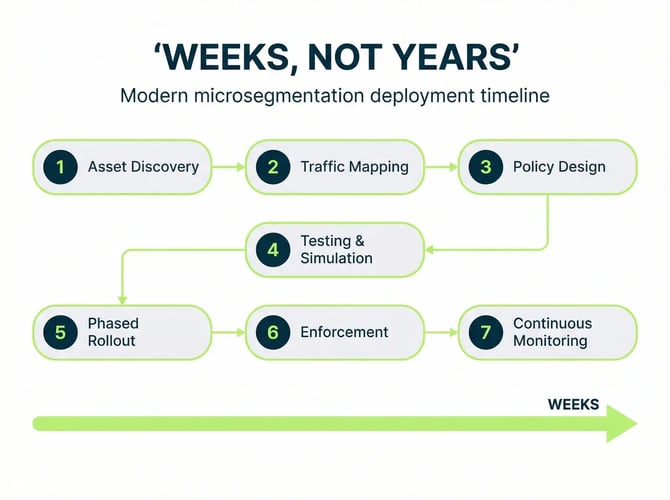
Most microsegmentation projects stall because teams skip critical steps: they jump to enforcement without complete asset discovery, build policies without understanding traffic flows, or try to segment everything at once instead of phasing the rollout. A structured, step-by-step approach prevents these common failures and delivers measurable security improvements within weeks.

Industry Insight
"We made more progress in 2 days with Elisity than we did in 2 years with our previous microsegmentation solution."
Andelyn Biosciences
The Numbers
Real-world implementation results from organizations that followed a structured approach to microsegmentation deployment, proving it can be done in weeks rather than years.
2 Days
To surpass two years of work with a previous solution
2,000+
Policies created and enforced
10,000+
Devices discovered and classified
4 Hours
Average time to create initial policy set
Implementation Step
Why Microsegmentation Implementation Matters Now
The urgency behind microsegmentation has shifted dramatically over the past two years. When I first started talking to CISOs about microsegmentation in 2020, it was a "nice to have" on most roadmaps. Today, it is a board-level priority, and the data backs that up.

Implementation Step
Step 1: Assess Your Current Network and Asset Inventory
Every failed microsegmentation project I have seen shares a common root cause: the team tried to write policies before they understood what was actually on the network. You cannot segment what you cannot see.
Before writing a single policy, you need a comprehensive inventory of every device, workload, and application communicating on your network. This includes:
Implementation Step
Step 2: Define Your Segmentation Strategy
With a clear picture of your network, the next step is deciding how to segment it. This is where strategy matters more than technology. I have seen organizations spend millions on microsegmentation platforms only to deploy them like expensive VLANs because they never defined a coherent strategy.
There are several approaches to microsegmentation, and the right one depends on your environment, risk profile, and operational maturity. The most common models include:
Implementation Step
Step 3: Design Microsegmentation Policies
Policy design is where microsegmentation either succeeds or collapses under its own complexity. The goal is policies that are granular enough to be effective but simple enough to be maintainable.
The fundamental shift in microsegmentation policy design is moving from "deny the bad" to "allow only the known good." This means your default policy should deny all traffic between segments, with explicit allow rules for verified, necessary communication paths.
Implementation Step
Step 4: Deploy in Learning Mode First
This is the step that separates successful implementations from disasters. Never go straight to enforcement. Always start in learning mode.
In learning mode, your microsegmentation platform observes all traffic and evaluates it against your proposed policies without actually blocking anything. This gives you:
- A real traffic baseline: the communication patterns your network actually has, not the ones on a diagram nobody has updated since the last audit.
- Policy validation: every flow your proposed rules would have blocked, so you fix the rule instead of the outage.
- Exception discovery: the legacy integrations, hardcoded IP dependencies, and vendor remote-access paths that never show up in a CMDB.
- Evidence for stakeholders: something concrete to show the application owner who is certain segmentation will break their system.
I recommend a minimum of two to four weeks in learning mode for each segment. Complex environments, especially those with OT or legacy systems, may need longer. The goal is to reach a point where your monitoring shows zero false positives for legitimate traffic.
Implementation Step
Step 5: Enforce Policies Incrementally
With monitoring complete and policies validated, you can begin enforcement. The key word here is "incrementally."
Start enforcement with your lowest-risk, highest-confidence segments. Typical phases include:
- Block what you already know is wrong: the flows nobody defends once you put them on a screen. Low risk, immediate value, and an easy first change review.
- Protect your highest-value systems: enforce around them while the change is still small enough to reason about.
- Separate device populations: keep building management away from clinical systems, contractors away from production, and so on.
- Tighten toward least privilege: narrow the remaining allow rules from broad ranges to specific ports and protocols.
For every enforcement action, have a documented rollback procedure. Know exactly how to revert a policy change if something breaks. Test the rollback before you need it. The ability to quickly revert gives your team confidence to enforce aggressively and gives your stakeholders confidence that microsegmentation will not cause prolonged outages.
St. Luke’s University Health Network segmented 15 hospitals, 350 practices, and 85,000 devices in 46 days by working through its major segmentation buckets in stages. For how a multi-site program sequences those waves, and where the time actually goes, see the honest multi-site rollout timeline.
Implementation Step
Step 6: Refine Policies and Expand Coverage
Enforcement is not the finish line. Networks change, and a policy set that was correct in March will be wrong by September if nobody maintains it.
Build a review rhythm. Watch for policy violations that turn out to be legitimate new traffic rather than attacks, and fold those in deliberately instead of opening a broad exception because someone escalated. Track which rules never match anything, because an unused rule is usually either a dead system or a sign your classification has drifted.
Then expand. Each segment you finish makes the next one faster, because the policy templates, the naming conventions, and the change process are already settled. By the third or fourth segment most teams are no longer negotiating the method, only the scope.
Implementation Step
Step 7: Operationalize and Maintain
The deployments that hold their gains are the ones that stop being projects. Microsegmentation has to become part of how the environment runs, not something a small team did once.
That means three handoffs. Policy changes move into your existing change management process, with the same approvals and audit trail as any other network change. Asset classification becomes part of onboarding, so a new device arrives already carrying an identity instead of waiting to be discovered. And your control mappings get written down against the frameworks you actually report on, so the evidence is ready before an auditor asks for it.
Assign an owner. The most common way a successful deployment decays is not technical. It is that the person who understood the policy model moved roles and nobody inherited it.

Stop East-West Attacks, Microsegment Your Networks
Resources
Elisity Microsegmentation: Accelerate Zero Trust Security in Weeks, Not Years
Microsegmentation Implementation FAQ
What is the first step in implementing microsegmentation?
The first step is conducting a comprehensive asset discovery and network mapping exercise. You need full visibility into every device, workload, and application on your network, along with their communication patterns, before you can write effective microsegmentation policies. Attempting to define policies without this foundation leads to gaps in coverage and unexpected disruptions during enforcement.
How long does microsegmentation implementation take?
A typical microsegmentation implementation takes 8 to 12 weeks from initial discovery through first enforcement for a pilot environment. Modern identity-based platforms that leverage existing network infrastructure can compress this to 3 to 4 weeks for initial sites. Full enterprise-wide deployment, covering all environments and device types, usually takes 3 to 6 months depending on organizational complexity and the number of sites.
Does microsegmentation require replacing existing network infrastructure?
No. Modern microsegmentation solutions, particularly identity-based approaches, work with the network infrastructure you already own, including your existing access layer and routers. There is no need to rip and replace network hardware, redesign VLANs, or deploy overlay networks. This infrastructure-agnostic approach eliminates the capital expenditure and extended timelines that historically made microsegmentation impractical for many organizations.
Can microsegmentation protect IoT and OT devices that cannot run agents?
Yes, but only if you choose the right approach. Agent-based microsegmentation solutions cannot protect devices that do not support software agents, which includes most IoT sensors, medical devices, industrial controllers, and OT systems. Identity-based and network-based microsegmentation solutions enforce policies at the network layer, providing protection for these unmanaged devices without requiring any software to be installed on them.
How does microsegmentation differ from network segmentation?
Traditional network segmentation divides a network into broad zones using VLANs and firewalls, typically at the subnet level. Microsegmentation applies granular policies at the individual workload or device level, controlling communication within those zones, not just between them. Think of network segmentation as building walls between rooms, while microsegmentation controls what each person in each room is allowed to do and who they can interact with.
What compliance frameworks require or recommend microsegmentation?
Several major compliance frameworks now reference microsegmentation as a key control. NIST SP 800-207 (Zero Trust Architecture) identifies microsegmentation as a core component. The 2025 HIPAA Security Rule updates include explicit network segmentation requirements. PCI DSS 4.0 requires segmentation to reduce the cardholder data environment scope. IEC 62443 for industrial environments mandates zone and conduit segmentation. CISA's Zero Trust Maturity Model includes microsegmentation as a pillar of network security maturity.
Resources



Continue Exploring Microsegmentation
The Complete Guide to Microsegmentation — Our comprehensive pillar hub
Types of Microsegmentation: 5 Approaches Compared — Compare agent-based, network-based, identity-based, and more
Microsegmentation vs Network Segmentation — Key differences explained
Ready to Implement Microsegmentation? Start Segmenting in Weeks, Not Years