


.svg)
.png)




RESEARCHED BY OMDIA

90% of Organizations Are Falling Behind on Microsegmentation.
Omdia’s 2026 survey of 352 security leaders reveals the real state of microsegmentation: what’s stalling programs, what’s working, and where your peers stand. Get the independent benchmark report.
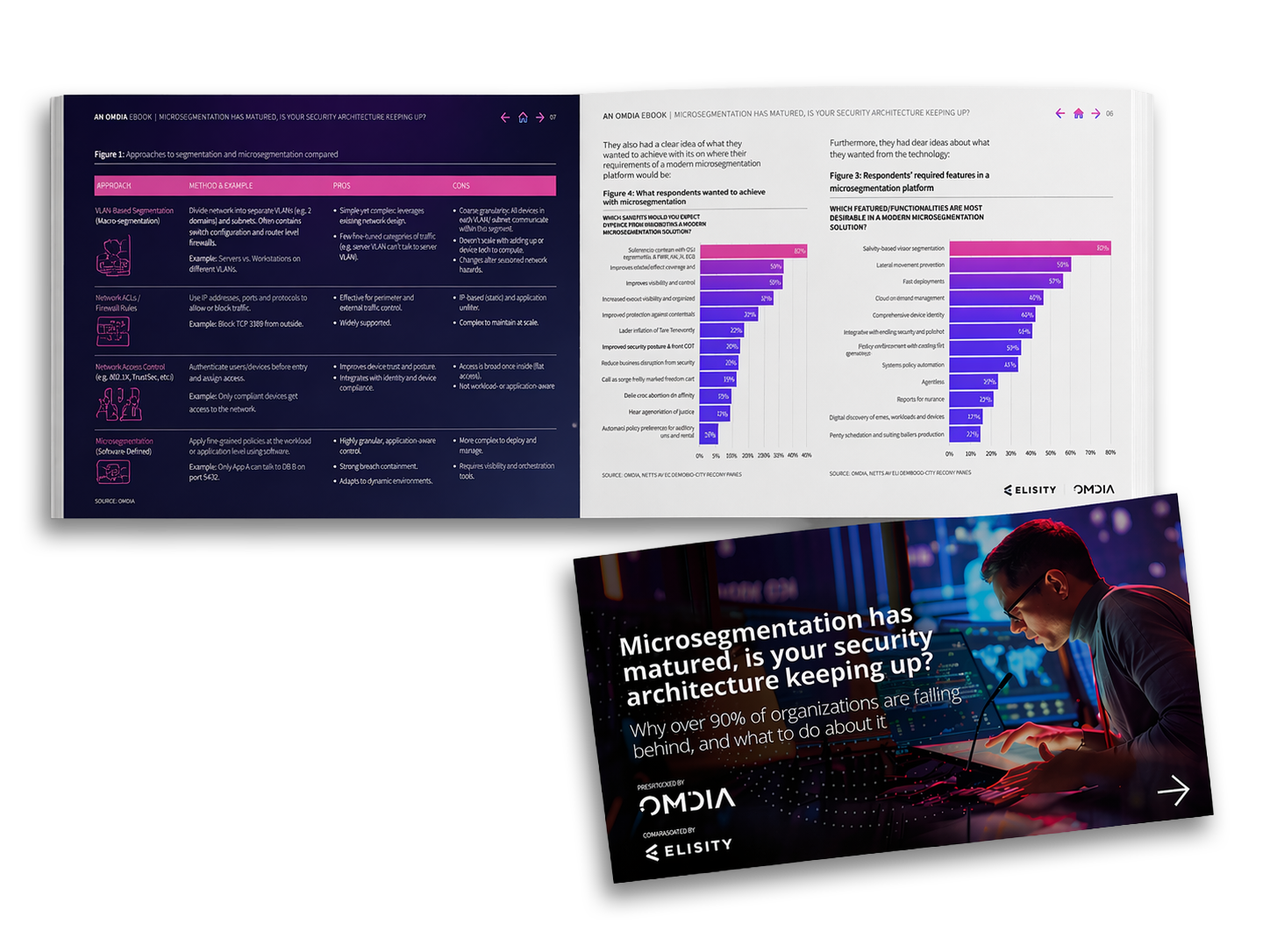
The State of Microsegmentation
Comparison
VLAN vs Microsegmentation: How Segmentation Approaches Compare
Legacy Solutions
VLAN-Based Segmentation ("Macro-segmentation")
- Pro: Simple yet complex. Leverages network infrastructure and existing network design.
Con: Coarse granularity: All devices in a VLAN can still reach each other unrestricted allowing lateral movement within the segment.
Network ACLs / Firewall Rules
- Pro: Wide support: All enterprise-grade networks support ACLs or firewall rules.
Con: Very much requires people resources and expertise: ACLs must be manually written and updated, which is error-prone and doesn’t adapt to dynamic networks.
Network Access Control (NAC)
- Pro: Pre-connect control: Blocks or isolates unknown devices at network entry.
Con: Often provides macro-segmentation (by groups like employees vs guests) rather than per-workload microsegmentation.
First Gen Microsegmentation
Agent-Based Microsegmentation
Pro: Granular, real-time control: Can enforce at the process/application level (Layer 7).
Con: Requires deploying and managing software on every protected workload – which can be operationally heavy for organizations with thousands of servers, and impossible for devices that don’t support agents (e.g. most IoT/OT gear).
Modern Microsegmentation
Identity-Based Microsegmentation
- Pro: No agents to install: Ideal for devices where agents aren’t feasible (IoT, OT, IoMT, printers, SCADA PLCs, older OS). Makes deployment easier in environments with diverse devices. . Leverages network infrastructure and existing network design.
Con: Limited visibility into encrypted or host-internal traffic: Agentless approaches often act on network headers. They might not see process-level info or be able to differentiate traffic once it’s encrypted end-to-end.
The Data
Doesn’t Lie.
Microsegmentation is no longer an awareness problem, it’s a scale problem: organizations understand it and know they need it, but very few are getting it across most of their critical environment.
This report cuts through vendor noise and delivers peer-level intelligence about where enterprise security teams actually stand.
Familiarity & Expectation of Microsegmentation
9%
51%
Key Insight: The Microsegmentation Gap is Real
Omdia found that only 9% of the 334 organizations running microsegmentation programs have 81% or more of their critical systems covered, which leaves over 90% falling behind. Microsegmentation is at the same time the initiative those security leaders most often prioritize to stop lateral movement, named by 57% of all 352 respondents. The intent is not the constraint. Coverage is.
Which features/functionalities are most desirable in a modern microsegmentation solution?
Identity-based microsegmentation
69%
Lateral movement prevention
54%
Fast deployments
51%
Cloud-delivered management
48%
Comprehensive device visibility
44%
Integrations with existing security and tech stack
41%
Policy enforcement with existing infrastructure
39%
Dynamic policy automation
36%
Agentless
26%
Reports for auditors
25%
Rapid discovery of users, workloads and devices
23%
Policy simulation and testing before production
21%
Which benefits would you expect to experience from implementing amodern microsegmentation solution?
Enhanced compliance with industry regulations (e.g., HIPAA, NIST, PCI DSS
45%
Improves attack surface coverage area
37%
Improves visibility and context
33%
Increased network visibility and operational efficiency
31%
Improved protection against ransomware and lateral movement attacks
29%
Easier enforcement of Zero Trust security principles
28%
Improved security posture for IT and OT environments
24%
Reduced business disruption from security initiatives
21%
Cost savings from reduced breach risk and downtime
15%
Enhances automation and efficiency
13%
Faster implementation of solution
11%
Automated policy enforcement and reduced manual workload
10%
Key Insight: Microsegmentation is the Top-priority, and Biggest Blocker
Identity-based microsegmentation is the single most desired capability in a modern microsegmentation solution, named by 69% of the 352 security leaders Omdia surveyed. It outranks lateral movement prevention at 54% and fast deployment at 51% by a wide margin.
Enabling a Zero trust Strategy
What are the primary business drivers for your organization’s microsegmentation initiative?
Network segmentation as part of a Zero Trust strategy
68%
Regulatory compliance (e.g. NIST, HIPAA, PCI DSS, etc.)
60%
Risk reduction from ransomware and lateral movement attacks
54%
Improved operational efficiency and security visibility
47%
Vendor requirements or industry standards
44%
Cyber insurance requirements
32%
Which user types require special consideration in your segmentation strategy?
Manufacturing
Equipment vendors
41%
Healthcare
Visiting clinicians
74%
Key Insight: Zero Trust Intent Isn’t Matching Zero Trust Action
68% of the 334 organizations running a microsegmentation program name a Zero Trust strategy as the primary driver, the top answer to that question. Yet when Omdia asked all 352 respondents which Zero Trust initiatives they have actually implemented, microsegmentation of critical applications and systems came in at 24%, far behind multi-factor authentication at 76%, endpoint and extended detection and response at 70%, and identity and access management at 64%. The intent is there. The execution is not.
"It took us 6 months to fully segment an entire site [with legacy segmentation approaches]. Multiply that by 75 sites, the time to value and the time to secure becomes elongated. And I think we all know that in cybersecurity, time is the enemy."
Mike Elmore
CISO, GSK
Preventing Lateral Movement
5
0 1 2 3 4 5
7
0 1 2 3 4 5 6 7 8 9 0 1 2 3 4 5 6 7
%
5
0 1 2 3 4 5
3
0 1 2 3 4 5 6 7 8 9 0 1 2 3
%
Which of the following Zero Trust initiatives has your organization implemented?
Multi-factor authentication (MFA
76%
Endpoint detection and response (EDR)/extended detection and response (XDR)
70%
Identity and access management (IAM)
64%
Zero Trust security for third-party / vendor access
55%
Cloud security posture management (CSPM)
49%
Continuous authentication and monitoring
48%
Secure access service edge (SASE)
41%
Secure remote access (e.g. ZTNA, VPN alternatives)
40%
Least-privilege access controls
36%
Network access control (NAC)
29%
Microsegmentation of critical applications / systems
24%
Software-defined perimeter (SDP)
20%
Key Insight: What’s The Hold Up? Legacy Solutions.
Nearly 50% of the organizations Omdia surveyed experienced an incident involving lateral movement in the past year. Most are still defending against it with methods built for a different era: 64% use or plan to use VLANs, 49% access control lists, 47% host-based firewalls, and 42% network access control. Only 22% of those security leaders describe themselves as very familiar with modern microsegmentation, so most teams have not yet worked with the agentless, identity-based approach that removes the hard part.
Segmentation is One Piece of the Puzzle
Which tools must your segmentation tool integrate with?
SIEM
67%
EDR
54%
SOAR platforms
49%
Identity
43%
Network/Infrastructure security
40%
Asset management
38%
CMDB
28%
Others
3%
Microsegmentation is Not Widely Used
What types of network segmentation methods does your organization currently use or plan to use?
1
0 1
9
0 1 2 3 4 5 6 7 8 9 0 1 2 3 4 5 6 7 8 9
%
1
0 1
6
0 1 2 3 4 5 6 7 8 9 0 1 2 3 4 5 6
%
How familiar are you with modern microsegmentation solutions?
5%
Not familiar at all
5% of the 352 security leaders Omdia surveyed had never heard of modern microsegmentation solutions.
31%
Slightly familiar
31% of the 352 security leaders Omdia surveyed had heard of modern microsegmentation solutions but knew little about them.
42%
Moderately familiar
42% of the 352 security leaders Omdia surveyed understood modern microsegmentation conceptually but had never worked with it directly.
22%
Very familiar
22% of the 352 security leaders Omdia surveyed had hands-on experience or in-depth knowledge of modern microsegmentation solutions.
Key Insight: Organizations Are Stuck on Legacy Methods
Organizations still rely primarily on traditional segmentation, with 64% of the 352 Omdia respondents using or planning VLANs, 49% access control lists, and 47% host-based firewalls. The two methods in the study that genuinely qualify as microsegmentation trail far behind at 19% for fabric overlay and 16% for agent-based. Familiarity is the constraint underneath the numbers, since only 22% of respondents report being very familiar with modern microsegmentation. The need is growing faster than readiness to adopt.
How was the Omdia microsegmentation survey conducted?
The research on this page comes from Microsegmentation Has Matured, Is Your Security Architecture Keeping Up?, an eBook researched and written by Omdia and commissioned by Elisity. Omdia is a technology research firm formed from the research division of Informa TechTarget and the acquired IHS Markit technology research portfolio.
Omdia surveyed 352 cybersecurity decision makers in 2025 and published the findings in 2026. Every respondent worked at a United States organization with 1,000 or more employees. The sample was split evenly by sector, with 50% in healthcare and 50% in manufacturing. Omdia records that second group as manufacturing, construction, and materials.
By organization size, 32% of the 352 respondents worked at companies of 1,000 to 2,499 employees, 26% at 2,500 to 4,999 employees, 21% at 5,000 to 9,999 employees, and 22% at organizations of 10,000 or more employees. By function, 54% sat in cybersecurity, 37% in IT, and 9% in operations. By seniority, 14% were C-level executives, 22% vice presidents, 38% directors, and 26% managers.
Two base sizes appear throughout the Omdia findings. Questions answered by the full sample carry a base of 352 cybersecurity decision makers. Questions asked only of organizations currently implementing or expanding a microsegmentation program carry a base of 334. The headline coverage finding, that only 9% have 81% or more of their critical systems microsegmented, is drawn from that base of 334.
Omdia asked respondents what percentage of their critical systems, applications, and networks have been or are planned to be successfully microsegmented. Of the 334 who answered, 3% reported no coverage, 21% reported 1 to 20% coverage, 40% reported 21 to 50% coverage, 28% reported 51 to 80% coverage, and 9% reported 81 to 100% coverage.
Omdia states the finding this way: “Only 9% report that 81% or more of their critical systems are microsegmented, leaving over 90% of organizations falling behind on microsegmentation efforts.”
The Omdia survey findings in full
Which features are most desirable in a modern microsegmentation solution?
Omdia asked all 352 security leaders which features are most desirable in a modern microsegmentation solution. Identity-based microsegmentation led at 69%, followed by lateral movement prevention at 54%, fast deployments at 51%, cloud-delivered management at 48%, and comprehensive device visibility at 44%. Integrations with the existing security and technology stack were named by 41%, policy enforcement using existing infrastructure by 39%, dynamic policy automation by 36%, agentless operation by 26%, reports for auditors by 25%, rapid discovery of users, workloads, and devices by 23%, and policy simulation and testing before production by 21%.
Which benefits do security leaders expect from microsegmentation?
Omdia asked all 352 security leaders which benefits they would expect from implementing a modern microsegmentation solution. Enhanced compliance with industry regulations such as HIPAA, NIST, and PCI DSS led at 45%, followed by improved attack surface coverage at 37%, better visibility and context at 33%, increased network visibility and operational efficiency at 31%, and improved protection against ransomware and lateral movement attacks at 29%. Easier enforcement of Zero Trust principles was named by 28%, improved security posture across IT and OT by 24%, reduced business disruption by 21%, cost savings from reduced breach risk and downtime by 15%, automation and efficiency gains by 13%, faster implementation by 11%, and automated policy enforcement with reduced manual workload by 10%.
What is driving microsegmentation initiatives?
Omdia asked the 334 organizations currently implementing or expanding microsegmentation what is driving the initiative. Network segmentation as part of a Zero Trust strategy led at 68%, followed by regulatory compliance with frameworks such as NIST, HIPAA, and PCI DSS at 60%, risk reduction from ransomware and lateral movement attacks at 54%, improved operational efficiency and security visibility at 47%, vendor requirements or industry standards at 44%, and cyber insurance requirements at 32%.
Which user types require special consideration?
Omdia asked which user types require special consideration in a segmentation strategy, and the answers diverge sharply by sector. Among the 164 healthcare respondents, visiting clinicians ranked first at 74% and clinical staff second at 72%. Among the 170 manufacturing respondents, remote engineers ranked first at 70%, manufacturing operators second at 58%, and equipment vendors third at 41%. Omdia also found that the device challenges differ by sector, with building management systems and industrial control systems hardest to segment in manufacturing and patient monitoring systems and IoMT hardest in healthcare, while remote access terminals rank third in both.
Which initiatives are prioritized to stop lateral movement?
Omdia asked all 352 security leaders which initiatives they are prioritizing to mitigate lateral movement risk. Microsegmentation ranked first at 57%, ahead of Secure Access Service Edge at 53%, enhanced endpoint security at 48%, Zero Trust architecture at 46%, identity-based access restrictions at 41%, extended detection and response at 39%, network access control at 31%, privileged access management at 29%, security tooling consolidation at 26%, user and entity behavior analytics at 24%, and deception technology at 16%.
Which Zero Trust initiatives have organizations actually implemented?
Omdia asked all 352 security leaders which Zero Trust initiatives their organization has actually implemented. Multi-factor authentication led at 76%, followed by endpoint and extended detection and response at 70%, identity and access management at 64%, Zero Trust security for third-party and vendor access at 55%, cloud security posture management at 49%, continuous authentication and monitoring at 48%, Secure Access Service Edge at 41%, secure remote access at 40%, least-privilege access controls at 36%, and network access control at 29%. Microsegmentation of critical applications and systems ranked near the bottom at 24%, just above software-defined perimeter at 20%. Omdia notes that both secure remote access and least-privilege access control score higher than microsegmentation. The gap between the 68% of the 334 organizations running a program who name Zero Trust as their driver and the 24% of all 352 who have deployed microsegmentation is the central say-do gap in the Omdia data.
Which tools must a segmentation platform integrate with?
Omdia asked the 334 organizations currently implementing or expanding microsegmentation which tools their segmentation platform must integrate with. SIEM led at 67%, followed by EDR at 54%, SOAR platforms at 49%, identity systems at 43%, network and infrastructure security at 40%, asset management at 38%, CMDB at 28%, and other tools at 3%. Omdia notes that integration is the single biggest challenge healthcare organizations report with previous microsegmentation efforts, cited by more than 50% of healthcare respondents, and the second biggest for manufacturing.
Which network segmentation methods are organizations using?
Omdia asked all 352 security leaders which network segmentation methods their organization currently uses or plans to use. VLANs led at 64%, followed by cloud-based segmentation at 57%, network-based segmentation at 55%, access control lists at 49%, host-based firewalls at 47%, and network access control at 42%. Only two of the methods offered qualify as microsegmentation, and both score poorly: fabric overlay segmentation is in place at 19% of organizations and agent-based segmentation at 16%.
How familiar are security leaders with modern microsegmentation?
Omdia asked all 352 security leaders how familiar they are with modern microsegmentation solutions. 22% described themselves as very familiar with hands-on experience or in-depth knowledge, 42% as moderately familiar in concept but without direct experience, 31% as slightly familiar having heard of them, and 5% as not familiar at all. Omdia’s reading is that roughly three quarters of the market has not worked with this generation of the technology, which it attributes partly to the operational burden of first-generation tools and partly to low awareness of what is now available.
Frequently Asked Questions About the Omdia 2026 Microsegmentation Report
The Omdia 2026 Microsegmentation Survey is independent research measuring microsegmentation programs across 352 cybersecurity decision-makers at organizations with 1,000+ employees in healthcare and manufacturing. It covers current segmentation approaches (VLANs, ACLs, NAC, agent-based, identity-based), microsegmentation coverage rates, Zero Trust alignment, deployment timelines, and the capabilities security leaders prioritize most in modern solutions. The report is vendor-agnostic peer-benchmark data, not a vendor evaluation.
The Omdia data points to three converging blockers. First, legacy infrastructure dependence: 64% still rely on VLANs, 49% on ACLs, and 47% on host-based firewalls, tools that weren’t built for modern east-west traffic. Second, a familiarity gap: only 22% of respondents report being "very familiar" with modern microsegmentation approaches, meaning most teams don’t know that agentless, identity-based options now exist. Third, project scope: traditional approaches require months or years to deploy, and 51% of security leaders now demand fast segmentation, making legacy rollouts a non-starter.
Omdia’s survey measured microsegmentation programs across 352 organizations with 1,000+ employees in healthcare and manufacturing. The full report includes peer-benchmark scoring on coverage (9% at 81% or more), familiarity (22% "very familiar"), lateral-movement exposure (50% hit in the past year), and segmentation approach mix (64% VLAN / 49% ACL / 42% NAC / 16% agent-based / 19% fabric overlay). Download the report to see the detailed scoring methodology.
The Forrester Wave evaluates microsegmentation vendors. Gartner Cool Vendors identifies emerging providers. Omdia’s 2026 Microsegmentation Survey is different: it’s a peer-benchmark of organizations, showing you what your counterparts are actually doing, where they’re stalling, and what they’re prioritizing next. It’s research for buyers, not about vendors.
What now? Make modern microsegmentation solutions work for you.
Microsegmentation is now the #1 initiative to stop lateral movement. Modern, identity-based, agentless solutions can be deployed in days, not years, with no downtime. The message is clear: evolve your Zero Trust architecture now, or stay exposed. But where do you start?

Identify the Right Platform
Demand unified user and device discovery, policy creation, simulation, and enforcement on existing infrastructure, with audit-ready reporting.

Implement in Weeks
Discover, simulate, enforce at the network edge. Tackle high-impact zones first, then expand and report coverage, accuracy, and blocked east-west.

Run a POV
Run a POV on real segments, include remote / third-party access, and measure time-to-visibility, time-to-policy, and lateral-movement containment.