


Risk-Based OT Vulnerability Management for Industrial Microsegmentation
Dragos discovers industrial assets passively and correlates each one with the CVEs and threat activity that actually matter. Elisity turns that risk context into identity-based microsegmentation policy, enforced through the network infrastructure you already own. Together they contain unpatchable OT devices without active scanning, re-IPing, or new hardware.
Support Documentation
Connect Dragos
Step-by-step guide to connecting the Dragos Platform to Elisity IdentityGraph using API credentials in the Elisity Cloud Control Center.
Dragos Classification Details
Review the Dragos asset classification attributes, vulnerability fields, and risk levels Elisity uses to build and adjust policy.
Challenge
Incomplete OT Asset Visibility and Vulnerability Correlation
An engineering workstation, a Siemens S7 controller, and a serial-to-Ethernet gateway can all sit on the same flat process subnet, and most inventories describe all three the same way: an IP address and a MAC prefix. That does not answer the question an OT security team actually has, which is whether a specific controller carries a vulnerability an adversary can reach. Active scanning is not a safe way to find out. Unexpected probe traffic sent to a controller running a decades-old stack can drop it, and in a plant that means lost batches, a safety hold, and a very short conversation with operations. So teams end up holding two incomplete pictures: an inventory that cannot say what a device is, and a vulnerability feed with no idea which of those devices exist on the plant floor. Neither one supports a segmentation policy anyone will sign off on. See how network asset discovery closes that gap.
Elisity Solution
Dragos Asset Intelligence and CVE Correlation Enrich Elisity IdentityGraph
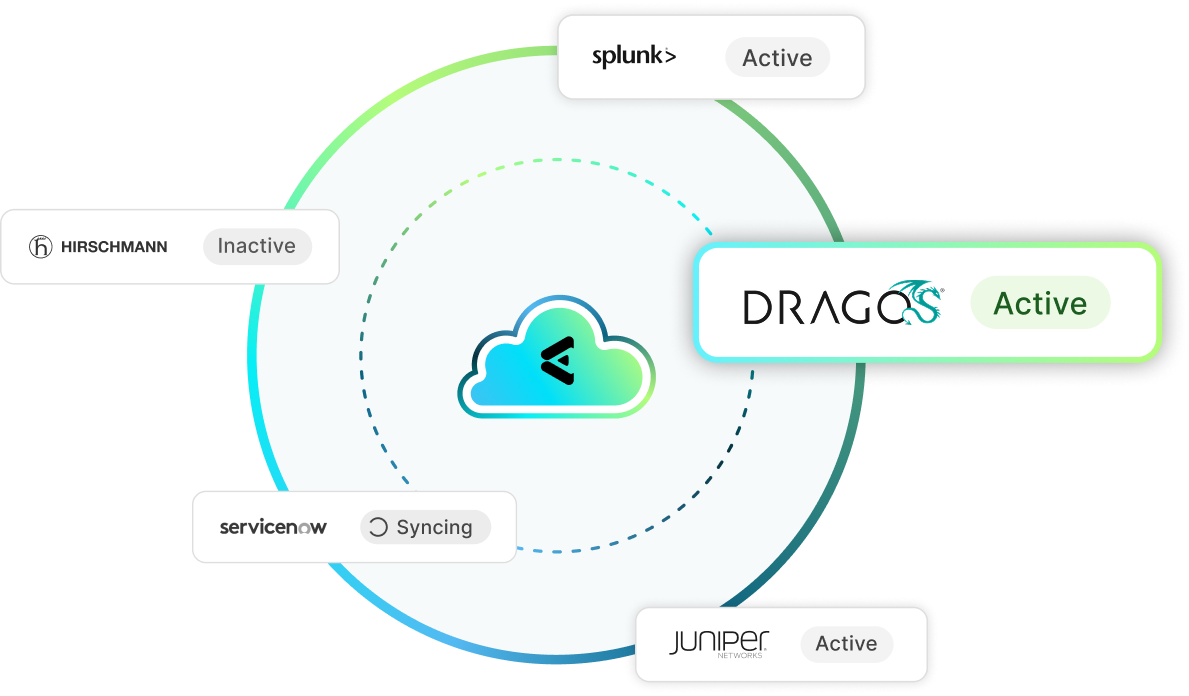
Dragos establishes what each industrial asset is, and Elisity uses that to decide what it is allowed to reach. The Dragos Platform discovers assets passively through native ICS protocol analysis across Modbus TCP, DNP3, EtherNet/IP, PROFINET, OPC UA, and S7comm, profiling device type, vendor, model, and firmware without sending a probe packet. Dragos then correlates each profile with the CVEs that apply to it and assigns a severity and a risk level. That complete record, asset identity plus vulnerability context, flows into Elisity IdentityGraph™ over an API connection you configure in the Elisity Cloud Control Center. IdentityGraph aggregates it with the other identity sources you already run, and Elisity classifies each asset into a Policy Group automatically. The outcome is a segmentation policy written against what a device is and what it is exposed to, rather than against the VLAN it happened to be assigned years ago.
Challenge
Managing OT Vulnerabilities Without Operational Disruption
Patching is the recommended fix and it is frequently the one thing you cannot do. A large share of ICS advisories arrive with no vendor patch available. Others carry a patch only the equipment vendor is permitted to apply, or one that voids a safety certification, or one that needs a validated change window you get twice a year. Meanwhile the vulnerability is still there, and so is the controller, and so is the flat network that lets a compromised jump host talk to it. Traditional segmentation projects promise a way out, but re-IPing a plant or rebuilding a VLAN scheme is a multi-year program carrying production risk of its own. What industrial teams need is a mitigation they can apply this quarter, at the network layer, without touching the asset, taking it offline, or waiting on a vendor for permission.
Elisity Solution
Now, Next, Never Prioritization Drives Dynamic Microsegmentation Policy
Elisity turns the Dragos Now, Next, Never framework into enforcement. Dragos rates each vulnerability against operational reality instead of CVSS score alone: Now for issues that demand immediate action because they are both exploitable and reachable in your environment, Next for issues to handle on the normal maintenance cycle, and Never for issues with no realistic operational impact that should not consume a change window. Those risk levels arrive in Elisity IdentityGraph alongside the asset profile. When an asset moves into the Now category, Elisity tightens the Policy Group around it, narrowing permitted flows to the specific peers and protocols the process actually requires and denying the rest. Nothing is installed on the asset and nothing is rebooted. Segmentation becomes the compensating control that holds the line while a patch waits for a maintenance window, or indefinitely, if the vendor never ships one.
Challenge
Prioritizing OT Risk When CVSS Scores Miss Operational Context
A CVSS 9.8 on a historian in the industrial DMZ and a CVSS 9.8 on a safety-instrumented controller are not the same problem, yet a spreadsheet sorted by score treats them identically. CVSS describes a vulnerability in the abstract. It does not know that one asset sits three hops from a corporate jump host while the other sits behind a conduit no external traffic reaches, and it has no view of which flows the process genuinely requires. So teams open the report, see several thousand findings, and stall, because there is no defensible way to choose the first twenty. The deeper problem is that the risk that matters most in industrial environments is rarely the individual CVE. It is lateral movement: an adversary landing in IT, pivoting through a shared service, and arriving in the process network with valid credentials and native protocols.
Elisity Solution
Automated Vulnerability Tracking and Lateral Movement Prevention
Elisity Cloud Control Center gives security, operations, and engineering one place to track an OT vulnerability from discovery through containment. Dragos network mapping exposes the paths an attacker could take between zones, and Elisity closes the ones the process does not need. Enforcement happens through the network infrastructure you already own, at the access layer, with no agents on the asset, no re-IPing, and no new hardware on the plant floor. Policy Groups update automatically as Dragos reclassifies an asset or revises its risk level, so a controller that becomes exposed is contained without waiting on a manual ticket. Every allow and deny is recorded against the asset identity, which is exactly the evidence an IEC 62443 zone and conduit assessment asks you to produce. Explore lateral movement prevention for industrial networks.
Explore Our Integrations
Elisity integrates with leading IT, OT, and IoT asset intelligence platforms. Combine deep device discovery and classification with identity-based microsegmentation enforced through your existing network infrastructure.
Device Intelligence / Risk Status
EDR / Risk Status
CMDB
Network Enforcement Point
User Identity / Device Metadata
SIEM
Dragos + Elisity Integration FAQ
Common questions about how the Dragos Platform integrates with Elisity to deliver risk-based OT vulnerability prioritization and identity-based microsegmentation across industrial networks.
The Dragos Platform passively discovers and profiles every asset on an industrial network using native ICS protocol analysis, then correlates each profile with known CVEs and assigns a severity and risk level. You connect Dragos to Elisity by entering API credentials in the Elisity Cloud Control Center, which takes minutes. Dragos asset intelligence and vulnerability context then flow into Elisity IdentityGraph, where Elisity classifies each asset into a Policy Group and enforces least-privilege access through the network infrastructure you already own. No agents are installed on OT assets and no active scanning is required.
No. Both halves of the integration are agentless and passive. Dragos discovers and classifies assets by analyzing network traffic rather than probing endpoints, which matters because active scans can disrupt controllers running legacy stacks. Elisity enforces microsegmentation through your existing network infrastructure, so nothing is installed on the PLC, HMI, historian, or engineering workstation being protected. That architecture is what makes the integration usable on insecure-by-design equipment, devices under vendor support restrictions, and assets carrying safety certifications that prohibit software changes.
Now, Next, Never is the Dragos approach to prioritizing OT vulnerabilities by operational risk rather than CVSS score alone. Now marks issues that require immediate action because they are both exploitable and reachable in your environment. Next marks issues to address on the normal maintenance cycle. Never marks issues with no realistic operational impact, which should not consume a change window. Elisity ingests those risk levels through IdentityGraph and adjusts policy accordingly, tightening the Policy Group around a Now asset so its permitted flows shrink to only the peers and protocols the process requires.
Yes, and in many industrial environments it is the only control available. A large share of ICS advisories ship without a vendor patch, and many others cannot be applied without vendor involvement, a validated change window, or a safety recertification. Identity-based microsegmentation reduces exposure instead of removing the flaw: Elisity restricts a vulnerable asset to the specific peers and protocols its process requires, so an unpatched controller is no longer reachable from a compromised jump host. This maps directly to the zone and conduit model in IEC 62443 and supports NIST CSF and NERC CIP programs.
The API connection itself takes minutes: enter your Dragos credentials in the Elisity Cloud Control Center and asset and vulnerability data begins enriching IdentityGraph immediately. From there, most organizations move from connection to enforced microsegmentation policy in weeks rather than the multi-year timeline a VLAN redesign or re-IP project demands, because Elisity builds Policy Groups from the Dragos classifications instead of a hand-built inventory. Policies can be reviewed in simulation before enforcement, so teams see exactly what would be allowed or denied before anything changes on the plant floor.
Resources

Living Off the Land Attacks in OT: The Microsegmentation Fix

AI Agents in OT Security: What S4x26 Revealed for 2026