


.svg)
.png)




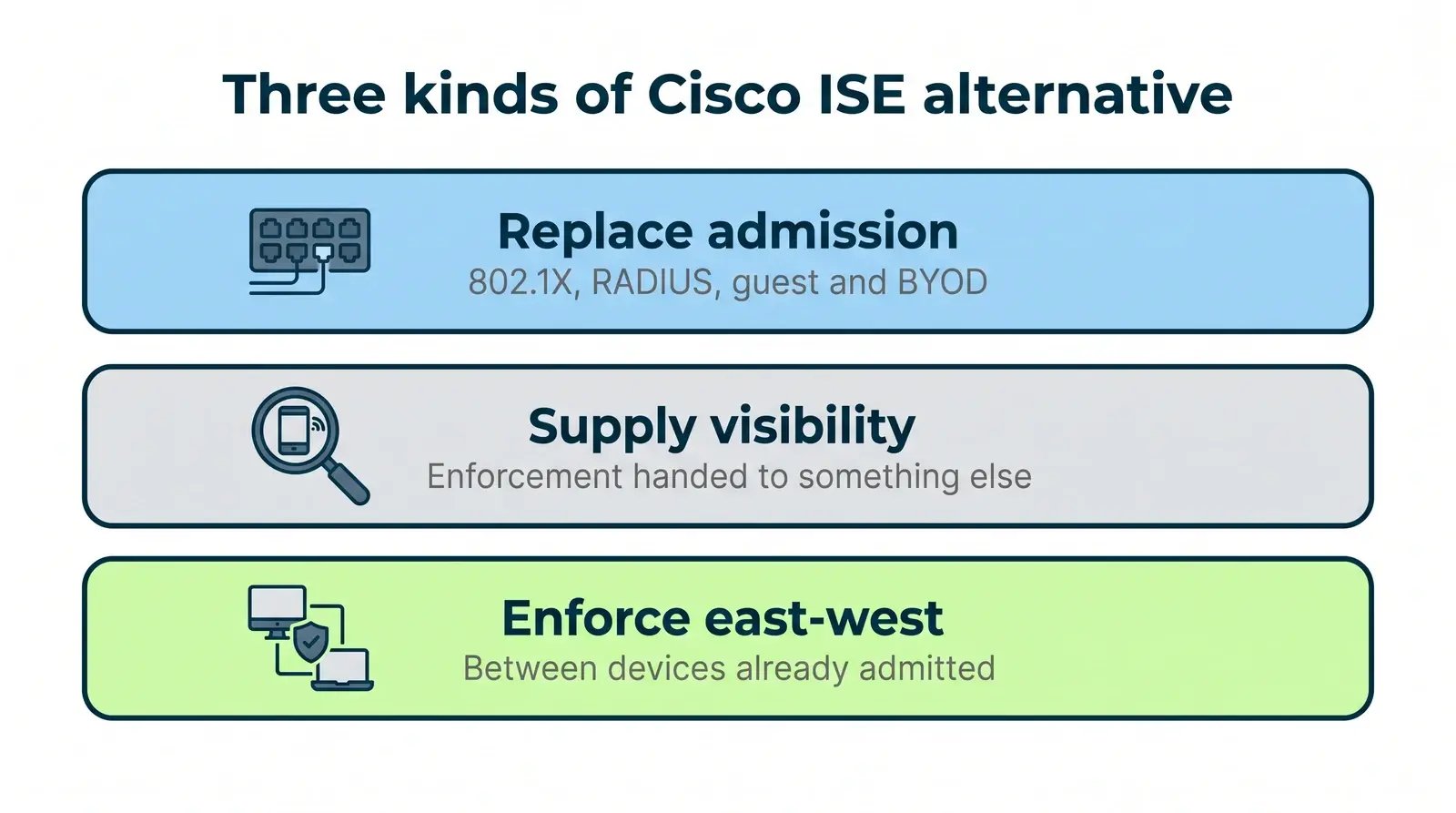
Short answer. Cisco ISE alternatives sort by which control you are replacing. ClearPass, FortiNAC, Portnox, Forescout, Mist Access Assurance and PacketFence replace admission: 802.1X, RADIUS, guest and BYOD. Elisity and Zero Networks replace the segmentation half of ISE, the control ISE hands to TrustSec tags, VLANs and ACLs. Elisity enforces that policy with no agents on existing Cisco, Arista, Juniper, HPE Aruba and Hirschmann switches, alongside 802.1X admission.
Every capability statement on this page, including every statement about Elisity, is drawn from the named vendor’s own current public documentation, and third-party sources are named and attributed where they are used. Elisity is scored in the same columns, on the same criteria, as every other product listed, including the functions Elisity does not perform. For the category boundary behind the split above, see network access control versus microsegmentation, compared dimension by dimension. Last updated .
What are the best Cisco ISE alternatives in 2026?
The phrase covers three different products, and the shortlist you want depends on which one you mean. Cisco ISE bundles admission control, device administration and segmentation policy into a single platform, so replacing it is rarely a one-for-one swap. Sorting candidates by what actually performs the enforcement is the fastest way to a real shortlist, and it is the same test applied on the microsegmentation pillar and in the Forescout alternatives comparison.
Cisco ISE alternatives that perform admission control
These decide whether a device is allowed onto the network at all. They terminate 802.1X, answer RADIUS, and in most cases carry the guest, BYOD and posture workflows that come with an ISE deployment.
- HPE Aruba ClearPass Policy Manager. The usual head-to-head competitor in ISE bake-offs. Aruba documents 802.1X, RADIUS and RadSec, TACACS+ device administration, device profiling, posture and guest and BYOD onboarding across multivendor infrastructure. Note that HPE now owns two network access control lines following the Juniper acquisition, so a multiyear commitment is worth testing against a stated roadmap.
- Fortinet FortiNAC. Documented network access control with visibility, automated response and integration into the Fortinet Security Fabric. Strongest where Fortinet is already the security platform of record.
- Portnox Cloud. SaaS-delivered network access control with published pricing. Note that its TACACS+ service runs as a local server on a customer-hosted VM or container, so device administration is not fully cloud-delivered.
- Juniper Mist Access Assurance. Cloud-native microservices access control with RadSec, aimed at Juniper and Mist estates.
- Extreme Networks ExtremeControl. Access control and policy enforcement aligned to Extreme infrastructure.
- Genians Genian NAC and macmon NAC (acquired by Belden in 2022). Smaller vendors that appear consistently on published network access control shortlists.
- Ivanti Policy Secure. Network access control, actively shipping, with a smaller installed base than the leading three.
- PacketFence. Open source access control with 802.1X, captive portal and device registration. You own deployment, integration and upgrades.
- Microsoft NPS and FreeRADIUS. RADIUS and 802.1X authentication only. Neither supplies ISE’s profiling, posture, guest lifecycle or policy orchestration, and treating either as a full ISE replacement is the most common scoping error on this list.
Cisco ISE alternatives that supply visibility and hand enforcement to something else
These classify what is on the network to a depth ISE does not reach, particularly for unmanaged, clinical and industrial devices. They do not themselves sit in the traffic path, and the enforcement action is executed by a switch, a firewall or a network access control platform they instruct.
- Forescout. Agentless discovery and classification across IT, IoT, OT and medical devices, with enforcement actions carried out through integrated infrastructure. The platform was renamed from Forescout 4D Platform to Forescout Vistaro on June 24, 2026.
- Armis Centrix. Asset intelligence for unmanaged and cyber-physical devices, with enforcement delegated to other controls. ServiceNow closed its acquisition of Armis on April 20, 2026, so the same roadmap question that applies to ClearPass under HPE applies here.
Cisco ISE alternatives that enforce east-west traffic between admitted devices
These replace the segmentation function of Cisco ISE, the control ISE hands to Security Group Tags, VLANs and access control lists, and leave the authentication and classification layers in place. They address what happens after a device is admitted.
- Elisity. Replaces the segmentation function of a Cisco ISE deployment, the TrustSec tag, VLAN and ACL policy layer, with identity-based microsegmentation enforced on existing access-layer switches, no agents and no additional hardware in the traffic path. Elisity discovers and classifies devices itself from network telemetry, and enriches that record from 25+ external identity sources, so a separate visibility product is enrichment rather than a prerequisite. Scored against the wider field in top microsegmentation solutions.
- Zero Networks. Microsegmentation with automated policy generation and multifactor authentication applied to east-west traffic.
Table A. Cisco ISE alternatives, keyed on enforcement mechanism
| Product | Replaces which ISE function | What performs enforcement | 802.1X and RADIUS | TACACS+ device administration | Agent required |
|---|---|---|---|---|---|
| Cisco ISE (the incumbent) | Reference row | Switch, via dynamic VLAN, downloadable ACL or Security Group Tag | Yes | Yes | Optional posture agent |
| HPE Aruba ClearPass | Admission, device administration, guest and BYOD | Switch, via role, VLAN or ACL | Yes, including RadSec | Yes | Optional |
| Fortinet FortiNAC | Admission and visibility | Switch and Fortinet fabric | Yes | No. Fortinet provides it through FortiAuthenticator | Optional |
| Portnox Cloud | Admission, delivered as SaaS | Switch, via RADIUS response | Yes | Yes. Each plan bundles a capped allocation of TACACS+ admins and devices, and the service runs as a local server on a customer-hosted VM or container | Optional |
| Juniper Mist Access Assurance | Admission, cloud-delivered | Switch and Mist infrastructure | Yes, including RadSec | Not documented as a Mist Access Assurance function. Juniper describes TACACS and TACACS+ as legacy protocols | No |
| Extreme ExtremeControl | Admission and policy | Extreme switching | Yes | No. Extreme provides it through Site Engine, and client-side rather than server-side | Optional |
| PacketFence | Admission, open source | Switch, via VLAN or ACL | Yes | No | Optional. Onboarding agents ship |
| Microsoft NPS | RADIUS authentication only | Switch, via RADIUS response | Yes, RADIUS and 802.1X | No | No |
| FreeRADIUS | RADIUS authentication only | Switch, via RADIUS response | Yes, RADIUS and 802.1X | No. Pre-release 4.x only | No |
| Forescout | Visibility and classification, not admission | Integrated switch, firewall or NAC | Yes, via the RADIUS Base Module (plugin v4.8.6, April 2026) | No | Optional (SecureConnector) |
| Armis Centrix | Visibility and classification, not admission | Integrated enforcement point | No RADIUS or 802.1X. Armis does document VLAN and ACL zoning through integrations | No | No |
| Elisity | None of the admission functions. Replaces the east-west segmentation ISE delegates to SGTs, VLANs and ACLs, and performs its own device discovery and classification | The existing access-layer switch, programmed by the Elisity Virtual Edge | Does not authenticate 802.1X supplicants. On HPE Aruba CX only, from release 26.7.0, the Elisity Virtual Edge is the RADIUS server for MAC Authentication Bypass, on the 6200, 6300 and 6400 CX Series, of which only the 6300 is Elisity-validated | No | No |
| Zero Networks | East-west segmentation, not admission | Host firewall and network controls | No | No | Agentless for network enforcement |
Competitor cells reflect each vendor’s own product documentation as checked in August 2026, and name the product rather than the vendor: capabilities frequently live in a sibling product (Fortinet’s TACACS+ in FortiAuthenticator, Extreme’s in Site Engine). Where a cell reads “No,” it means we found no such capability documented for that product, not that the vendor has none. Re-verify against current documentation before making a shortlist decision.
Which Cisco ISE capability are you actually replacing?
Most failed ISE replacements are scoping failures rather than product failures. ISE is four products sold as one, and a shortlist assembled before the scope is settled will contain candidates that cannot do the job and exclude candidates that can.
Table B. The four jobs inside a Cisco ISE deployment
| The job | What ISE does | Where to look for a replacement |
|---|---|---|
| Admission | 802.1X, MAC Authentication Bypass, RADIUS, profiling, posture, guest and BYOD onboarding | ClearPass, FortiNAC, Portnox, Mist Access Assurance, ExtremeControl, PacketFence |
| Device administration | TACACS+ authentication and command authorization for network engineers logging into switches and routers | Of the products on this page, we found in-product TACACS+ device administration documented only for HPE Aruba ClearPass and Portnox Cloud, the latter as a separately licensed per-user module (checked August 2026). Fortinet provides it through FortiAuthenticator rather than FortiNAC, and Extreme through Site Engine. This is the requirement most often discovered late, and it eliminates several otherwise strong candidates |
| Classification | Device profiling to determine what an endpoint is | Forescout, Armis, Claroty, Nozomi, Ordr, or the classification built into the admission platform. Elisity classifies natively and consumes those systems as enrichment |
| Segmentation | Assigns a Security Group Tag at authentication, then relies on TrustSec, VLANs and ACLs to make the tag mean something | Elisity, Zero Networks, or a TrustSec rollout carried through to completion |
Inventory the Cisco-native dependencies before shortlisting anything. TACACS+ for device administration, TrustSec and Security Group Tags, pxGrid integrations, posture policy, guest portals and Catalyst Center or Meraki integration are each a separate commitment, and Cisco ISE combines all of them. Replacing it may take more than one product.
Why do organizations look for a Cisco ISE alternative?
The reasons cluster, and they point at different replacements.
- Licensing and total cost. Essentials, Advantage and Premier tiers, plus the appliance or virtual machine footprint, plus the operational staff to run it.
- Operational complexity. Policy sets, authorization profiles and identity source sequences accumulate, and few teams retain the people who designed them.
- Devices that cannot authenticate. Infusion pumps, imaging modalities, building management controllers and programmable logic controllers cannot run a supplicant. MAC Authentication Bypass admits them by MAC address, which is spoofable and says nothing about what the device may reach afterwards.
- Segmentation that never finished. This is the common one, and it is not a licensing problem. The authentication layer works. The tags are assigned. What did not happen is the part where every switch receives current tag mappings and the access control lists that make a tag enforceable.
What does Cisco ISE enforce, and what performs the enforcement?
ISE is a policy decision point. It does not sit in the traffic path, and it does not itself block a packet. It authenticates an endpoint and returns an authorization result to the switch: a dynamic VLAN assignment, a downloadable ACL, or a Security Group Tag. The switch performs the enforcement.
Cisco TrustSec is the framework that turns a Security Group Tag into a policy outcome. ISE assigns the tag at authentication and distributes IP-to-tag mappings, commonly using SGT Exchange Protocol where inline tagging is not available end to end. Every enforcement point then needs current mappings and the Security Group ACLs that define which tag may reach which tag.
That distribution problem is real and necessary work, and it is where TrustSec programs most often stall. Devices move, mappings go stale, and the tag on the wire stops matching the policy in the matrix. A device can be correctly identified, correctly admitted, and still reach every other device on its VLAN.
Is Elisity a Cisco ISE alternative, or a different control entirely?
Elisity replaces the segmentation half of a Cisco ISE deployment, the policy layer a TrustSec program is meant to deliver. It is not a replacement for device admission. Cisco ISE decides whether a device is allowed onto the network, using 802.1X, RADIUS, MAC Authentication Bypass and profiling. Elisity decides what that device may reach once it is on.
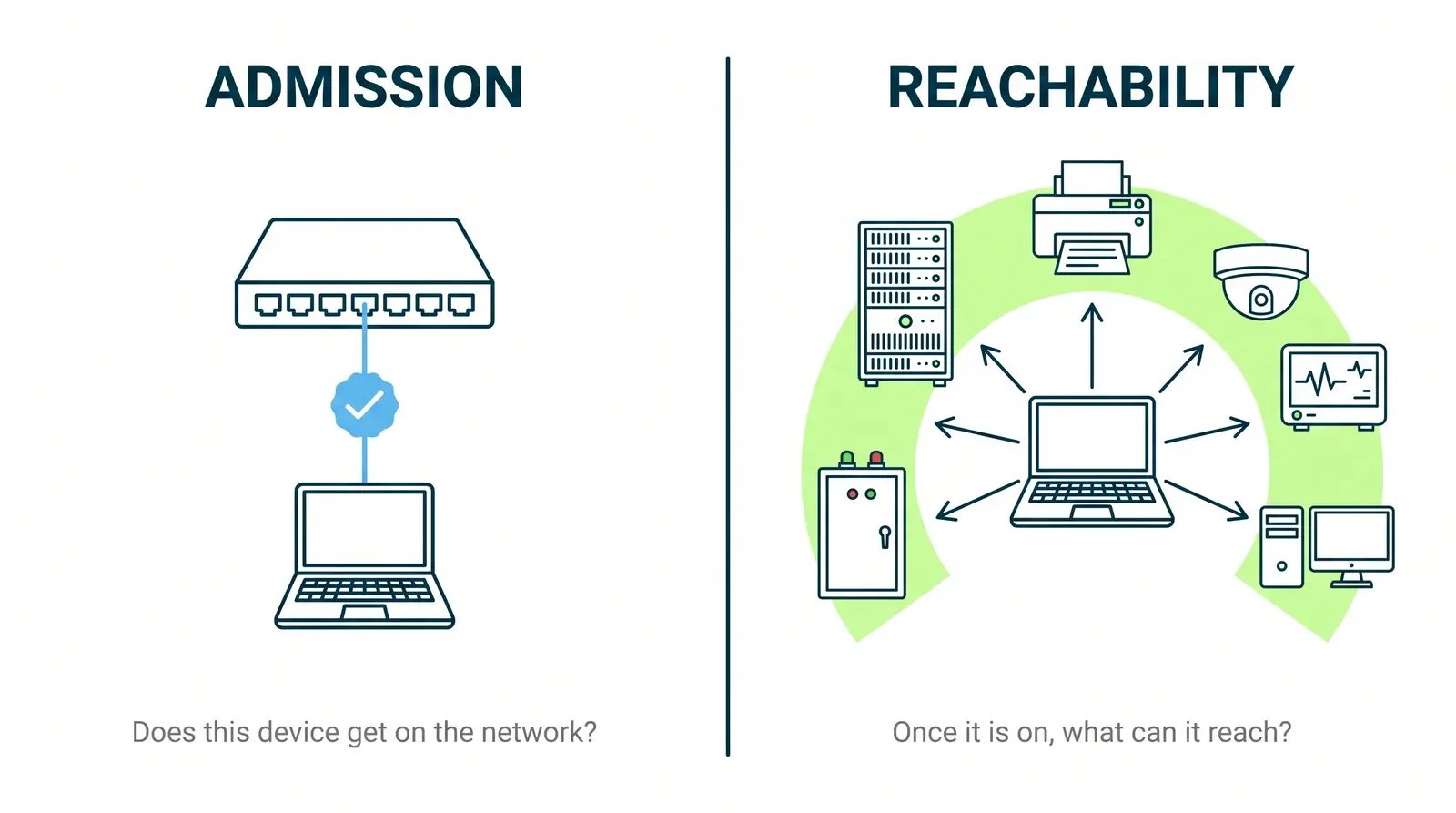
That is not a smaller problem than admission. It is the problem ISE leaves open by design, and it is the reason the segmentation half of a TrustSec program so often outlives the people who started it. Elisity enforces identity-based least-privilege policy on the Cisco Catalyst switches already deployed, programming the IP and tag mappings, policy access control lists, CTS commands and SXP peering that TrustSec uses, with no agents and no new hardware in the traffic path. It runs alongside an existing ISE deployment without changes to that configuration.
What Elisity does not do
Stated plainly, because the rest of this page is only useful if this part is accurate.
- No TACACS+ device administration. Elisity does not provide TACACS+ for network device login. The Elisity Virtual Edge’s own privilege-15 service account may be authenticated by your TACACS+ or RADIUS server, which is Elisity consuming your authentication service rather than providing one. If you need Cisco ISE for network device administration, this page does not cover that requirement.
- No 802.1X supplicant authentication. Elisity does not authenticate 802.1X supplicants and is not an admission control platform. Where 802.1X is already deployed, its authentication events become one more identity signal rather than something Elisity replaces.
- No guest or BYOD onboarding. No guest portal, no sponsor portal, no captive portal, no certificate provisioning and no supplicant configuration. Through the Microsoft Intune connector, a device’s Ownership attribute is available as a Policy Group match criterion, which segments a personally owned device rather than onboarding one.
- No posture assessment. Elisity runs no posture agent and applies no admission-time posture gate. It consumes posture attributes from endpoint detection and mobile device management platforms, including CrowdStrike, Microsoft Defender, Microsoft Intune and SentinelOne, and turns them into policy conditions.
- No Cisco ISE integration. Elisity does not consume Cisco ISE as an identity source. There is no pxGrid integration and no ISE connector, and Cisco ISE has no entry in Elisity’s published identity-source list (checked August 2026). One exception is worth stating precisely, because older Elisity material has described ingesting ISE classification data: where a switch already peers with ISE over SGT Exchange Protocol, Elisity can supply IP-to-SGT mappings into that TrustSec domain, which is Elisity producing mappings rather than consuming ISE identity. Confirm the current position with Elisity before relying on either reading. Some platforms on this page do document pxGrid integrations with ISE, Forescout and Armis among them; Fortinet consumes pxGrid through FortiManager rather than FortiNAC. For the rest we found no pxGrid integration in the vendor’s own documentation as of August 2026. Verify against your own deployment. Elisity’s published identity sources are Microsoft Active Directory and Microsoft Entra ID, alongside asset and endpoint systems including Armis, Claroty xDome, Claroty Medigate, Nozomi Networks, Dragos, Ordr, Asimily, Tenable One, Palo Alto Networks IoT Security, ServiceNow, NetBox, CrowdStrike, Microsoft Defender, Microsoft Intune and SentinelOne.
- No active scanning and no deep packet inspection. Discovery is passive rather than absent. Elisity natively discovers and classifies devices from MAC OUI analysis, DHCP fingerprinting, IP Device Tracking, CDP and LLDP, traffic flow telemetry and RDAP or WHOIS IP ownership data, then enriches that record from external identity sources. What it does not do is scan the network or inspect packet payloads.
What Elisity does on the RADIUS layer, and where
One qualification to the 802.1X boundary above, because it is specific, recent and narrowly scoped. On HPE Aruba CX switches, from Elisity release 26.7.0, the Elisity Virtual Edge acts as the switch’s RADIUS server for MAC Authentication Bypass. The platform scope is the HPE Aruba 6200, 6300 and 6400 CX Series; of those, only the 6300 Series is tested and validated by Elisity, and the 6200 and 6400 CX Series are listed as vendor-capable but not validated. Aruba CX nodes can only be managed by a Virtual Edge VM, not by a switch-hosted Virtual Edge, and Elisity does not manage them over the management VRF because AOS-CX cannot originate a RADIUS Change of Authorization from it. It receives MAC authentication requests on UDP 1812 and RADIUS accounting on UDP 1813, and issues a RADIUS Change of Authorization on UDP 3799 to move an endpoint into the role that matches its Policy Group. On the Cisco, Arista and Juniper enforcement paths, Elisity runs no RADIUS server, and RADIUS is instead one of the telemetry sources identity is drawn from. Elisity does not provide an enterprise 802.1X, wireless or VPN authentication service on any platform.
Source: Elisity Support, “Onboarding HPE Aruba CX Switches as Virtual Edge Nodes,” updated August 19, 2026.
Which switches does Elisity enforce on, and what happens if you leave Cisco?
This is the question a Cisco ISE operator asks about any segmentation product, and on this page it is also where the comparison turns. Elisity onboards existing access-layer switches as Virtual Edge Nodes, which are the policy enforcement points, across five switch vendors rather than one.
Table C. Switch platforms supported as Elisity Virtual Edge Nodes
| Vendor | Models supported as enforcement points | Minimum code | Validation and caveats |
|---|---|---|---|
| Cisco | Catalyst 9200, 9200CX, 9200L, 9300, 9300X, 9300L, 9350, 9400, 9500, 9600, 3850, 3650, IE3400, and the Catalyst 9800 Series Wireless Controller | 16.10.1 across most of the range. 9300X 17.15.1, 9350 17.18.1, IE3400 and 9800 WLC 17.9.4, 3850 and 3650 3.07.05E | Tested by Elisity QA. StackWise Virtual supported. 9500X and 9600X do not support flow telemetry collection. On the 9800 WLC, IOS XE 17.15.4 or newer is recommended for intra-SSID and intra-VLAN enforcement |
| Arista | CCS-720XP-48Y6-F, CCS-720XP-48ZC2-F, CCS-720XP-96ZC2, CCS-720DP (48S), CCS-722XPM-48ZY8, DCS-7050SX3-48YC8 and DCS-7010TX-48. Also CCS-720DF, CCS-720DT (excluding 720DT-24S), CCS-750, CCS-755, DCS-7010TX, DCS-7050CX3, DCS-7050SX3, DCS-7050TX3 and DCS-7300X3 | 4.30.3M | The second group is vendor-capable but not tested or validated by Elisity. The 7500R3, 7800R and 7280R3 need a specific TCAM template and are validated for lab use only, not recommended for production |
| Juniper | EX4100 and EX4400. Also QFX5120 (32C, 48Y) and EX4650 | 22.4R1 | Onboarded through Juniper Mist or by direct switch integration. The second group is not tested or validated by Elisity, and some platforms may not support simultaneous telemetry and policy enforcement because of hardware limits |
| HPE Aruba | 6300 Series, tested and validated. Also 6200 Series and 6400 CX Series | 10.11 or later, 6200 Series 10.15 | Managed only by a Virtual Edge VM, not a switch-hosted Virtual Edge. The second group is vendor-capable but not tested or validated by Elisity. RADIUS MAC Authentication Bypass and Change of Authorization on this platform require Elisity release 26.7.0 or later |
| Hirschmann | OS2x and Octopus 2 | Not published in the matrix | Managed only by a Virtual Edge VM |
Recommended code levels reflect Elisity QA testing; older code may operate with caveats. Treat the Cisco 16.x entries as absolute floors rather than recommendations: those trains are long past their support windows and carry unpatched vulnerabilities, so run a current supported train. Confirm your licensing tier as part of scoping, since some platform features depend on vendor entitlements such as Cisco Network Advantage or DNA Advantage. Note also that onboarding programs IP Device Tracking and flow telemetry on the switch, which can collide with an existing IPDT or NetFlow configuration. Source: Elisity Support, Hardware Compatibility Matrix, updated 22 June 2026.
Two consequences follow, and they matter most to the buyer who is actually shopping.
If the estate is mixed, one policy model covers it. Cisco ISE authenticates against multivendor infrastructure over RADIUS, but its segmentation model is narrower than its admission model: Security Group Tags and Security Group ACLs are Cisco TrustSec constructs. On the non-Cisco part of an estate, confirm what would actually enforce a tag, because that answer decides whether one policy covers the building or only the Cisco half of it. Elisity applies the same identity-based policy across every platform in Table C from a single policy model.
If you are moving off Cisco, ISE cannot be the segmentation control. A refresh that replaces Catalyst switches with Arista, Juniper or HPE Aruba takes TrustSec with it, and a segmentation programme built on SGTs has to be rebuilt on whatever replaces it. This is the case that a Cisco-native control cannot answer at all, and it is a common reason the search for an ISE alternative starts. An enforcement layer that already spans five vendors does not have to be chosen again the next time the switching vendor changes.
Elisity also supports hosting the Virtual Edge container directly on Cisco Catalyst 9300, 9300X, 9300L, 9300LM, 9350 and 9400 Series switches, which removes the hypervisor requirement at a site. Application hosting on the 9300LM requires an SSD-240G on the front-panel USB Type A port. Palo Alto Networks VM-Series, NGFW and Panorama on PAN-OS 10.2 or later are supported as enforcement points through the Panorama Dynamic Address Group integration.
How does Elisity reduce the policy work that makes Cisco ISE hard to operate?
Operational complexity is the reason most often given for leaving ISE, and it is not a licensing problem. Policy sets, authorization profiles and identity source sequences accumulate faster than the team that built them changes over. Any replacement that reproduces that curve has solved nothing. Elisity Intelligence, the AI engine embedded across Cloud Control Center, exists to keep policy work from compounding, and it operates under one stated rule: AI recommends, humans decide.
AI device classification
When a device reaches IdentityGraph without a known category, a cache window first lets directory, CMDB and endpoint connectors supply what they know. Only then does the classification engine weigh the remaining evidence, including MAC adjacency, observed traffic patterns and public IP ownership, and propose a category with the evidence that produced it. An administrator accepts or rejects each proposal. An accepted classification updates IdentityGraph and triggers Policy Group reassignment automatically.
Policy suggestions, in simulation first
The Insights engine recommends Policy Groups and Allow or Deny policies from observed behaviour, with Policy Group suggestions tailored to the vertical: Healthcare and Clinics, Manufacturing and Industrial, Corporate and Enterprise, and Education. Every suggested policy is created in Simulation Mode by default and enforces nothing until an administrator promotes it. The workflow shows the current Policy Matrix and its Enforcement Score, then the score the recommended policies would produce, so the change is quantified before it is made rather than after.
Traffic Review closes the loop. After a policy has run in simulation, the engine reads the observed traffic and advises whether to promote it or keep watching, on a timing profile the administrator sets, from Aggressive at 30 minutes to Extended at 30 days. A simulated deny-all policy that has seen no traffic is recommended for promotion.
The assistant, and what governs all of it
The Elisity Assistant, added in release 26.2, answers questions about devices, traffic, policies and product documentation in natural language from inside Cloud Control Center. It is enabled by default for all users and needs no additional licence, and it can be disabled under Settings, System, Advanced, Insights.
Three governance properties matter to anyone evaluating this next to a Cisco deployment. Inference runs on private LLM instances via AWS Bedrock inside a single-tenant Cloud Control Center, so network data, device identities and traffic patterns are never sent to a public AI service. Customer data is never used to train, fine-tune or improve the models. And no AI-generated classification or policy takes effect without explicit administrator acceptance, with responses scoped by the same role-based access controls that govern the rest of the platform.
Source: Elisity Support, Elisity AI Capabilities Data Sheet, updated 29 April 2026.
Can Elisity run alongside an existing Cisco ISE deployment?
Yes, and for most organizations that is the deployment model rather than a migration step. Elisity does not require changes to an existing ISE configuration, does not consume ISE as an identity source, and does not participate in ISE policy.
Where a Cisco switch already peers with ISE over SGT Exchange Protocol, Elisity can be configured in SXP Peer-Only Mode. In that mode the Elisity Virtual Edge Node programs only the required SXP peer statement on the switch, adds and removes no other CTS commands during normal operation, and supplies identity-based IP-to-SGT mappings into the existing TrustSec domain. The direction is worth reading carefully: Elisity produces mappings into a TrustSec deployment rather than consuming anything from ISE.
Policy distribution at scale is handled through Distribution Zones, which Elisity documents as logical constructs that segment the network into zones for scalable distribution of identity-based policy, optimize tag propagation, enforce policy within defined boundaries, and support overlapping IP space through Isolated Distribution Zones.
Where is Cisco ISE still the right choice?
Several situations, and a comparison page that does not say so is not worth reading.
- TACACS+ device administration is a hard requirement. If ISE authenticates every network engineer logging into every switch and authorizes their commands, that function has to land somewhere before ISE can be decommissioned. Elisity does not provide it.
- Guest, sponsor and BYOD workflows are in production. Captive portals, sponsor approval and certificate provisioning are ISE functions with real operational dependencies.
- The estate is Cisco end to end and TrustSec is working. A TrustSec deployment that is actually finished, with current mappings and maintained SGACLs, is doing the job. The alternative is for programs where that did not happen.
- Posture assessment gates admission. If a device must prove its patch state before it is allowed on, that is an admission-time control.
- Wired and wireless 802.1X with certificate-based authentication is the core requirement. That is an admission platform, and the alternatives are in the first band on this page.
What should you verify before replacing or supplementing Cisco ISE?
Table D. Verification checklist
| Check | Why it decides the shortlist |
|---|---|
| Export the ISE policy set and authorization profiles | The live policy is usually smaller and stranger than the documented one. Simplify before you migrate anything. |
| Confirm whether TACACS+ is in use | The single most common late discovery. It eliminates candidates that cannot provide device administration. |
| Count endpoints that authenticate by MAC Authentication Bypass | A large MAB population means admission is not the control doing the work, and segmentation probably is. |
| Check whether SGTs are assigned and whether SGACLs are actually enforced | Tags assigned without enforced ACLs is the specific failure state this page exists to describe. |
| Inventory access-layer switch models and code levels | Determines whether any switch-enforced option is available without a hardware refresh. See Table C. |
| Confirm Catalyst licensing tier and existing IP Device Tracking / NetFlow config | Some platform features depend on Network Advantage or DNA Advantage entitlement, and onboarding programs IPDT and flow telemetry that can collide with what is already configured. |
| List pxGrid consumers | Anything downstream of ISE through pxGrid has to be rehomed or re-pointed. Note that what Cisco deprecated is pxGrid 1.0 (XMPP), not pxGrid itself: 2.0 is WebSocket-based and Cisco continues to extend it. |
| Test representative flows in a proof of concept | Managed Windows and macOS, unmanaged and personally owned devices, phones and printers, clinical or industrial equipment, guest wireless, and engineer TACACS+ login. |
Frequently asked questions about Cisco ISE alternatives
What are the best Cisco ISE alternatives in 2026?
It depends which ISE function you are replacing. For admission control, meaning 802.1X, RADIUS, posture, guest and BYOD, the alternatives are HPE Aruba ClearPass, Fortinet FortiNAC, Portnox Cloud, Juniper Mist Access Assurance, Extreme ExtremeControl, PacketFence, Microsoft NPS and FreeRADIUS. If you also need TACACS+ device administration, that list narrows sharply: of the products here we found it documented in-product only for ClearPass and Portnox Cloud. For device visibility and classification, they are Forescout and Armis. For enforcing what an admitted device may reach, which is the control ISE delegates to Security Group Tags, VLANs and ACLs, they are Elisity and Zero Networks.
Is Elisity a Cisco ISE replacement?
No. Elisity is not a replacement for device admission. Cisco ISE decides whether a device is allowed onto the network using 802.1X, RADIUS, MAC Authentication Bypass and profiling. Elisity decides what that device may reach once it is on, enforcing identity-based policy on the Cisco Catalyst switches already deployed, with no agents and no new hardware. It runs alongside an existing ISE deployment without changes to that configuration.
Does Elisity integrate with Cisco ISE or use pxGrid?
No. Elisity does not consume Cisco ISE as an identity source and there is no pxGrid integration. Elisity’s published identity sources are Microsoft Active Directory and Microsoft Entra ID, alongside asset, endpoint and configuration management systems. Where a Cisco switch already peers with ISE over SGT Exchange Protocol, Elisity can run in SXP Peer-Only Mode and supply identity-based IP-to-SGT mappings into that existing TrustSec domain.
Does Elisity support 802.1X, RADIUS or TACACS+?
Elisity does not authenticate 802.1X supplicants and does not provide TACACS+ device administration. On HPE Aruba CX switches only, from Elisity release 26.7.0, the Elisity Virtual Edge acts as the RADIUS server for MAC Authentication Bypass and issues RADIUS Change of Authorization to apply the correct role. That scope is the 6200, 6300 and 6400 CX Series, of which only the 6300 Series is tested and validated by Elisity, and those nodes are managed by a Virtual Edge VM rather than a switch-hosted Virtual Edge. On the Cisco, Arista and Juniper paths, Elisity runs no RADIUS server and reads RADIUS only as a source of identity telemetry.
Can I replace Cisco ISE with Microsoft NPS or FreeRADIUS?
Only if your requirement is RADIUS and 802.1X authentication. Neither supplies device profiling, posture assessment, guest and BYOD lifecycle, TACACS+ device administration or policy orchestration. Both are capable authentication servers and neither is a full ISE equivalent.
Which switches does Elisity enforce policy on?
Five switch vendors, not one. Cisco Catalyst 9200, 9200CX, 9200L, 9300, 9300X, 9300L, 9350, 9400, 9500, 9600, 3850, 3650 and IE3400 plus the Catalyst 9800 Series Wireless Controller; Arista CCS-720 and DCS-7050 families; Juniper EX4100 and EX4400, onboarded through Mist or directly; HPE Aruba 6300 Series, with 6200 and 6400 CX vendor-capable but not validated by Elisity; and Hirschmann OS2x and Octopus 2. Palo Alto Networks firewalls are supported as enforcement points through the Panorama Dynamic Address Group integration. That multivendor reach is the practical difference from a Cisco-native segmentation control: if the access layer stops being Cisco, TrustSec stops with it. The current list and its caveats are published in the Elisity Hardware Compatibility Matrix.
Do I still need Cisco ISE if I deploy identity-based microsegmentation?
If ISE performs 802.1X admission, TACACS+ device administration, posture assessment or guest and BYOD onboarding, then yes, those functions still need a home. Identity-based microsegmentation addresses a different layer: what an admitted device may reach. Many organizations run both, with ISE handling admission and a segmentation platform enforcing east-west policy.
Does Elisity use AI to create segmentation policy?
It uses AI to propose policy, not to apply it. Elisity Intelligence recommends Policy Groups and Allow or Deny policies from observed network behaviour, and classifies devices that arrive without a known category using evidence such as MAC adjacency, traffic patterns and public IP ownership. Every suggestion is created in Simulation Mode and enforces nothing until an administrator promotes it, and no AI-generated classification or policy takes effect without explicit human acceptance. Inference runs on private LLMs in a single-tenant instance, and customer data is not used to train the models.
Why do Cisco TrustSec rollouts stall?
Assigning a Security Group Tag at authentication is the straightforward part. Making the tag mean something requires every enforcement point to hold current IP-to-tag mappings and maintained Security Group ACLs, and to keep both accurate as devices move. When that distribution work is incomplete, endpoints are tagged and classified while traffic between them is still unfiltered.

What a Multi-Site Microsegmentation Rollout Actually Looks Like (and Why Most Take Years)

How to Secure Devices That Cannot Be Patched: 10 Compensating Controls for OT, IoMT and End-of-Life Systems

Why Network Segmentation Projects Fail: A RedSeal CPTO View