


.svg)
.png)




Microsegmentation Defined
Microsegmentation is a network security technique that creates fine-grained security zones around individual workloads, devices, or applications. Each zone has its own set of access policies controlling which other zones, users, and services can communicate with it. If a device doesn't have explicit permission to reach another device, the connection is denied.
Often called network microsegmentation when applied specifically to network infrastructure, this approach secures east-west traffic flows within data centers, campus networks, and multi-cloud environments at a granularity that traditional perimeter tools cannot match.
It's worth clarifying what we're not talking about. In marketing, "microsegmentation" refers to dividing customers into small audience groups. In cybersecurity, it refers to dividing a network into small, policy-controlled segments. This page is about the cybersecurity definition.
Traditional network security focuses on north-south traffic: data flowing in and out of your network through the perimeter. Firewalls, intrusion detection systems, and web application firewalls handle this well. But they largely ignore east-west traffic: communication happening between devices and workloads inside your network. East-west traffic now accounts for the majority of data center communication, and it's where attackers do their most damaging work after an initial breach.
Microsegmentation applies policy enforcement to that east-west traffic. It doesn't replace your perimeter defenses. It extends security to the interior of your network where VLANs and firewalls were never designed to operate at scale. For how that plays out against VLANs specifically, see zero trust segmentation vs VLANs.
A few terms you'll see throughout this guide:
- Workload: Any application, service, virtual machine, container, or device that processes data on your network.
- Policy: A rule defining which workloads can communicate, over which protocols, and under what conditions.
- Segment: An isolated zone containing one or more workloads, governed by its own set of policies.
- East-west traffic: Communication between devices and workloads within your network, as opposed to north-south traffic crossing the perimeter.
What Is Network Microsegmentation?
Network microsegmentation divides east-west traffic into per-workload and per-device zones, then enforces who may talk to whom by identity rather than by where a device sits on the infrastructure you already run. It is agentless and adds no new hardware, so it contains lateral movement that perimeter firewalls and VLANs let through unchecked.
While microsegmentation as a concept covers any fine-grained security zoning, network microsegmentation refers specifically to enforcing those zones through the network infrastructure itself. It is the practice of dividing a network into granular security segments at the workload or device level, with policies applied to every east-west communication path.
This distinction matters because many organizations believe they already have microsegmentation when they really have network segmentation. VLANs, ACLs, and traditional firewall zones create broad boundaries, but they do not control traffic between devices within the same zone. Network microsegmentation closes that gap by enforcing per-device or per-workload policies on lateral traffic, regardless of whether two devices sit on the same VLAN or subnet.
Why VLANs and ACLs Are Not Network Microsegmentation
VLANs were designed for broadcast domain management, not security. A device inside VLAN 10 can freely communicate with every other device on VLAN 10. ACLs add some control at the router boundary, but they are IP-based, static, and operationally painful to manage at scale. A typical enterprise campus has thousands of inter-device communication flows. Writing and maintaining individual ACL entries for each flow is unsustainable, and any DHCP change or device migration breaks the rules.
Network microsegmentation replaces this model with identity-based policies. Instead of "allow 10.1.2.15 to 10.1.2.30 on port 443," the policy becomes "allow MRI scanner to communicate with PACS server on DICOM protocol." The policy follows the device identity, not its IP address, and remains valid even when the device moves to a different port, wiring closet, or building.
How Network Microsegmentation Controls Lateral Movement
Once an attacker gains a foothold inside the network, their next objective is lateral movement: pivoting from the compromised device to higher-value targets. In a flat or broadly segmented network, this is trivial. Network microsegmentation eliminates the open paths that lateral movement depends on.
Every device-to-device communication must be explicitly authorized. If a compromised workstation attempts to reach a database server, a domain controller, or an adjacent IoT device, the network microsegmentation policy blocks the connection at the network edge before the traffic ever reaches its destination. The breach is contained to the initial point of compromise.
Network Microsegmentation Use Cases
Data center segmentation: Enforce least-privilege policies between application tiers (web, app, database) and between tenants in shared infrastructure. Prevent any compromised workload from reaching resources outside its authorized communication paths.
Campus network security: Segment managed endpoints, unmanaged IoT devices, guest users, and operational technology on the same physical network without VLAN sprawl. Identity-based network microsegmentation policies apply consistently across wired, wireless, and VPN connections.
Multi-cloud and hybrid environments: Extend network microsegmentation policies across on-premises data centers and public cloud workloads. Consistent policy enforcement regardless of where a workload runs ensures that migration to the cloud does not create new lateral movement opportunities.
IoT and OT device protection: Network microsegmentation is essential for securing devices that cannot run endpoint agents, including medical equipment, industrial controllers, building management systems, and surveillance cameras. Agentless, network-native enforcement is the only viable approach for these environments.
The benefits of network microsegmentation align directly with zero trust principles: granular access control, reduced attack surface, continuous policy enforcement, and identity-driven security that does not depend on network topology. Organizations adopting network microsegmentation typically see measurable reductions in their exploitable attack surface within weeks of initial deployment.
Why Microsegmentation Matters in 2026
Every network I've walked into over the last five years has the same problem. There's a firewall at the perimeter, maybe some VLANs separating departments, and then inside the network, everything can talk to everything. A compromised laptop in accounting can reach a PLC on the manufacturing floor. A rogue IoT sensor can ping the EPIC server in a hospital.
The average data breach costs $4.88 million globally (IBM, 2024), and a significant share of that cost comes from attackers moving freely through flat internal networks. The CrowdStrike 2026 Global Threat Report recorded the fastest eCrime breakout time at just 27 seconds from initial compromise to lateral movement. That's not a window you can close with manual incident response.
Meanwhile, the microsegmentation market is projected to grow from $8.2 billion in 2025 to $41.24 billion by 2034 (Exactitude Consultancy), a 26.78% CAGR. Forrester Research has called this the "Golden Age of Microsegmentation," noting that buyers "have more choices than ever and can have some confidence that these once-failure-prone projects may actually work this time."
Three converging forces are driving adoption: AI-driven policy automation eliminating manual complexity, cyber insurance carriers requiring demonstrable segmentation maturity, and the explosion of unmanaged IoT and OT devices creating attack surface that perimeter security can't protect.
How Does Microsegmentation Work?
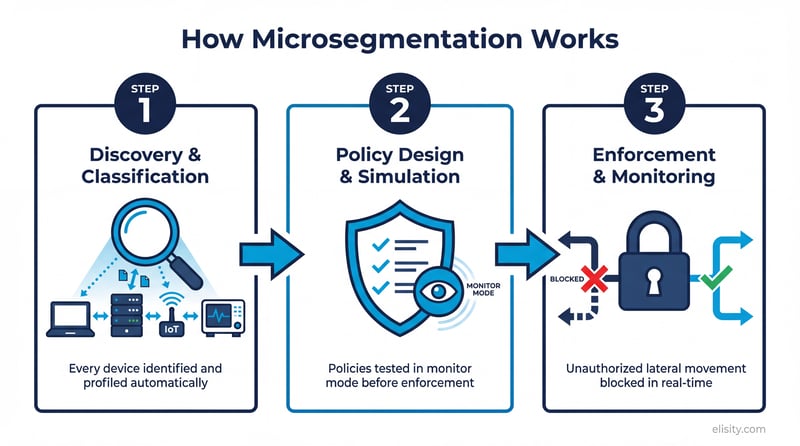
Microsegmentation works by removing the freedom of movement that attackers depend on inside flat networks. The process follows three core steps, regardless of which technology approach you use.
Step 1: Discovery and Classification. Before you can segment anything, you need to know what's on your network. Modern microsegmentation platforms continuously discover every device, workload, and user, then classify them by type, function, owner, and risk profile. Identity-based approaches correlate data from Active Directory, CMDBs, endpoint detection tools, and OT asset platforms to build a rich identity profile for every asset. One large U.S. health system discovered and classified 99% of its devices within 4 hours of deployment, without disrupting patient care.
Step 2: Policy Design and Simulation. With complete network visibility, you define policies specifying exactly which devices and workloads are allowed to communicate. The best microsegmentation platforms let you design policies based on device identity (what something is) rather than network constructs like IP addresses (where something sits). Before enforcing any policy, you simulate it. Simulation mode lets you see what traffic would be blocked without actually blocking it, catching misconfigurations before they cause outages.
Step 3: Enforcement and Continuous Monitoring. Once validated, you move to enforcement. The platform actively blocks unauthorized communication in real time. If a compromised endpoint tries to reach a database server it has no business talking to, the connection is denied at the network level. Continuous monitoring keeps policies current as new devices join and threats evolve.
How Microsegmentation Goes Beyond Traditional Segmentation
Microsegmentation enforces policy at the workload and device level by identity, so it contains east-west movement that coarse-grained segmentation lets through. For a side-by-side breakdown of the differences, see our full guide to microsegmentation vs network segmentation.
Types of Microsegmentation (Including Network Microsegmentation)
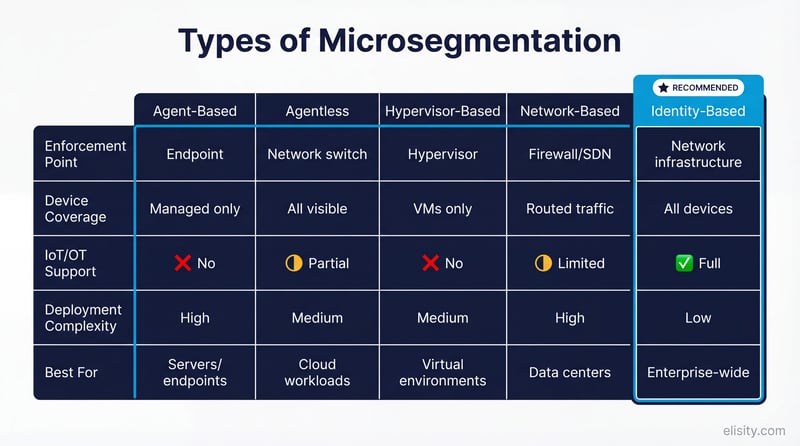
Not all microsegmentation is built the same. I've seen organizations choose the wrong approach and spend 18 months learning that lesson. The five primary types of microsegmentation differ in how they discover assets, where they enforce policy, and what kinds of devices they can protect.
Agent-Based Microsegmentation. Installs a software agent on every endpoint. The agent monitors traffic and enforces policies at the OS level. Works well for managed servers in data centers and cloud environments. The limitation: you can't install agents on medical devices, industrial controllers, IP cameras, or most IoT and OT devices. In environments where 40-60% of assets are unmanaged, agent-based approaches leave a massive enforcement gap.
Agentless Microsegmentation. Enforces policies through existing wired and wireless network infrastructure without deploying agents. Critical for healthcare, manufacturing, and critical infrastructure environments where devices can't accept agents. Works with what you already have, requiring no hardware upgrades or network re-architecture.
Hypervisor-Based Microsegmentation. Embeds segmentation into the virtualization layer. Effective for virtualized data center workloads but doesn't extend to physical devices, IoT, OT, or campus networks.
Network-Based Microsegmentation. Uses VLANs, ACLs, and firewall rules to segment traffic. Familiar to network teams but operationally unmanageable at scale. Policies tied to IP addresses break every time a device moves or gets a new address.
Identity-Based Microsegmentation. Assigns security policies based on the verified identity of each device, user, or workload rather than its network location. Policies follow the asset wherever it connects. A cardiac monitor gets the same security policy whether it's plugged into a port in the ER or moved to the ICU. This is what makes microsegmentation practical in environments with thousands of diverse, mobile, and unmanaged devices.
Benefits of Microsegmentation
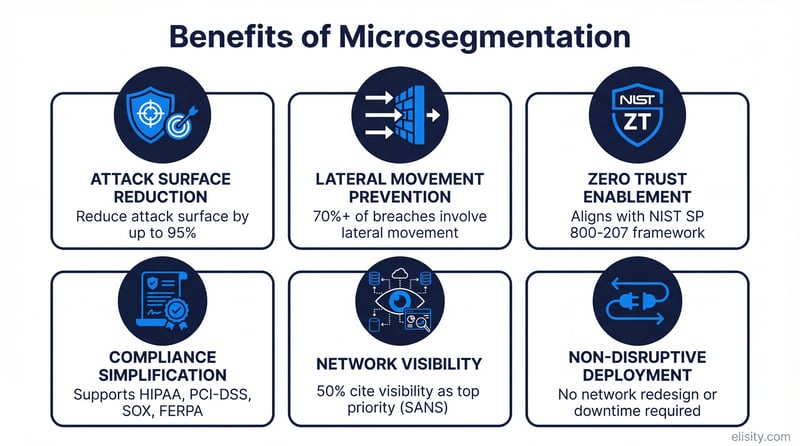
Organizations don't deploy microsegmentation because it's a nice security concept. They deploy it because it solves specific, expensive problems. Here are six measurable benefits backed by real-world data.
Reduces the Attack Surface
Every open connection between devices is potential attack surface. Microsegmentation enforces least-privilege policies, eliminating unnecessary paths. If a workstation in finance doesn't need to reach the building management system, that path doesn't exist.
Prevents Lateral Movement
Over 70% of successful breaches involve lateral movement. Microsegmentation contains breaches at the point of origin. The CrowdStrike 2026 Global Threat Report found the average eCrime breakout time is 29 minutes. Microsegmentation makes that movement impossible regardless of how fast the attacker operates. For a deeper look at specific attack patterns, see our analysis of lateral movement techniques.
Enables Zero Trust Security
Microsegmentation is the enforcement mechanism that makes zero trust operational. Without it, zero trust is a policy framework on paper. NIST SP 800-207, CISA, and NSA all identify network segmentation as a critical control in zero trust architectures.
Simplifies Compliance
HIPAA, PCI-DSS, NIST 800-171, and IEC 62443 all require network segmentation. Microsegmentation provides both the technical enforcement and the device-level audit trail that proves compliance during assessments. 60% of organizations in Akamai's 2025 Segmentation Impact Study reported lower cyber insurance premiums after improving their segmentation capabilities.
Improves Visibility and Control
You can't protect what you can't see. Microsegmentation platforms start with complete network visibility, discovering and classifying every device. The SANS 2025 ICS/OT Survey found that 50% of organizations identified asset visibility as their top investment priority. The discovery phase often reveals devices teams didn't know existed: rogue access points, forgotten test servers, and unauthorized IoT devices.
Deploys Without Network Disruption
Legacy segmentation approaches (re-architecting VLANs, deploying new firewalls, re-IPing devices) cause significant downtime. Modern microsegmentation deploys on top of existing infrastructure without hardware changes or device downtime. Max Everett, CISO at Shaw Industries and former White House CIO, deployed microsegmentation at two manufacturing sites in less than an hour.
Microsegmentation Use Cases by Industry
Microsegmentation applies broadly, but certain industries face unique challenges that make it particularly critical.
Healthcare and Medical Device Security
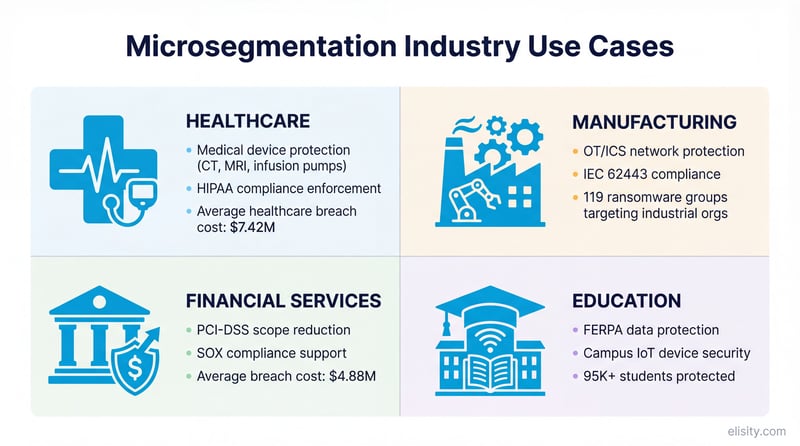
A mid-sized hospital has 10,000 to 85,000 connected devices: infusion pumps, patient monitors, PACS imaging systems. Most can't accept security agents. Healthcare ransomware attacks increased 49% year-over-year in 2025, with breaches costing $7.42 million on average (IBM, 2025), the highest of any industry for 14 consecutive years. A top 10 U.S. health system reduced its microsegmentation project cost from $38 million to $9 million (76% TCO reduction) and cut staffing from 14 FTEs to just 2. Read how one CISO approached this in the Main Line Health case study.
This exact use case gets deeper treatment in Elisity’s guide to healthcare microsegmentation.
Manufacturing and OT/ICS Environments
PLCs, HMIs, SCADA systems, and industrial IoT sensors now share infrastructure with corporate IT. The Dragos 2026 OT Cybersecurity Report identified 119 ransomware groups targeting industrial organizations, with over 3,300 targets. Microsegmentation isolates OT zones from IT networks without requiring downtime. A global industrial electronics manufacturer saved $18.5 million across 53 facilities by deploying identity-based microsegmentation for OT security instead of upgrading firewall infrastructure.
Financial Services and Compliance
PCI-DSS requires network segmentation to isolate cardholder data environments. SOX mandates access controls for financial systems. GLBA requires customer data safeguards. Microsegmentation provides the enforcement mechanism and audit trail that satisfies all three, with device-level policies mapping directly to compliance controls.
Education and Campus Networks
K-12 districts and universities manage sprawling campus networks with thousands of student devices, faculty endpoints, and building management systems. Lee County Schools protects 95,000 students across 120+ locations with identity-based microsegmentation, achieving FERPA and NIST compliance while reducing cyber insurance premiums, all without adding IT headcount.
Microsegmentation and Zero Trust
Zero trust microsegmentation isn't a separate category. It's what microsegmentation was designed to enable.
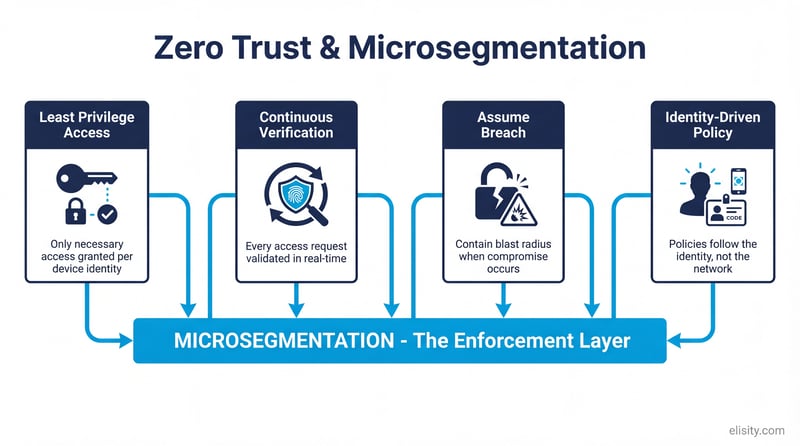
The core principle of zero trust, as defined in NIST 800-207, is "never trust, always verify." Every access request must be authenticated, authorized, and continuously validated. Microsegmentation is the technology that enforces this principle at the network level.
Here's how microsegmentation implements each zero trust pillar:
- Least privilege access: Policies restrict each device to only the connections it needs. A printer can receive print jobs but can't initiate connections to database servers.
- Continuous verification: Device identity is verified not just at connection time but continuously. If behavior changes, policies adapt in real time.
- Assume breach: Microsegmentation limits the blast radius of a compromise to a single segment rather than the entire network.
- Identity-driven policy: Policies tied to device identity (what it is, who owns it, what it does) rather than network location. This is the shift from network-centric to identity-centric security that zero trust demands.
Ransomware doesn't cause catastrophic damage by encrypting one device. It spreads across hundreds or thousands of devices through unrestricted east-west traffic. Microsegmentation removes that pathway. RDP abuse is present in 90% of ransomware incidents (Sophos), and living-off-the-land techniques like pass-the-hash and Kerberoasting all fail at the network layer when microsegmentation policies deny the unauthorized connections these attacks require.
Challenges of Microsegmentation and How to Overcome Them
Let's be honest about the challenges. Microsegmentation has historically been difficult to implement. That's changing, but teams should plan for these obstacles.
Policy complexity at scale. As devices grow, potential policies grow exponentially. Manually maintaining thousands of rules is unsustainable. Solution: Use identity-based policies that apply automatically to device categories. Instead of writing a rule for each of your 500 infusion pumps, write one policy for "infusion pumps" that applies to all based on classified identity. This reduces policy count by orders of magnitude.
Legacy and unmanaged devices. OT equipment, medical devices, and IoT sensors can't accept agents. Any approach requiring agent deployment leaves these devices unprotected. Solution: Choose an agentless approach that enforces policy through existing network infrastructure. This is the only way to achieve coverage across managed and unmanaged devices.
Organizational resistance. Network teams worry about outages. Application teams worry about broken connectivity. Executives worry about cost. Solution: Start in observe mode. Show stakeholders exactly what will happen before it happens. One Director of IT Security at a biosciences company described making "more progress in 2 days than in 2 years with the previous solution" once the team could see policies in action before committing.
Maintaining policies over time. Networks aren't static. Devices join, leave, and change roles. Solution: Deploy a platform with continuous discovery and automated policy recommendations. As new devices join, they're automatically classified and assigned appropriate policies based on identity.
Proving ROI to leadership. Security investments often struggle to demonstrate returns. Solution: Track before-and-after metrics: policy count, mean time to segment new devices, compliance audit prep time, and insurance premium changes. Organizations consistently report 70-80% TCO reductions when comparing identity-based microsegmentation to legacy firewall-based approaches.
Best Practices for Implementing Microsegmentation
Implementation is where most microsegmentation projects succeed or fail. For a full walkthrough, see our how to implement microsegmentation guide. Here are the practices that separate successful deployments from stalled projects.
Use identity-based policies, not IP-based rules. Policies tied to device identity follow the asset wherever it connects. IP-based rules break every time a device moves. GSK cut its implementation timeline from one year per site to one week for three to four sites by using identity-based policy automation.
The same practices scale to multi-site programs, where each site moves through learning mode and incremental enforcement on its own schedule. Timelines vary widely. For a candid account, including a health system that segmented 15 hospitals in 46 days, see what a multi-site microsegmentation rollout actually looks like.
Always simulate before enforcing. Simulation mode lets you see what traffic would be blocked without actually blocking it. Never go straight to enforcement. This single practice prevents more outages than any other implementation decision you'll make.
Start with your highest-risk zones. Begin with guest networks, IoT segments, and OT environments, then expand outward. These zones have the highest exposure and often the quickest time to value.
Leverage existing infrastructure. Modern microsegmentation deploys on top of your existing network infrastructure. There's no need for hardware upgrades, network redesigns, or device downtime. Aaron Weismann, CISO at Main Line Health, noted that identity-based enforcement was "the easiest to implement and easiest to manage" across a five-hospital health system.
Align with compliance frameworks early. Map your microsegmentation policies to specific regulatory requirements (HIPAA, PCI-DSS, NIST 800-171, IEC 62443) from the start. This makes audit preparation a reporting exercise rather than a scramble.
For a deeper look at the top microsegmentation solutions driving this evolution, including how different vendors approach these challenges, see our 2026 vendor comparison.
Frequently Asked Questions About Microsegmentation
What is network microsegmentation?
Network microsegmentation is the practice of segmenting an enterprise network down to the individual workload or device and governing each connection by identity, not by subnet or VLAN. Because the policy is identity-based and agentless, it deploys across any data plane with no new hardware and stops lateral movement east to west.
What is the difference between microsegmentation and network segmentation?
Network segmentation divides the network into broad zones using VLANs, subnets, and firewalls, primarily controlling north-south traffic. Microsegmentation operates at a much finer granularity, enforcing policies between individual workloads and devices based on identity rather than IP address, controlling east-west traffic within those zones.
How does microsegmentation prevent lateral movement?
Microsegmentation enforces least-privilege access policies between every workload and device on the network. If an attacker compromises one system, they cannot move laterally to other systems because the microsegmentation policies block unauthorized communication paths, containing the breach to the initial point of compromise.
Is microsegmentation part of zero trust?
Yes, microsegmentation is a foundational component of zero trust architecture. Zero trust requires that no entity is trusted by default, and microsegmentation enforces this principle by requiring explicit authorization for every network communication, regardless of whether it originates inside or outside the network perimeter.
Can microsegmentation protect IoT and OT devices?
Yes, but only with agentless, identity-based microsegmentation approaches. Traditional agent-based solutions cannot protect IoT and OT devices because these devices cannot run endpoint software. Network-native microsegmentation platforms like Elisity enforce policies through the existing network infrastructure, securing managed and unmanaged devices alike.
What is microsegmentation in simple terms?
Microsegmentation divides your network into small, isolated zones and controls exactly which devices can talk to each other. Think of it like a hotel where every room has its own lock and key, instead of just one lock on the front door. If someone breaks into one room, they can't access any other room. It's the same concept applied to your network: every device gets its own security boundary, and communication between devices requires explicit permission.
What are the main types of microsegmentation?
There are five primary approaches: agent-based (software on every endpoint), agentless (policy enforced through network infrastructure), hypervisor-based (segmentation in the virtualization layer), network-based (VLANs and ACLs), and identity-based (policies tied to device identity rather than network location). Each has tradeoffs. Agent-based works for managed servers. Agentless is essential for IoT and OT. Identity-based is the most flexible for mixed environments. See our full types of microsegmentation guide.
What can microsegmentation do that a firewall cannot?
Firewalls control traffic at network boundaries (north-south). Microsegmentation controls traffic between devices inside the network (east-west). Scaling firewalls to enforce per-device policies across thousands of internal connections is operationally unsustainable. Microsegmentation does this natively, applying policy at the individual workload level without routing all internal traffic through chokepoints. It also handles device types that firewalls struggle with: IoT sensors, medical devices, and OT controllers that don't follow traditional traffic patterns.
How long does it take to implement microsegmentation?
It depends on the approach. Legacy firewall-based segmentation typically takes 12-18 months for a single site. Modern identity-based approaches can achieve initial segmentation in weeks. GSK cut its per-site timeline from one year to one week by switching from firewall-based rules to identity-based policy automation. Max Everett, CISO at Shaw Industries, deployed microsegmentation at two manufacturing sites in less than an hour. The key factors are: do you need agents (which slows deployment), and does your platform require network re-architecture (which adds months)?
Does microsegmentation require agents on every device?
No. Agent-based microsegmentation requires software on every endpoint, which is fine for managed servers but doesn't work for IoT, OT, medical devices, or anything that can't accept a software agent. Agentless microsegmentation enforces policies through the network infrastructure already in place, covering managed and unmanaged devices without installing anything on the endpoints themselves. For environments with a mix of IT, IoT, and OT devices, agentless is the only practical option.
What industries benefit most from microsegmentation?
Healthcare, manufacturing, financial services, education, and government all see significant returns. Healthcare and manufacturing benefit the most because they have the highest concentration of unmanaged IoT and OT devices that traditional security tools can't protect. Financial services benefits from the compliance automation. Education benefits from the operational simplicity of protecting large, distributed campus networks with limited IT staff. But any organization with a flat or under-segmented internal network benefits from microsegmentation.
How does microsegmentation help with compliance?
Microsegmentation maps directly to the segmentation requirements in major compliance frameworks: HIPAA (healthcare), PCI-DSS (payment card data), NIST 800-171 (government contractors), IEC 62443 (industrial environments), and FERPA (education). It provides both the technical control (enforcing access restrictions) and the audit evidence (device-level logs showing who accessed what, when, and whether it was authorized). Organizations have reported faster audit preparation, cleaner findings, and in many cases, reduced cyber insurance premiums tied directly to improved segmentation posture.
For a vendor-by-vendor comparison scored on enforcement model, deployment, and analyst standing, see the best zero trust microsegmentation solutions for 2026.

Microsegmentation Best Practices

Microsegmentation and Zero Trust: A Powerful Security Duo

The Benefits of Identity-Based Microsegmentation for Network Security