


.svg)
.png)




Short answer. Zscaler sells several architecturally different products that carry the word segmentation, so the alternatives depend on which one you mean. If you are replacing user-to-application access, you are shopping in the SSE and ZTNA market. If you are replacing device-to-device traffic control inside a campus, branch, plant or hospital, you are shopping in the east-west segmentation market, where Akamai, ColorTokens, Elisity, Illumio, Zero Networks and others publish documented approaches. For most enterprises the outcome is layering rather than replacement. This guide covers the device-to-device question in depth and only signposts the user-access vendors, rather than implying a balance it does not deliver.
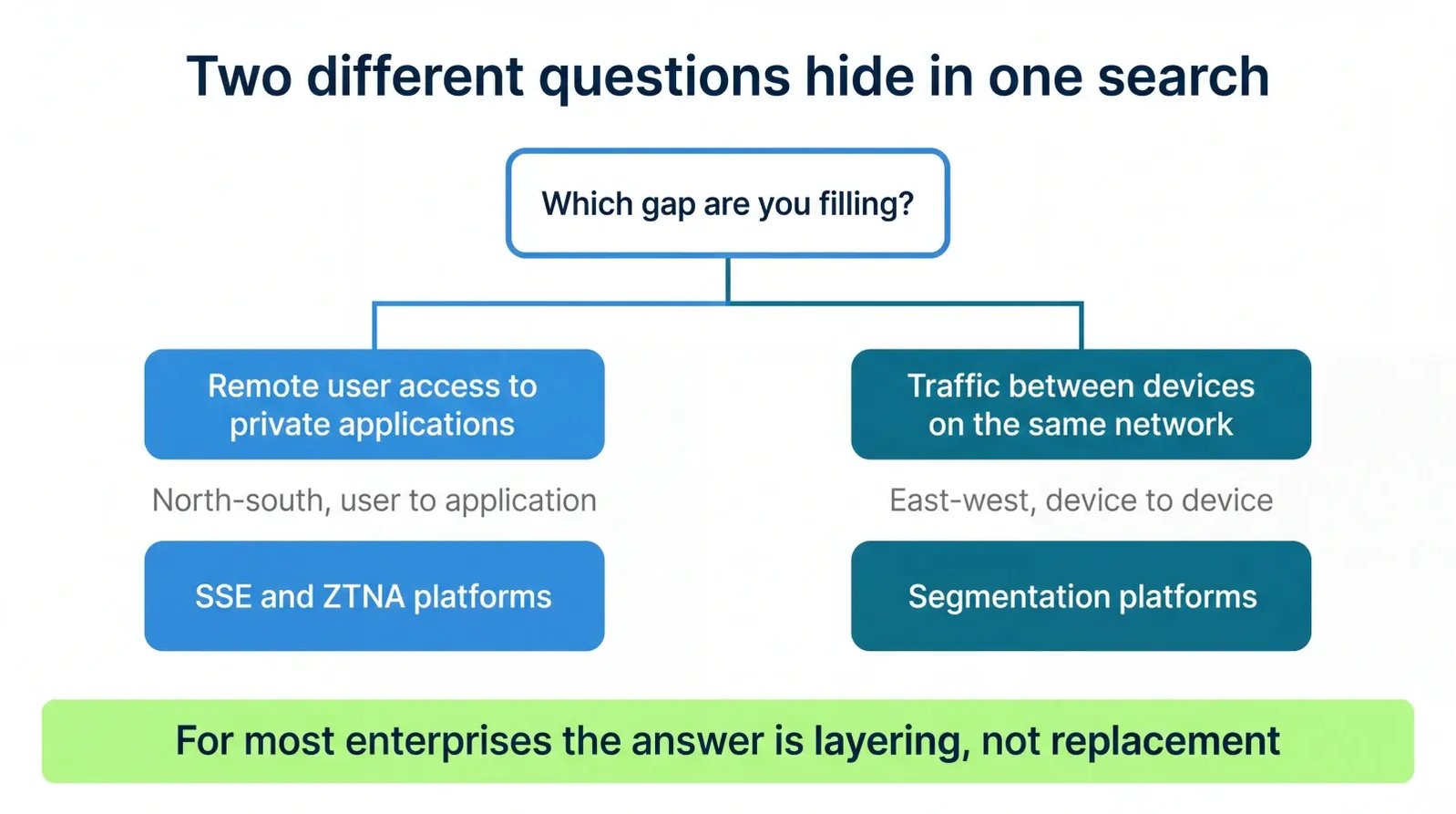
The shortlist, grouped by the gap you are actually filling. Each description is drawn from the vendor’s own published scope language, listed alphabetically, with no ranking implied.
If the gap is remote user access to private applications: Zscaler Private Access documents user-to-application access brokered by the Zero Trust Exchange, with an App Connector deployed in front of the private application. Other vendors compete directly here. This guide does not compare them at the same depth.
If the gap is workload-to-workload traffic on hosts that can run software: Akamai Guardicore Segmentation documents both agent-based and agentless options, and states agentless is suited to in-cloud PaaS, IoT and OT. Cisco Secure Workload documents agent-based enforcement for data center and cloud workloads. ColorTokens Xshield documents a combination of lightweight agents, reuse of existing EDR agents, native cloud controls and an agentless Gatekeeper appliance. Illumio documents a Virtual Enforcement Node deployed into user space on each protected workload, which programs the host operating system firewall. Zscaler Microsegmentation documents granular visibility, group recommendations and local enforcement in what Zscaler calls a simple agent-based architecture for cloud and data center workloads.
If the gap is device-to-device traffic on assets that cannot run software: Elisity documents identity-based policy enforced by access-layer infrastructure already deployed, against a published compatibility matrix of specific hardware models and software versions. Zero Networks documents a fully agentless model in which a Segment Server observes connections for a learning period, then applies rules to host firewalls on managed devices and to access control lists on the network infrastructure connecting unmanaged OT devices. Zscaler Zero Trust Device Segmentation, also published as OT/IoT Segmentation, documents an agentless design that isolates every IP endpoint into a network segment of one using a DHCP proxy gateway placed in the traffic path.
Which Zscaler segmentation product do you mean?
This is the question that decides everything downstream, and it is the reason a single shortlist cannot answer the query. Read against Zscaler’s own published documents, at least four distinct products carry segmentation or access language, and they do not address the same traffic.
| Zscaler product | Traffic direction (north-south / east-west) | Agent required | Where enforcement sits |
|---|---|---|---|
| Zscaler Internet Access (ZIA) | User and office traffic to the internet | Client Connector, or a PAC file, or a tunnel from the site | Zscaler cloud |
| Zscaler Private Access (ZPA) | User to private application access | Client Connector on the device, App Connector at the application | Zscaler cloud, brokered |
| Zscaler Microsegmentation | Server to server and east-west traffic for cloud and data center workloads | Yes, described by Zscaler as a simple agent-based architecture | On the host, described as host-based segmentation |
| Zero Trust Device Segmentation, also published as OT/IoT Segmentation | Device to device traffic inside branch, factory and campus networks | No, agentless | A DHCP proxy gateway appliance in the traffic path |
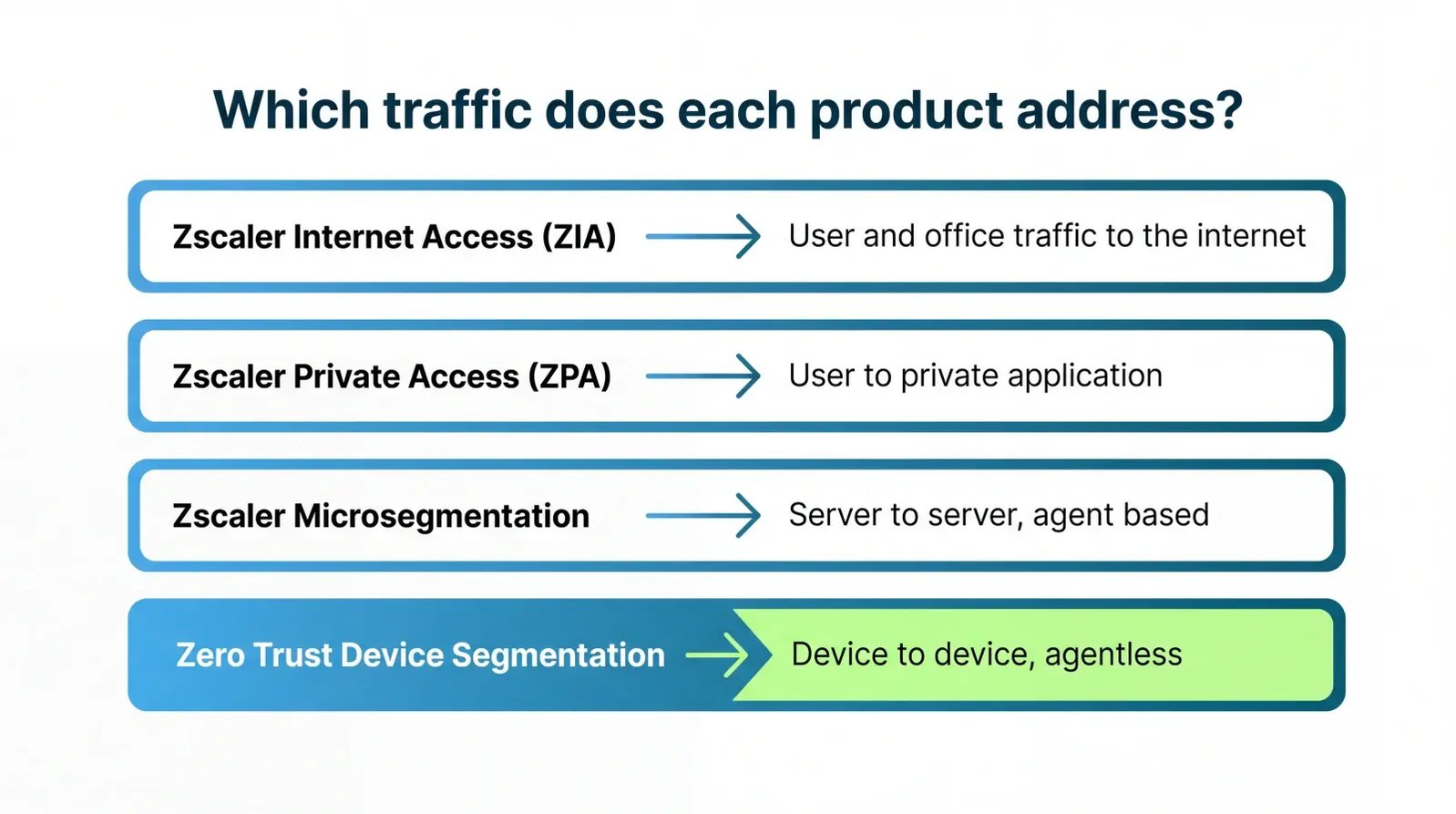
One documentation note, recorded because it costs buyers real diligence time: the device segmentation line is published under two names, Zero Trust Device Segmentation and OT/IoT Segmentation, across two current documents. Product renaming is common across this market, and several other vendors in this guide have renamed or rebranded segmentation products in the same period.
What happened to Airgap Networks after Zscaler acquired it?
Zscaler announced an agreement to acquire Airgap Networks on 11 April 2024 and completed the acquisition on 12 April 2024. Zscaler’s announcement described the goal as combining its Zero Trust SD-WAN with Airgap’s agentless segmentation technology to bring segmentation to IoT and OT devices across branches, campuses, factories and data centers. In its annual report for the fiscal year ended 31 July 2024, Zscaler recorded total purchase price consideration of 124.4 million dollars, on an allocation the filing describes as preliminary and subject to working capital adjustment, plus deferred merger consideration for certain Airgap employees with a grant-date fair value of 20.3 million dollars payable in restricted shares.
Airgap’s technology, before the acquisition, was built on a DHCP proxy architecture that isolated devices and controlled access by identity and context. That mechanism is still visible in the current product. Zscaler’s Zero Trust Device Segmentation data sheet places a DHCP proxy gateway in the traffic path and describes isolating every IP endpoint into a network segment of one, with gateway appliances available as physical or virtual machines and a two-node option.
Why this matters for the shortlist. Zero Trust Device Segmentation is the Zscaler product that actually competes for the device-to-device use case, and it is the one an evaluation should test. Zscaler Microsegmentation, by Zscaler’s own description, is agent-based and scoped to cloud and data center workloads, which makes it a different product for a different estate.
Do I need Zscaler and microsegmentation, or do they overlap?
For most enterprises they do not overlap, because they govern different traffic directions. Zscaler’s core services govern north-south traffic: ZIA governs traffic leaving the organisation for the internet. ZPA governs a user reaching a private application. Neither one sees an infusion pump talking to a workstation on the same VLAN, or a programmable logic controller talking to a historian in the same cell. That east-west traffic is what microsegmentation addresses, and it is the traffic ransomware uses to move once it lands. Identity-based platforms such as Elisity enforce east-west policy on the Catalyst, EX and Arista switches an organisation already operates, which is why the two layers are usually deployed together rather than chosen between.
The genuine overlap question is narrower than the query suggests. It applies only if you are comparing Zero Trust Device Segmentation against another east-west product, because those two are competing for the same job. Comparing ZPA against a microsegmentation platform is comparing a remote access control against a lateral movement control.
Access-layer segmentation platforms and SSE platforms are also frequently deployed together, and several vendors on both sides publish mechanisms for exchanging policy context between the two, so that an identity decision made in one is reflected in the other.
What does a segment of one do to Layer 2 traffic?
This is the most consequential technical question on this page, and it applies to any per-device isolation design, not only Zscaler’s.
Zero Trust Device Segmentation isolates every IP endpoint into a network segment of one. Practitioners who have deployed the architecture describe the mechanism plainly: because every device sits on a host route, there is no Layer 2 communication between devices, and deployment involves making the gateway the default gateway and changing endpoint subnet masks accordingly. Proponents describe this as straightforward to roll out and effective in IoT and OT environments.
That same property is the constraint. A meaningful set of operational protocols depend on Layer 2 adjacency or broadcast and multicast on a shared segment. PROFINET and EtherCAT on a plant floor, IEC 61850 GOOSE messaging in substations, BACnet discovery in building systems, multicast DNS device discovery, and some nurse-call and clinical paging systems all assume peers can reach each other at Layer 2. Where a device population depends on that behaviour, isolating each endpoint into its own segment changes how those protocols work, and the design has to account for it.
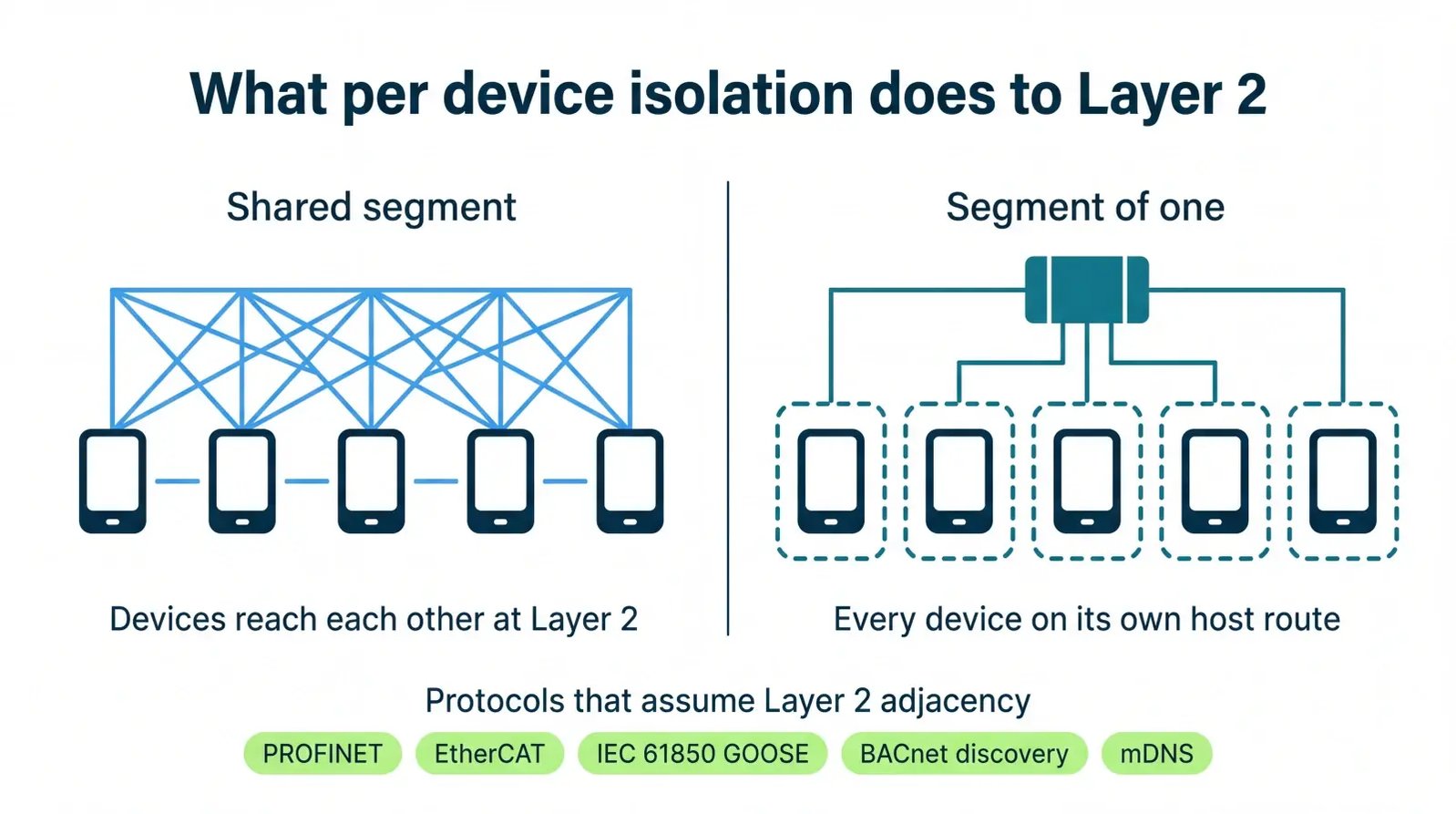
This is a question to put to any vendor whose model isolates devices individually, and to test in a proof of value against your actual protocol mix rather than against a generic device list. Two further prerequisites follow from the same architecture. Placing a DHCP proxy in the path makes DHCP a production-critical service, which interacts with static-IP devices, hardcoded default gateways and address reservations. And gateway appliances are hardware or virtual machines to size, deploy and maintain per site.
What are the alternatives to Zscaler for segmentation?
The table below is keyed on the vendor, and every entry is drawn from that vendor’s own published documentation.
| Vendor and product | Agent required | Where enforcement happens | Documented scope | One documented limit |
|---|---|---|---|---|
| Akamai Guardicore Segmentation | Optional, agent and agentless options | Host agent, or agentless at the network and host system layer | Hybrid cloud workloads, with agentless stated as suited to in-cloud PaaS, IoT and OT | Akamai states agent deployment is recommended for maximum visibility and control |
| ColorTokens Xshield | Optional | Native agent, reused EDR agent, native cloud controls, or an agentless Gatekeeper appliance | Hybrid IT and OT, with a Gatekeeper deployable as a virtual machine or as hardware on the shop floor | No Gatekeeper sizing figures are published in the data sheet or solution brief |
| Elisity | No | Access-layer infrastructure already deployed, with a cloud control plane | Campus, branch, clinical and OT device estates, using identity rather than address | Enforcement is bounded by a published compatibility matrix of specific hardware models and software versions, and only covers traffic that traverses that infrastructure |
| Illumio | Yes | On the workload, by programming the host operating system firewall | Clouds, data centers and endpoint devices | Illumio states its user-space agent has less visibility into processes deeper in kernel space than kernel-based alternatives |
| Zero Networks Segment | No | Host firewalls on managed devices, and access control lists on the network infrastructure for unmanaged devices | Mixed IT, OT and IoT estates, after an observation period | Enforcement for unmanaged devices depends on what the connecting network infrastructure supports |
| Zscaler Zero Trust Device Segmentation | No | A DHCP proxy gateway appliance in the traffic path | Branch, factory and campus networks, isolating every IP endpoint into a segment of one | Per-device isolation removes Layer 2 adjacency between devices, and gateway appliances are deployed per site |
| Zscaler Microsegmentation | Yes | On the host, described by Zscaler as host-based segmentation | Cloud and data center workloads, server to server | An agent-based model does not address devices that cannot run software |
What does each approach not do?
Every architecture in this market trades something. The trade is usually the most useful thing to know about it.
Agent-based platforms give the richest context, because software on the host can see processes and applications, not only addresses. They cannot protect anything that will not accept an agent, which in a hospital or a plant is frequently the majority of the connected estate.
Per-device isolation using a gateway in the path requires no agent and reaches devices nothing else can reach. It changes Layer 2 behaviour for every device it protects, makes DHCP production-critical, and adds appliances to size and maintain at each site.
Enforcement by access-layer infrastructure requires no agent and no new hardware in the path, and preserves normal Layer 2 behaviour. It only sees traffic that actually traverses the enforcing infrastructure, so traffic between devices behind a downstream unmanaged device, or in a daisy-chained topology, reaches no enforcement point. It is also bounded by a published compatibility matrix, so the specific models and software versions in your estate decide what is enforceable. This constraint applies to every vendor in this category without exception, and it is the first thing to check against your own hardware inventory.
Cloud-delivered access controls such as ZIA and ZPA govern traffic that leaves the site or reaches an application. They are not designed to see or stop device-to-device traffic on a local segment, and evaluating them as though they were is the single most common category error behind this query.
How does each approach go live without breaking production?
In a hospital or on a plant floor, deployment risk decides the evaluation more often than the feature list does. Six questions separate the options, and only two of them can be answered from published documentation today. Ask every vendor for the other four in writing, and treat a demonstration as an illustration rather than an answer.
First, is there a genuine observe-only mode in which policy is provisioned but not enforced? Illumio documents that state in product terms: provisioned rules can sit in a non-enforcing “Static Policy” state, the workloads display a Staged status, and administrators must manually click Apply Policy to enforce the rules. Illumio’s documentation recommends that state for testing. Zero Networks documents a different route to the same caution, a Segment Server installed on the network that monitors all connections for up to a 30-day learning period before it centrally applies rules. Those two behaviours are documented. For any other product, ask for the page reference rather than the claim.
Second, what has to be installed, and what privilege does it need? Akamai documents both agent-based and agentless options for Guardicore Segmentation, and states that agent deployment is recommended for achieving maximum visibility and control, so the less invasive choice can also be the less capable one. Cisco documents agentless visibility for Secure Workload through NetFlow/IPFIX and ERSPAN connectors as an alternative to host agents, which require root or administrator privileges. Zscaler documents zero-touch Airgap Gateway provisioning for Zero Trust Device Segmentation, with physical or virtual gateways and a two-node option. Those are three different change-control conversations: a host package, a traffic feed, or an appliance per site.
The remaining four questions are the ones this page cannot answer, because none of the vendor documentation reviewed for this page contains a complete failure specification. Where a design places an appliance in the traffic path, the architecture implies that the availability of that appliance becomes the availability of production, but implication is not documentation. Put the following to every vendor during a proof of value, and require the answers in writing.
| Question to put to every vendor | What a usable answer contains |
|---|---|
| What happens to traffic while the enforcement point reboots? | Whether traffic continues or stops, for how long, and whether that behaviour is configurable |
| What happens when the enforcement point cannot reach the management plane? | Whether the last known policy keeps enforcing, for how long, and what stops working first |
| How long does a full rollback take, and what is the procedure? | A written, ordered procedure and a timed run on a live segment, not an assurance |
| Does the cutover fit one maintenance window? | Per-site steps with a duration against each, compared against your real window |
Test the failure, do not accept the assurance. Schedule a deliberate failure inside the proof of value: reboot the enforcement point, cut its path to the management plane, and run the rollback with a stopwatch, on a segment that matters but that you can afford to lose for the length of a maintenance window. A vendor that will not schedule that test has already answered the question.
What happens when the enforcement point fails?
Ask this in every evaluation, and require a document rather than a demonstration. Vendors publish where enforcement lives far more consistently than they publish what happens when it stops. Architecture is the part you can verify today, so start there and treat failure behaviour as a written question each vendor answers for your design.
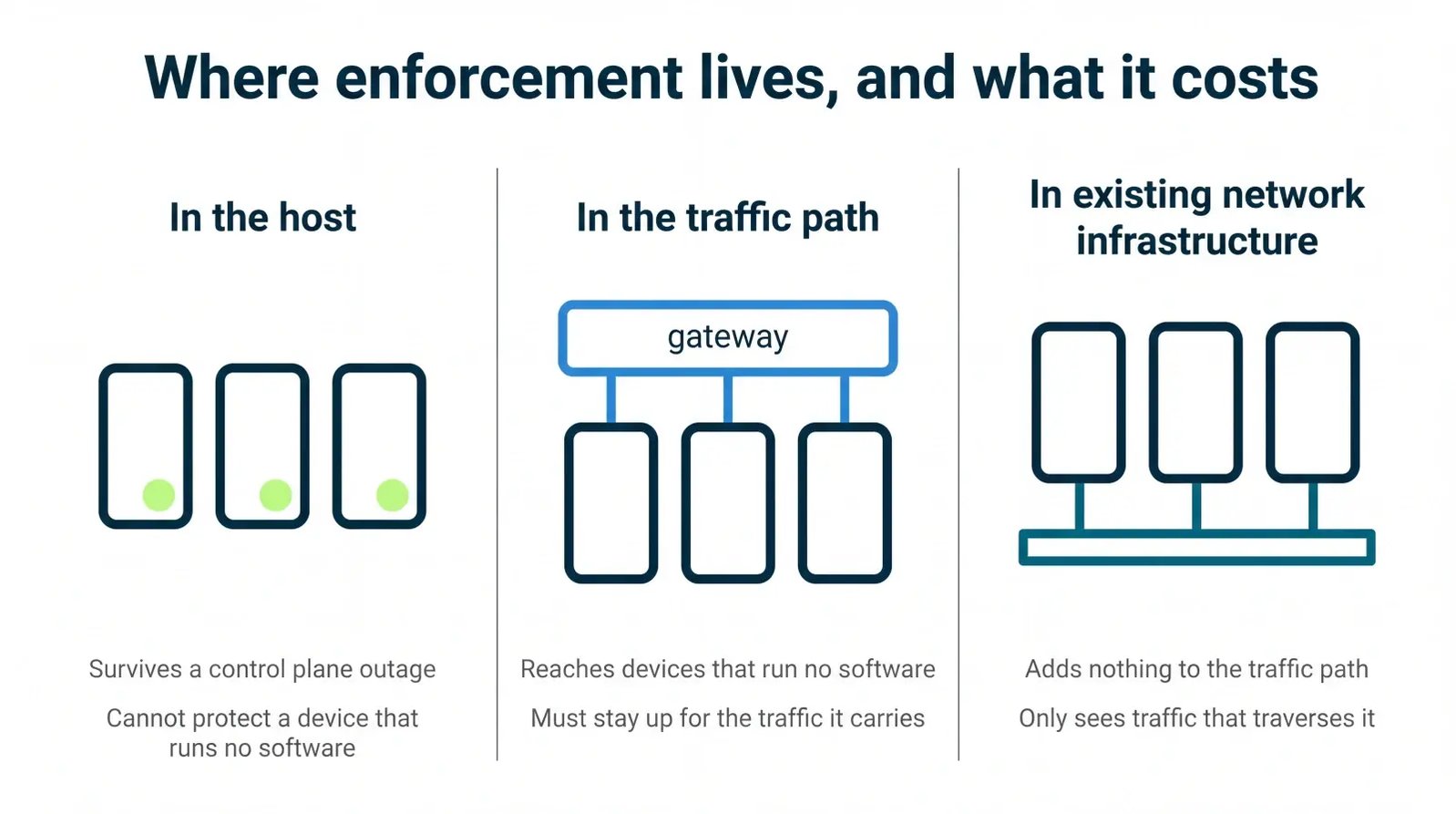
| Where enforcement lives | Documented architecture | Documented failure behaviour | What the architecture implies, to confirm with the vendor |
|---|---|---|---|
| On the protected host | Illumio documents that its Virtual Enforcement Node retrieves policy from the Policy Compute Engine, enforces locally by programming the native operating system firewall, and that the engine never initiates communication with workloads. | not documented | Rules already sit in the host firewall, so losing the management plane looks architecturally different from losing enforcement. That is reasoning from the design, not a published failure specification. |
| In a device placed in the traffic path | Zscaler Zero Trust Device Segmentation documents a DHCP proxy gateway in the traffic path. | Zscaler documents a two-node gateway option. Whether traffic continues or stops on failure: not documented | A component in the traffic path has to stay up for the traffic it carries, and a per-device design carries all of it. Ask for documented fail-open or fail-closed behaviour, and for what an appliance pair does during a failover. |
| On network infrastructure already deployed | Zero Networks documents rules applied to host firewalls on managed devices and to access control lists on the infrastructure connecting unmanaged devices. Cisco documents TrustSec enforcement at the exit network device using Security Group ACLs. | Zero Networks documents an additional Trust Server for high availability. Behaviour of installed rules during a control-plane outage: not documented | Nothing is added to the path, so no new component sits between two devices. Only traffic that traverses the enforcing infrastructure reaches a policy decision at all. |
| Nowhere, by design | Forescout documents that eyeSegment does not enforce traffic itself; it orchestrates controls across existing enforcement points. | not documented | Failure behaviour is inherited from whatever actually enforces, so the question repeats for each underlying control. |
Every “not documented” above means the statement was absent from the sources reviewed here: Zscaler’s Zero Trust Device Segmentation data sheet and OT/IoT segmentation brief, Illumio’s Virtual Enforcement Node and security policy documentation, Zero Networks’ platform pages and technical product overview, Forescout’s eyeSegment page, and Cisco’s TrustSec collateral. Absence is not evidence of bad behaviour. It means the answer has to come from the vendor in writing, against your topology.
The limitation named earlier under what each approach does not do applies here too, to every design that enforces on infrastructure already deployed, without exception. Traffic between two devices behind the same downstream unmanaged hardware, or on a daisy-chained run, never traverses an enforcement point, so no policy is evaluated on it. That holds for Cisco TrustSec, the unmanaged-device path in the Zero Networks model, Elisity, and any comparable approach. Map the access-layer topology before an evaluation, not during one.
Two questions the DHCP dependency raises. The section on a segment of one already covers why a DHCP proxy in the path makes DHCP production-critical. The operational follow-ups are narrower: ask how a device that never requests an address is handled, and what reaches that device if the proxy is unavailable.
How much discovery and classification work is this really?
Policy quality is downstream of classification quality. A rule that permits an infusion pump to reach its own vendor’s server and nothing else is only as good as the inventory that decided which endpoints are infusion pumps. In a hospital or on a plant floor that inventory is rarely clean when the project starts, and cleaning it is usually the longest task on the plan.
Platforms in this market split on where classification comes from. Some document native discovery, some document a dependency on systems you already own, and the table below shows both patterns. The useful question is therefore narrower than whether a platform does discovery: which sources can it consume, and how much manual classification is left once those integrations are connected?
| Platform | Documented discovery and classification input | Published figure for manual classification remaining |
|---|---|---|
| Arista Multi-Domain Segmentation | Documented dependency on external sources such as NAC systems, CMDBs and virtualization infrastructure management to classify endpoints into microperimeters, plus Arista NetDL for traffic mapping | not documented |
| Cisco TrustSec | Classification at network access, for example through 802.1X, with ISE assigning a Security Group Tag | not documented |
| Elisity | Native discovery plus external enrichment: Elisity classifies devices itself from MAC OUI analysis, DHCP fingerprinting, traffic flow telemetry and RDAP or WHOIS IP ownership data, and IdentityGraph enriches that record from 25+ sources including Active Directory, CMDBs and EDR platforms such as Armis, Claroty and Medigate | not documented |
| Forescout eyeSegment | More than 30 agentless discovery methods covering managed, unmanaged and headless devices, classifying by device type, function, operating system, behaviour, risk score and communication patterns | not documented |
| Palo Alto Networks OT Security | 350 or more OT asset profiles, 1,070 or more OT and ICS app identifiers and 650 or more OT threat signatures, applied through passive machine learning, App-ID and Device-ID for devices that cannot run agents | not documented |
The third column is the honest state of the market. Across the Forescout eyeSegment product page, the Palo Alto Networks OT security solution page, the Arista Multi-Domain Segmentation product page, Cisco’s published TrustSec material and Elisity’s own solution overview data sheet, we found no figure in any of them for how many endpoints remain unclassified once its integrations are connected. Treat any number offered verbally as a claim to test against your own inventory.
Two shapes of dependency are worth separating. A platform that discovers natively carries that workload itself. A platform that consumes classification from a NAC system, a CMDB or a clinical asset tool, as Arista documents, inherits the accuracy of those systems, which the architecture implies will surface as a policy gap wherever the upstream record is stale or missing. Ask each vendor to confirm from documentation what happens to an endpoint it cannot classify, because that default decides whether an unknown device is quietly permitted or quietly cut off.
Scope shapes the effort too. Elisity publishes a comparison rating its own cloud and Kubernetes support as limited, and states that organisations with primarily cloud-native workloads may need to pair it with a cloud-focused tool, so a discovery model built around campus and OT estates leaves the cloud estate to be classified separately.
Four questions that size this work. Which asset intelligence sources we already own can you consume on day one, and which need a project of their own? What proportion of endpoints does your product classify without human input, measured on our data? Who owns the residual classification, our staff or yours? And when an asset record changes upstream, how long before policy reflects it?
What the classification engines do to that number
One further distinction belongs here, because it bears directly on how much of this work stays manual. Elisity documents an ML classification engine that proposes a category for any device arriving in IdentityGraph without one, from evidence including MAC adjacency, observed traffic patterns and public IP ownership, and an insights engine that recommends Policy Groups and Allow or Deny policies from observed behaviour. Both are advisory by design: a proposed classification changes nothing until an administrator accepts it, and a suggested policy is created in Simulation Mode and enforces nothing until it is promoted. Inference runs on private LLM instances via AWS Bedrock in a single-tenant architecture, and customer data is not used to train the models. None of this settles the question above, because an engine that proposes a classification is still not a published figure for what proportion it gets right on your estate. Ask for that number against your own data.
Source: Elisity Support, Elisity AI Capabilities Data Sheet, updated 29 April 2026.
We already have NAC or an asset intelligence platform. Do we need microsegmentation too?
In most environments these are complementary layers rather than substitutes, because they answer different questions. Network access control and asset intelligence platforms largely answer what is on the network and whether it should be admitted. Segmentation answers what a thing may talk to once it is admitted. A device can be correctly identified, correctly admitted and still reach every other device on its VLAN.
The segmentation vendors themselves document consuming that data rather than replacing it. Cisco TrustSec classifies at network access, where Cisco ISE assigns a Security Group Tag, then propagates the tag and enforces at the exit device using Security Group ACLs. Arista states its Multi-Domain Segmentation depends on external sources including NAC systems and CMDBs to classify endpoints. In each case the asset system stays and the segmentation product reads from it.
Cisco ISE is compared on the same terms in our guide to which Cisco ISE job you are actually replacing, and what enforces once TrustSec no longer applies.
A second distinction matters more than the category label: whether a product is the enforcement point, or a policy modelling and orchestration layer above other enforcement points. Forescout states that eyeSegment does not enforce traffic itself, and that it orchestrates controls across enforcement points, driving existing network infrastructure, NAC systems and firewalls. That is a legitimate design, not a deficiency, but it decides what you are buying and which team owns the failure mode.
| Platform | What its own documentation says it consumes or depends on | Does it enforce traffic itself |
|---|---|---|
| Cisco TrustSec | Classification at network access, for example 802.1X, where Cisco ISE assigns a Security Group Tag | Yes, at the exit device using Security Group ACLs or firewall rules, with no endpoint agent |
| Forescout eyeSegment | More than 30 agentless discovery methods covering managed, unmanaged and headless devices | No. Forescout states it orchestrates controls across existing enforcement points |
| Arista Multi-Domain Segmentation | NAC systems, CMDBs and virtualization infrastructure management solutions for classification | Yes, policy orchestrated by CloudVision on Arista’s own EOS network infrastructure, with no agents on endpoints and workloads, though Arista documents that classification depends on external sources |
| Elisity | Native classification from network telemetry, enriched from Active Directory, CMDBs, EDR platforms and tools such as Armis, Claroty and Medigate | Yes, at access-layer infrastructure already deployed |
One distinction worth stating plainly, and updated on 16 August 2026 after a re-read of the current Forescout material. Forescout describes eyeSegment as “a unified policy layer across disparate enforcement points” that will “orchestrate controls across enforcement points”, and the eyeSegment page does not name the component that performs the enforcement. The Forescout network segmentation solution page does name one: it lists eyeControl and states that it will “Enforce and automate policy-based controls”. So the platform does enforce, through a separately licensed module, and an earlier version of this page recorded the absence of any enforcement claim, which is no longer accurate. Whether your own deployment already blocks east-west traffic therefore depends on which modules you licensed and how they are configured, so confirm it against your configuration. For the full treatment, see our Forescout alternatives comparison.
Three questions that settle it. First, which system today decides whether two admitted devices on the same VLAN may exchange traffic, and where is that decision enforced? Second, does the segmentation product read from the asset platform you already own, and through which documented integration? Third, if the product models policy without enforcing it, what enforces it, and do you already run that? Ask vendors to answer from documentation.
Frequently asked questions
Every capability statement on this page is drawn from the named vendor’s own current public documentation. Elisity is scored on the same criteria as every other option listed, including the functions Elisity does not perform. Last reviewed 3 August 2026.
What are the alternatives to Zscaler for segmentation?
It depends which Zscaler product you are replacing. For user-to-application access, the alternatives are other SSE and ZTNA platforms. For workload-to-workload traffic on hosts that can run software, documented alternatives include Akamai Guardicore Segmentation, Cisco Secure Workload, ColorTokens Xshield and Illumio. For device-to-device traffic on assets that cannot run software, documented alternatives include Elisity, Zero Networks and Zscaler’s own Zero Trust Device Segmentation. Establishing which traffic is unprotected today is the step that makes the shortlist obvious.
Do I need Zscaler and microsegmentation, or do they overlap?
In most enterprises they do not overlap, because they govern different traffic. Zscaler Internet Access governs traffic to the internet and Zscaler Private Access governs a user reaching a private application. Neither sees device-to-device traffic on a local network segment, which is what microsegmentation controls and what lateral movement uses. A genuine overlap exists only when comparing Zscaler Zero Trust Device Segmentation against another east-west segmentation product, because those two address the same traffic. Identity-based microsegmentation platforms such as Elisity enforce that east-west policy on the switches an organisation already operates, so the two are usually deployed together.
Is Zscaler Microsegmentation agentless?
No. Zscaler describes Zscaler Microsegmentation as providing local enforcement in a simple agent-based architecture, and describes the capability as host-based segmentation for cloud and data center workloads. Zscaler’s agentless offering is a different product, Zero Trust Device Segmentation, which is also published as OT/IoT Segmentation.
What happened to Airgap Networks after Zscaler acquired it?
Zscaler announced the acquisition on 11 April 2024 and completed it on 12 April 2024, recording total purchase price consideration of 124.4 million dollars in its annual report for the fiscal year ended 31 July 2024. Airgap’s DHCP proxy architecture remains visible in Zscaler Zero Trust Device Segmentation, which places a DHCP proxy gateway in the traffic path and isolates every IP endpoint into a network segment of one.
Does isolating every device into a segment of one break OT protocols?
It changes how any protocol that depends on Layer 2 adjacency or broadcast behaves, because devices on individual host routes do not communicate at Layer 2. Protocols to test include PROFINET, EtherCAT, IEC 61850 GOOSE, BACnet discovery, multicast DNS discovery and some clinical paging systems. Whether this is a problem depends entirely on your protocol mix, so it should be tested in a proof of value against real traffic rather than against a generic device list.
Can microsegmentation protect devices that cannot run an agent?
Yes, but only with an architecture that does not require one. Agentless approaches differ in where they enforce: Zscaler Zero Trust Device Segmentation uses a DHCP proxy gateway appliance placed in the traffic path, Zero Networks applies access control lists to the network infrastructure connecting unmanaged devices, and Elisity enforces using access-layer infrastructure already deployed against a published compatibility matrix. Each choice carries different prerequisites and different failure behaviour.
Which approach is best for a hospital or a plant?
There is no single answer, because the deciding factors are specific to the estate. Four variables matter and none of them outranks the others: what proportion of the assets can host software, where enforcement can physically live, what context the policy needs beyond an address, and which environments have to be covered, including cloud workloads. An architecture that suits a data center rarely suits a plant floor, and the reverse is equally true.
Does an agentless approach mean no new hardware?
Not necessarily, and the difference is worth checking. Agentless means no software on the protected device. It does not mean nothing is added to the network. Designs that place a gateway appliance in the traffic path add hardware or virtual machines to size and maintain per site. Designs that enforce using access-layer infrastructure already deployed do not, but are bounded by what that infrastructure supports.

What a Multi-Site Microsegmentation Rollout Actually Looks Like (and Why Most Take Years)

How to Secure Devices That Cannot Be Patched: 10 Compensating Controls for OT, IoMT and End-of-Life Systems

Why Network Segmentation Projects Fail: A RedSeal CPTO View