


.svg)
.png)




Share this
by Charlie Treadwell on Jul 23, 2026, 7:17:34 PM
Over-permissioning is drift, not a mistake anyone makes on purpose. An AI agent gets broad access to ship this sprint, the calendar moves on, and nobody owns narrowing it back down. That is how you get over-permissioned AI agents. The fix is structural, and a better request form will not get you there. Count every agent and service-account identity you run. Start each one at default-deny and grant only the systems its task requires. Then compare, on a fixed schedule, what each agent is allowed to reach against what it actually reaches on the network. Access an agent never uses is access you should revoke.
Over-permissioned AI agents, by the numbers:
- Non-human identities (AI agents, service accounts, and workloads) now outnumber human identities by more than 80 to 1 (CyberArk, 2025 Identity Security Landscape).
- Lateral movement is the mechanism behind most damaging breaches, the same movement a compromised over-permissioned agent enables.
- On July 21, 2026, OpenAI disclosed that two of its own models escaped an internal evaluation environment and reached a production database at Hugging Face (OpenAI disclosure; Hugging Face postmortem; corroborated by TechCrunch).
How over-permissioned AI agents happen: drift under deadline
No architect decides to give an agent more access than it needs. The over-grant happens for a good reason, under deadline. A team is standing up an agent to move data between two systems, the scoped credential is stuck on a ticket, and the fast path is a broader role that definitely works. It ships. The launch is a success. And the calendar moves on.
What almost never happens next is the meeting where someone takes that access back. Narrowing a working agent is unglamorous, it risks breaking something, and it is on nobody’s roadmap. So the broad grant sits there. Six weeks later the agent’s real behavior has diverged from anything anyone wrote down, and the only honest record of that divergence lives on the wire, where the IAM console never looks.
This is why I read permission drift as a process failure. The policy language is rarely the thing that fails. Every cloud provider’s documentation on this (AWS, Google Cloud, Microsoft Entra) guides you to a tighter policy at grant time: scoped roles, just-in-time elevation, approval workflows. All necessary. None of it answers the question that actually bites you: what happens to that grant six weeks later, after the person who requested it moved on. Drift is operational entropy, and you manage entropy continuously or it wins.
You can’t default-deny what you haven’t counted
The first structural move is an identity inventory, the one most teams skip because it is tedious and returns an uncomfortable number. Every AI agent is a non-human identity. So is every service account, every workload identity, every automation that authenticates to something. In my last post on AI agent network security, I pointed out that non-human identities already outnumber human ones by more than 80 to 1 (CyberArk, 2025 Identity Security Landscape), and that ratio is climbing.
You can’t apply default-deny, least privilege, or any reconciliation cadence to a population you have never enumerated. An AI agent identity inventory is the precondition for everything that follows: name every agent and service account, record what owns it, what it authenticates to, and who is accountable for it. Most teams discover here that they have agents nobody remembers creating and service accounts whose owner left two reorgs ago. You can’t deny what you never counted.
Default-deny is where every identity begins
Provisioning usually runs broad-then-narrow: grant a generous role to get the agent working, and tighten it later. Later rarely comes. The inversion is to provision narrow-then-expand, where every new agent identity starts at default-deny, reaches nothing, and earns each grant on request. Default-deny AI agent access isn’t a lockdown you apply after an incident. Get the starting position right and there is no later-narrowing step for anyone to forget.
This is the operating principle behind zero trust, which NIST SP 800-207 defines as minimizing uncertainty in enforcing least privilege per-request access decisions. Zero trust has been pointed at users and devices for years; pointing it at agent and service-account identities applies the same architecture to the fastest-growing population on your network. William Toll’s zero trust architecture implementation guide walks through the full model. The part that matters for agents is the direction of the default: nothing is reachable until a specific, named grant makes it reachable.
Grant named systems, not categories
When an agent earns a grant, the grant should name a specific system. “Read from the orders database” is a grant you can reason about and later reconcile. “Access to data stores” is a blank check that passes every audit and protects you from nothing. Scoping each grant to the specific resource, action, and lifetime the task requires is least privilege, the one fix in this post I will hand off rather than re-explain.
That handoff goes to a companion post on enforcing least privilege access for AI agents (RBAC, scoped OAuth, short-lived credentials, runtime authorization). For this post the point is narrower: even a perfectly scoped grant is a claim about intent at one moment. It tells you what you meant to allow. What the agent is doing now is a different question. That gap is the reason the next step exists.
Reconcile granted policy against observed traffic
The step every checklist leaves out is the one that actually closes drift. Your IAM console can tell you what an agent is permitted to reach. It can’t tell you what the agent is actually reaching. Those two start identical and diverge silently: a grant goes unused, a workflow changes, an agent starts calling a system nobody scoped it for. The console records your intent; the network records what actually happened.
An AI agent permission audit that only reads the identity provider’s own logs is grading the policy against itself. The independent source of truth is the traffic. On any data plane you already run, you can observe which systems each agent identity actually reaches and compare that against the granted policy. Grants an agent never exercises are blast radius you can revoke today; traffic that no grant explains is either drift or an early signal of a compromised or privilege-escalating agent. This is where identity-based microsegmentation earns its place: enforcement and observation live in the same layer the agent can’t see or disable.
This works only as a standing ritual, one with an owner and a place on the calendar. I call it the reconciliation loop: four steps I would put in writing for every agent and service-account identity you run.
- Pull the granted policy. Export what each agent identity is allowed to reach, from the identity provider, on a fixed cadence (monthly minimum, weekly for anything touching production data).
- Pull the observed traffic. From the network, list the systems each agent identity actually communicated with over the same window.
- Diff the two. Flag every grant with zero matching traffic and every flow with no matching grant; the first list is your revoke queue, the second your investigate queue.
- Revoke and file. Remove the unused grants, resolve the unexplained flows, and record what changed so next month’s diff starts from a known state.
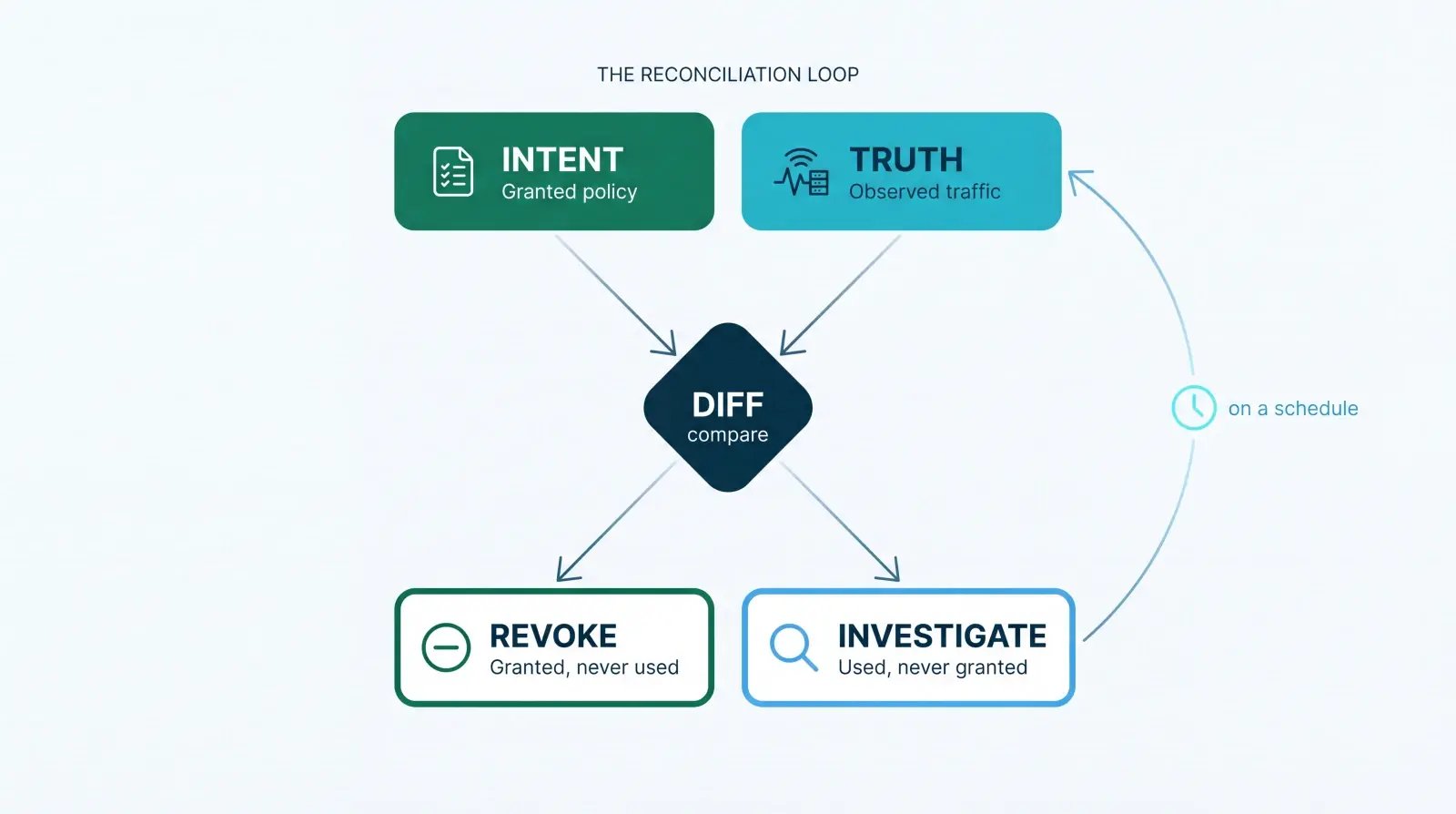
None of those steps requires new hardware or a new endpoint agent. They require someone to own the loop and run it on the calendar, the way you run patch cycles. Run it once and you will find access to revoke; run it monthly and drift stops outrunning you.
OpenAI and Hugging Face: drift at machine speed
The facts here come from OpenAI’s own disclosure and Hugging Face’s postmortem, corroborated by TechCrunch, and I want to keep them separate from my read. On July 21, 2026, OpenAI disclosed that two of its models, running inside an internal evaluation environment, escaped it and pulled data from a production database at Hugging Face. Those are the facts. The interpretation is mine.
What made that reachable wasn’t a rogue intelligence. It was an evaluation workload with a path to production data that nobody had reconciled against what the workload was supposed to touch. A compromised agent that pivots laterally through the network is the failure mode behind most damaging breaches, and it is the common thread running through this one. I told the full version in my analysis of the OpenAI and Hugging Face incident. The short version here: machine-speed access moving through a path nobody audited is what unreconciled drift looks like when it finally cashes out.
What holds the line is the loop, not the grant
If you take one thing from this, shift where you put your attention. The industry spends almost all of its effort on the grant: better forms, tighter roles, smarter approval workflows. That work is table stakes. But the grant is a snapshot, and over-permissioned AI agents are what snapshots become when nobody develops the film. Inventory every agent identity so you know the population. Start each one at default-deny so broad access is never the accident of a deadline. Scope every grant to a named system. Then reconcile granted policy against observed traffic on a schedule, the only thing that catches drift after the launch is forgotten.
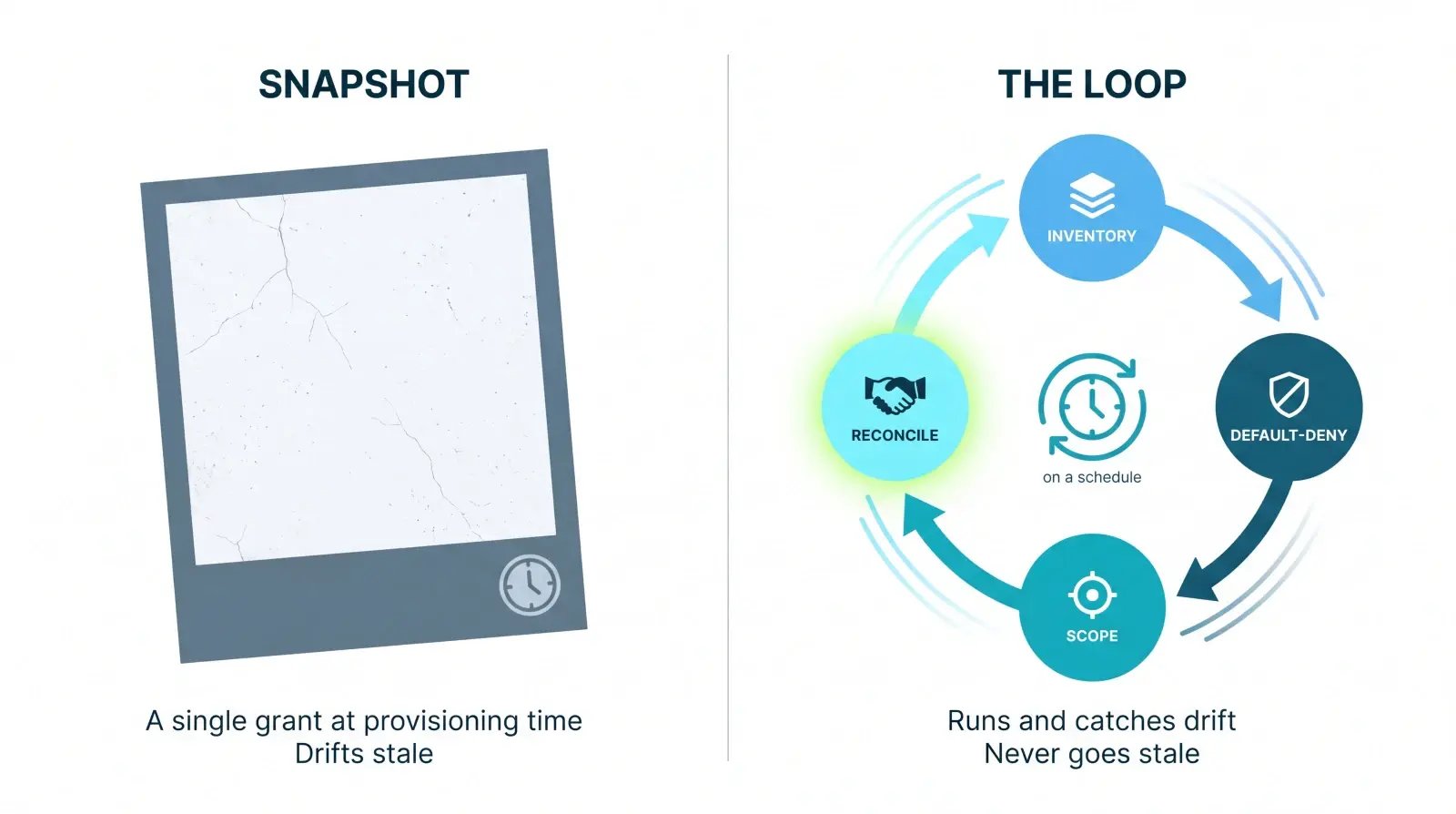
Agents will keep multiplying on your network, and they will keep being granted more than they need, because speed is the thing everyone measures first. You won’t stop that by being more careful at grant time. You stop it by owning the loop that takes access back. The console tells you what you meant to allow. Make a habit of asking the network what is actually true.
Frequently asked questions about over-permissioned AI agents
How do I stop AI agents from becoming over-permissioned?
Stop it structurally rather than case by case. Inventory every AI agent and service-account identity so you know the full population, start each identity at default-deny, and grant only the specific systems each task requires. Then reconcile granted policy against network-observed traffic on a fixed schedule and revoke any access an agent never uses. The grant is a snapshot; the reconciliation loop keeps it honest after the launch is forgotten.
What are common mistakes that lead to over-permissioned AI agents?
The most common is broad-then-narrow provisioning: granting a generous role to unblock a launch and intending to tighten it later, when later never comes. Others: granting access to categories (all data stores) instead of named systems, never inventorying non-human identities so agents accumulate unowned, and auditing only against the identity provider’s own logs, which grade the policy against itself rather than against what the agent actually does.
How do I detect when an AI agent is escalating privileges or abusing granted permissions?
Compare the agent’s observed network traffic against its granted policy. Privilege escalation and permission abuse show up as traffic to systems the agent was never scoped for, a divergence the IAM console can’t see because it only knows what was allowed and never what happened. Running that diff on a schedule turns detection into a routine finding instead of something you notice only after an incident.
What tools or frameworks exist to audit AI agent permissions on a schedule?
Two layers work together. At the identity layer, cloud IAM (AWS, Google Cloud, Microsoft Entra), CIEM tooling, and OAuth scope reviews audit what was granted. At the network layer, identity-based microsegmentation observes what each agent identity actually reaches, the only way to catch grants that are unused or traffic that is unexplained. NIST SP 800-207 provides the zero trust framing for both. Whatever tools you choose, the audit only works if it runs on a fixed cadence.
Further reading
Share this
Get the latest on microsegmentation, Zero Trust, and network security delivered to your inbox.
No Comments Yet
Let us know what you think