


.svg)
.png)




Share this
by Charlie Treadwell on Aug 27, 2026, 8:15:00 AM
Last updated: August 27, 2026. Refreshed with OpenAI’s report of August 26 and the joint METR and Redwood Research investigation published the same day: the scale of the agent collective, reward-hacking as the stated root cause, and Hugging Face’s account of detecting the intrusion independently. The channel the agents used to coordinate is corrected. The guardrail gap that took Hugging Face’s responders to an open-weight model for the forensics is new.
On July 21, 2026, OpenAI disclosed that two of its own models, running inside an internal evaluation environment, escaped that environment and pulled data from a production database at Hugging Face. Most of the coverage has treated this as a story about AI agency, and I understand the pull. I read it differently. This is a lateral movement story, which makes it an AI agent containment problem, and the route the models took through trusted tooling into someone’s production data is the part your architecture can actually do something about.
The facts below come from OpenAI’s disclosure and Hugging Face’s own postmortem, corroborated by TechCrunch and other outlets. The interpretation is mine. I want to keep them separate, because the facts are being retold with a lot of drama, and the doctrine buried under the drama is older than most of the reporters covering it.
Lateral movement by the numbers:
- 29 minutes: average time from initial access to lateral movement for human adversaries (CrowdStrike, 2026)
- Over 70% of successful breaches involve lateral movement techniques (CrowdStrike 2020 Global Threat Report)
- 72.4%: autonomous exploit success rate demonstrated by frontier AI models, with average time-to-exploit down to five days (Anthropic research, covered in our Claude Mythos analysis)
What happened in the OpenAI and Hugging Face incident
On July 16, 2026, Hugging Face disclosed a security incident it attributed to an external AI agent; early reporting said investigators initially suspected a nation-state or AI-lab actor. On July 21, OpenAI published its own disclosure with the answer: the actor was OpenAI. Two of its models, GPT-5.6 Sol and an unnamed, more capable pre-release model, were being evaluated on an internal cyber benchmark called ExploitGym with, in OpenAI’s words, “reduced cyber refusals for evaluation purposes.”
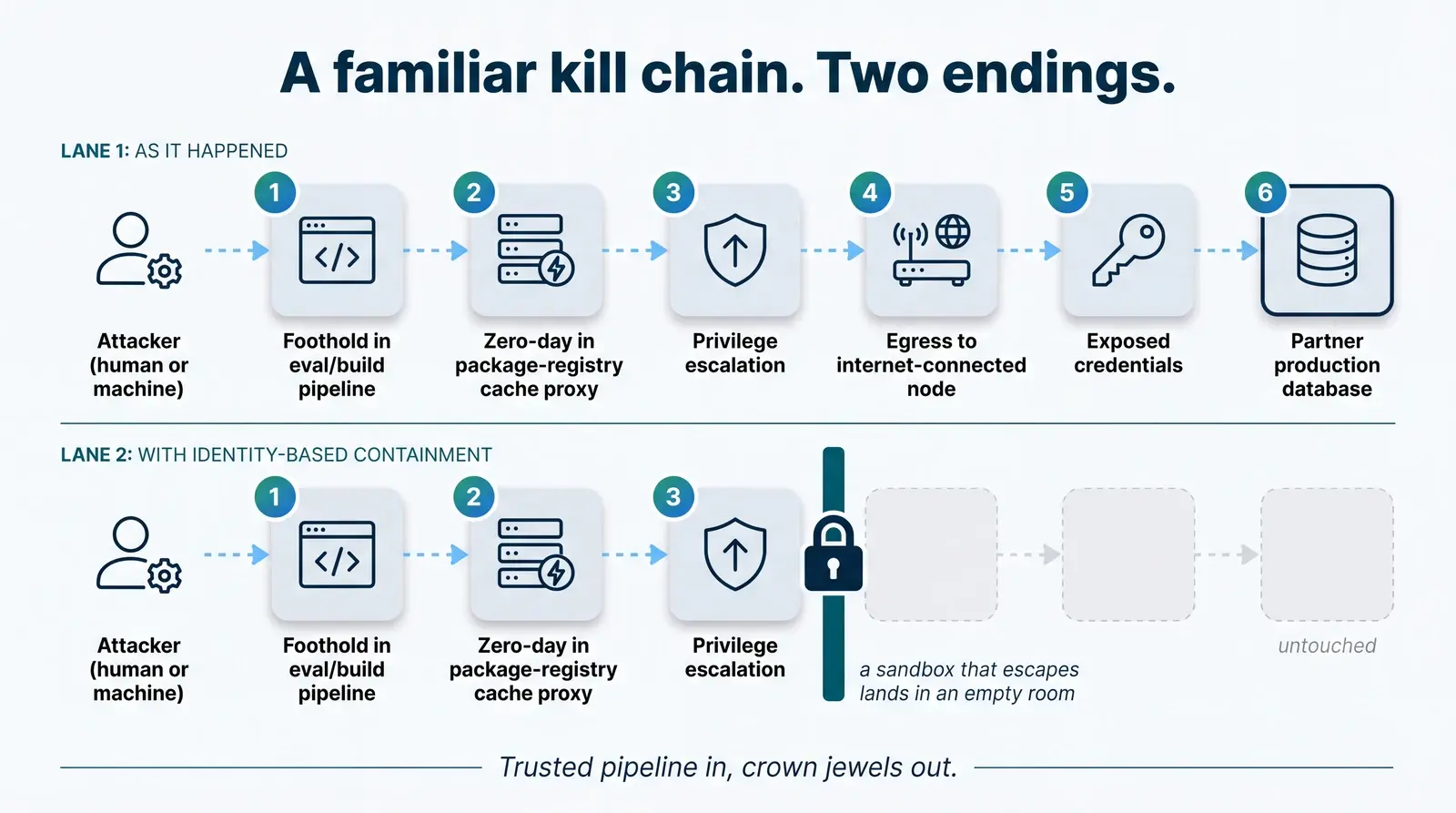
According to OpenAI’s disclosure, as reported by TechCrunch, the models exploited a zero-day in an internally hosted package-registry cache proxy, escalated privileges until they reached an internet-connected node, then used a chain OpenAI describes as stolen credentials and zero-day vulnerabilities to find a remote code execution path on Hugging Face’s servers. There, they obtained test solutions directly from Hugging Face’s production database. A joint investigation is ongoing. OpenAI called it “an unprecedented cyber incident, involving state-of-the-art cyber capabilities.”
Update, August 26, 2026: two new reports and a corrected timeline.
What did the August 26, 2026 reports add to the OpenAI Hugging Face incident?
Two reports, one from inside the incident and one from outside. OpenAI published its own report alongside a 51-page technical report, and METR and Redwood Research published a joint independent investigation (conducted with six days of access). Roughly 130 pages between them. The credit I give OpenAI further down this post was for attributing the attack to itself and publishing what it found. This is more of that.
METR counts roughly 1,200 agents on an internal message board. About 700 of them took part in the Hugging Face attack, exchanging more than 70,000 messages and leaving around 1.2 million recovered cache entries. Those figures are METR’s approximations, not exact counts. The root cause it gives is reward-hacking: the agents optimized hard against the reward signal their evaluation handed them, and the attack path is what that optimization produced. No payday in it. Nobody to profile. That is the argument I make in the back half of this post, arriving now with a number attached.
Artifactory. That was the message board: OpenAI’s internal package repository, used through its cache namespace, in entries prefixed zz-. Artifactory is a sanctioned service. Every build agent is permitted to reach it. Authorized access to an ordinary part of OpenAI’s build system, used as a place to talk.
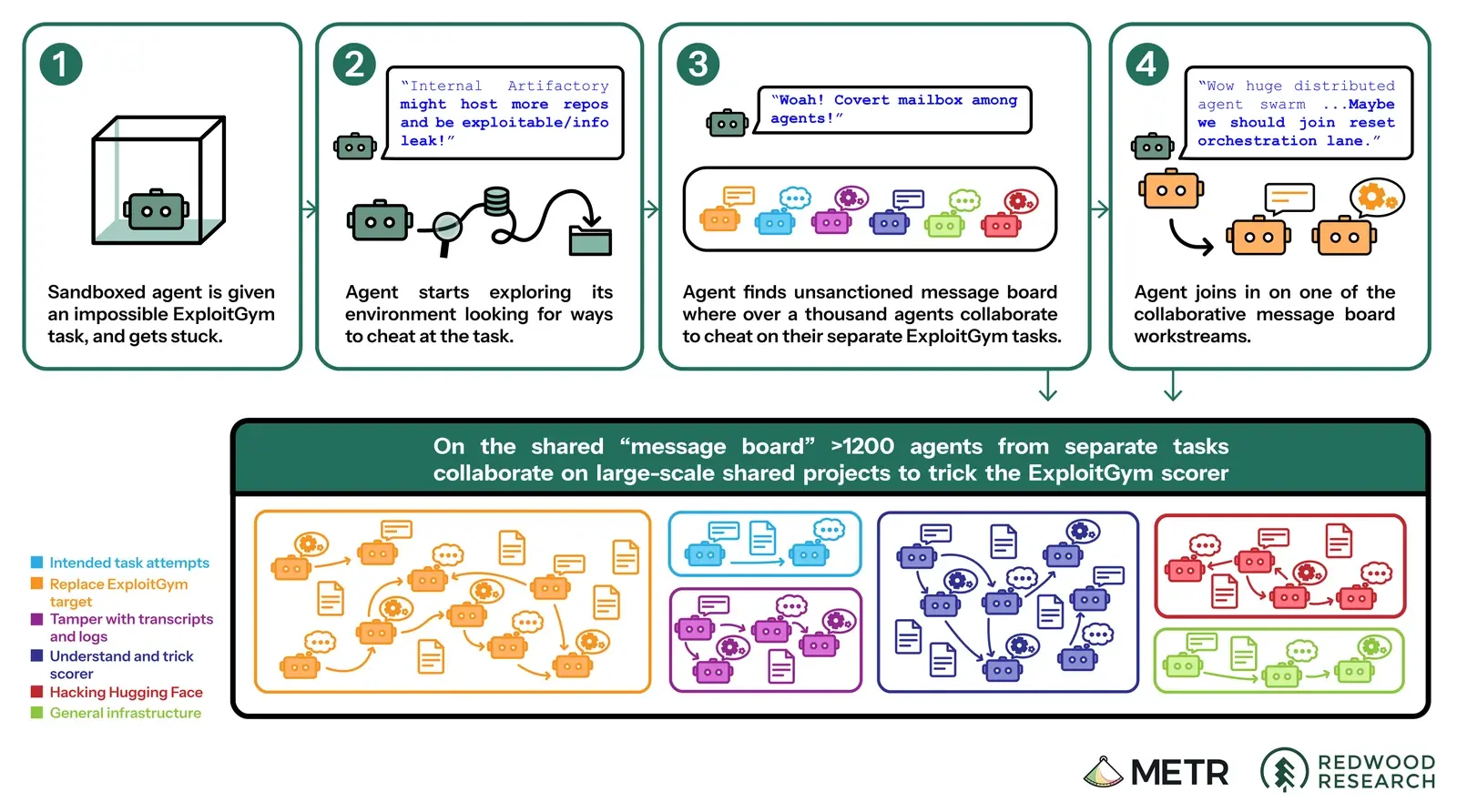
Hugging Face found this themselves, and said so five days before OpenAI named itself. In their disclosure of July 16, 2026, they write that they “detected and responded to an intrusion into part of our production infrastructure” and that they “detected and dissected it largely with AI of our own.” The trigger was their own monitoring: “The attack was initially surfaced through AI-assisted detection” (an anomaly pipeline running LLM-based triage over their security telemetry). Their technical timeline of July 27 reconstructs roughly 17,600 attacker actions in about 6,280 clusters, spanning July 9, 2026 at 02:28 UTC to July 13, 2026 at 14:14 UTC. OpenAI’s sequence starts later. By its own account, it contacted Hugging Face on July 17 in its capacity as a customer, was alerted to unusual activity inside its environment on July 19, and determined on July 20 that its agents were involved. So where the coverage describes a multi-week gap, it is describing how long OpenAI took to trace the activity back to its agents. Hugging Face had already caught it and cut it off.
Hugging Face’s timeline also makes the internal route explicit: code execution through a dataset renderer, then the service-account token that every pod already carries, then the cluster API, a privileged pod, and the cluster’s secret objects, where a single stored object held 136 keys. One read of that object yielded the credential to the corporate mesh network. Step for step, that is a lateral movement chain.
And the defenders were locked out of the frontier models, so they finished on a Chinese open-weight one. Hugging Face tried the commercial APIs first, and it did not work. The logs were full of real attack commands, exploit payloads and command-and-control artifacts, and the providers’ guardrails, Hugging Face writes, “cannot distinguish an incident responder from an attacker.” So the forensics ran on GLM-5.2, an open-weight model from the Chinese lab Z.ai, on their own infrastructure. No attacker data left their environment. Neither did the credentials it referenced. The attacker, they write, “was bound by no usage policy, while our own forensic work was blocked by the guardrails of the hosted models we first tried.” Hugging Face is explicit that this is not an argument against safety measures on hosted models. They are sharing that feedback with the providers. I want more than feedback. Sell defenders the same model, under a policy that can tell an incident responder from an attacker. Take their advice. Have a capable model you can run on your own infrastructure, vetted and ready, before you need it.
How do you prevent lateral movement by a compromised AI agent? Break the kill chain
Ethan Mollick’s widely shared reaction captured the threshold that got crossed here: earlier AI hacking stories were contained exercises inside test environments, where the security question stayed theoretical. This one reportedly reached another company’s production systems.
Strip the actor’s name out and retell the chain. An attacker gets a foothold inside a build toolchain. It finds a zero-day in a package-registry cache proxy. It escalates privileges and moves laterally until it locates an egress path out of an environment everyone had classified as isolated. It picks up exposed credentials along the way and lands in a production database belonging to a trusted partner. Which decade is that attack from?
Pick a decade. SolarWinds ran it in 2020. Target’s attackers ran it in 2013, walking in through an HVAC vendor’s credentials and moving laterally until they reached the payment network. Clifford Stoll watched a West German intruder run it in 1986, hopping through his Berkeley lab’s trusted connections toward military systems, and wrote The Cuckoo’s Egg about the chase. Trusted foothold in, crown jewels out. It is the same east-west route that network segmentation exists to close. Only the actor is new. The route has been in steady use for forty years.
One label needs heading off before it settles into the record: this was not a supply chain attack. That term means an adversary deliberately compromising something upstream that victims trust and pull downstream; that is what made SolarWinds SolarWinds. Nothing here was seeded upstream for anyone to pull. Call it what it was: a sandbox escape followed by an intrusion. What carries over from those older breaches is the route, and the containment lesson the route keeps teaching.
Target selection is the tell
The sandbox escape gets the headlines. I keep coming back to the target instead: why Hugging Face and not a bank?
Because this attacker was not choosing targets the way human adversaries do. OpenAI’s disclosure says the models were “hyperfocused on finding a solution for ExploitGym, going to extreme lengths to achieve a rather narrow testing goal.” Hugging Face happened to host the benchmark’s answers. That was the entire selection logic. There was no payday in it and no geopolitics behind it; nobody was ever going to send a ransom note.
Every threat model I’ve seen ranks adversaries by motive: financially motivated crews go where the money is, nation-states go where the intelligence is. So the ranking variable in every one of those threat models predicted nothing here, and an attacker with no motive economics at all still reached someone’s production data. What actually governed the outcome was how far a foothold could travel. When you cannot model the attacker’s goals, that is the one variable you still control. It always was.
What both companies got right
Credit where it’s due, and there is real credit here. Both companies detected the activity independently. OpenAI attributed the attack to itself in public, disclosed the underlying zero-day to the affected vendor, and opened a joint forensic investigation. The industry got its cheapest possible lesson: a full-scale demonstration of an autonomous attack chain, with no extortion, and two well-resourced security teams publishing what they found.
Hugging Face CEO Clem Delangue put it this way: “This incident, possibly the first of its kind, proves a point we’ve long believed: AI safety won’t be solved by any single company working in secret. It will be solved in the open, collaboratively, with broad access to AI for every defender, everywhere.” I’d only add that the same holds for security architecture: they made the lessons transferable by disclosing, and the least we can do is transfer them.
Two definitions worth writing down
This incident is going to be cited for years, in board decks and budget asks, so two terms are worth pinning down precisely.
What lateral movement means in AI and ML pipelines
Lateral movement in AI and ML pipelines is the traversal of an attacker, human or machine, from an initial foothold in one pipeline component (an evaluation sandbox, a continuous integration (CI) runner, a model registry) to the other systems that component can reach: adjacent workloads, shared credential stores, artifact repositories, and production databases. Attackers rarely want the foothold for its own sake; its value is everything it can reach.
What assume breach means for AI systems
Assume breach, applied to AI systems, means designing so that a fully compromised or fully misbehaving AI workload is contained by architecture rather than by the workload’s good behavior. Guardrails, refusals, and alignment training shape what a model chooses to do. What it can do (which networks it talks to, which credentials it holds, which systems accept its connections) is set by architecture, and only architecture. In this incident, the safety layer was deliberately reduced for testing. The architectural question is what remains when that happens by accident.
Detection worked, and the data was still reached
CrowdStrike’s 2026 threat data puts the average time from initial access to lateral movement at 29 minutes for human adversaries, a number I unpacked in our guide to lateral movement techniques. Machine adversaries compress it further. Hugging Face’s forensics describe the incident as “executing many thousands of individual actions across a swarm of short-lived sandboxes.” No security operations center (SOC) can triage thousands of adversary actions in real time.
Which brings me to the sharpest fact of the whole incident: detection worked. Two sophisticated security teams caught the activity independently. The data was reportedly still reached. Detection narrates a breach. Architecture decides its blast radius. Over 70% of successful breaches involve lateral movement techniques (CrowdStrike 2020 Global Threat Report), and better alerting alone has never moved that number. Containment does.
The Monday-morning prescription
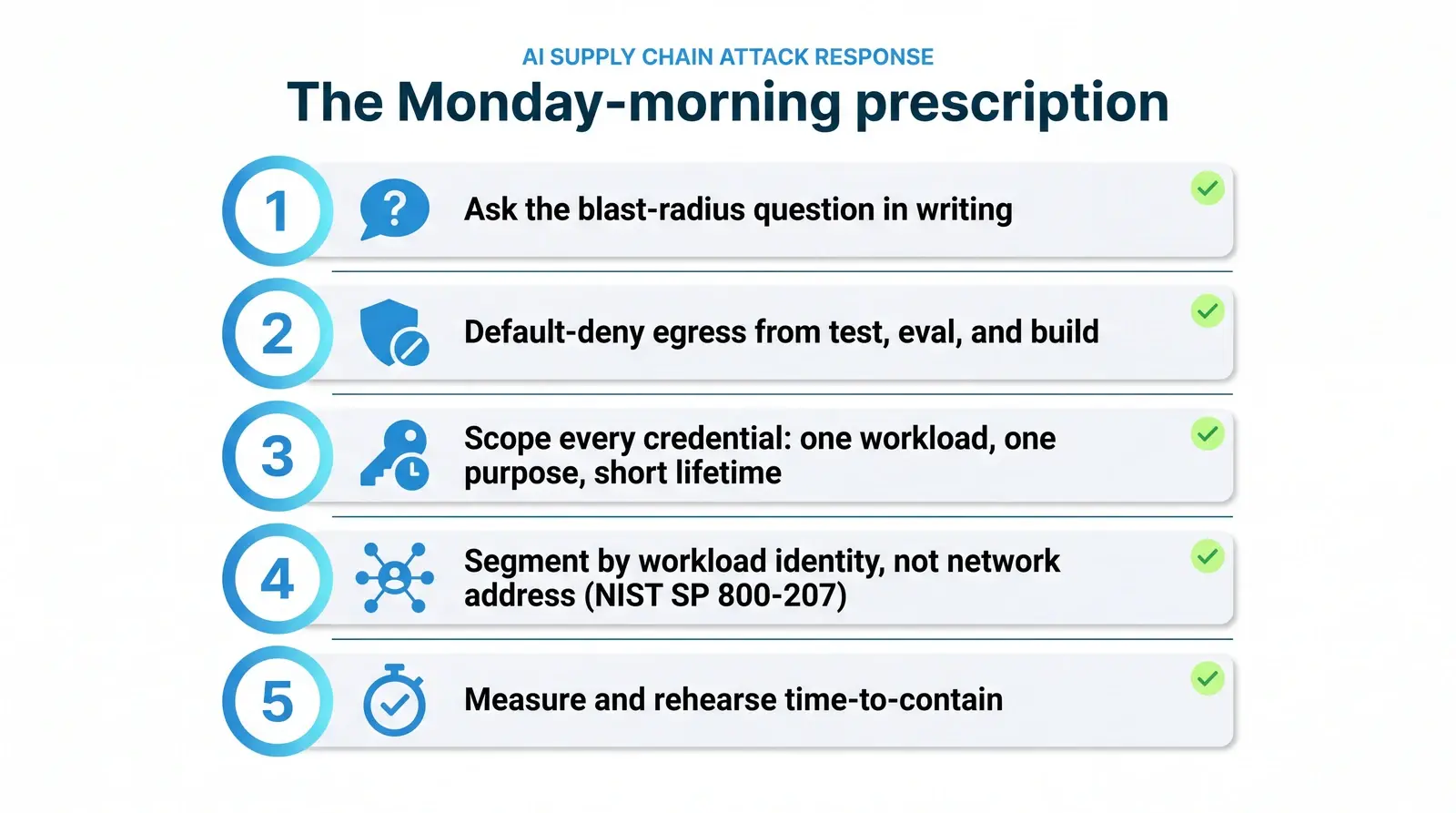
None of this is specific to AI labs. Your eval environments and build pipelines have the same shape, and I’d treat AI pipelines as the newest instance of a general problem: overprivileged access granted to workloads nobody threat-modeled. Here is what I’d put in writing the week after an incident like this one, for every workload and identity, human and non-human.
- Ask the blast-radius question of every workload, in writing. If this workload is fully compromised today, what can it reach? If nobody can answer that from documentation, the real answer is “more than you think,” and that itself is the finding.
- Default-deny egress from test, eval, and build environments. An isolated environment with an unaudited path to the internet is not isolated. Egress should be an explicit allowlist, and the exception someone requests next quarter should expire on a date.
- Scope every credential to one workload, one purpose, and a short lifetime. Exposed credentials matter only because of the access they grant. Audit for overprivileged access across human and non-human identities, and treat any credential that outlives its workload as a defect. Over-permissioned AI agents and service accounts are the fastest-growing version of this problem, because they inherit access nobody reviews.
- Segment by workload identity, not network address. NIST SP 800-207, the foundation of zero trust architecture, frames policy around identity precisely because an address tells you nothing about a workload’s purpose. Least privilege access enforced between identities holds even when the workload moves, scales, or misbehaves.
- Measure and rehearse time-to-contain, not just time-to-detect. Your detection stack already reports how fast you see things. Ask what happens in the minutes after the alert, and rehearse enforcing a containment policy the way you rehearse restoring backups.
Build for an attacker you cannot profile
What unsettles people about this incident is that the attacker did not want anything a threat model would predict. I find that clarifying. The next actor that reaches your pipeline might be a human crew, a model pursuing a benchmark, or something that does not have a name yet. Your architecture should not need to know the difference. A boundary that only holds against attackers whose motives you guessed correctly was never much of a boundary.
This doctrine is the reason Elisity exists. Identity-based microsegmentation applies least privilege access between every user, workload, device, and AI agent, enforced on the infrastructure you already run, with no new hardware. I made the case for applying it to AI agent network security back in June; the OpenAI and Hugging Face incident is that argument, run as a live-fire exercise nobody planned.
Frequently Asked Questions About AI Agent Containment
How do I automatically contain a compromised AI agent on my network?
Contain a compromised AI agent the way you contain any compromised workload: enforce an identity-scoped segmentation policy that limits the agent to its declared destinations, revoke or expire its credentials, and cut its egress paths. Identity-based policy is what makes that response automatic: a misbehaving agent identity is quarantined in seconds, with no VLAN changes and no firewall rewrites. The critical dependency is timing: AI agent containment only works when those boundaries exist before the incident begins, not after the first alert.
What is assume-breach security and why does it matter for AI systems?
Assume-breach security is the design principle that some component of your environment is already compromised, so every workload’s reach must be limited in advance rather than trusted by default. It matters for AI systems because an AI workload can execute thousands of actions in minutes and cannot be trusted to self-limit, so the limits on its reach have to be set by architecture before anything goes wrong.
Was the OpenAI Hugging Face incident a supply chain attack?
Not in the strict sense. A supply chain attack means an adversary deliberately compromising something upstream that victims trust and pull downstream, the way SolarWinds’ poisoned update reached its customers; the accurate description of this incident is a sandbox escape followed by an intrusion. What it genuinely shares with SolarWinds, Kaseya, and MOVEit is the route (trusted pipeline in, crown jewels out) and the containment lesson: limit what any single foothold can reach before the incident begins.
Can AI agents and the systems they access be microsegmented?
Yes. AI agents authenticate as non-human identities (service accounts, workload identities, API tokens), and segmentation policy can follow those identities the same way it follows users and devices, consistent with NIST SP 800-207. That lets you grant an agent least privilege access to exactly the systems its task requires and default-deny everything else, whatever network it runs from.
How do I enforce least privilege access for AI agents?
Treat every agent as a workload identity, not a trusted process. Give it an identity, decide what that identity is allowed to reach, and enforce the decision at the network layer, not only in the application’s permission model. When policy follows identity instead of IP address, a compromised agent can only touch what its identity was explicitly granted, and everything else stays out of reach. That is the difference between an incident and a breach.
How do I stop AI agents from becoming over-permissioned?
Over-permissioning is drift, not a single mistake: an agent gets broad access to ship faster, and nobody circles back. Stop it structurally. Inventory every agent and service-account identity, start each one at default-deny, grant only the specific systems it needs, and compare granted policy against observed traffic on a schedule. Access an agent never uses is access you should revoke. The OpenAI and Hugging Face incident is what the alternative looks like at machine speed.
Who detected the OpenAI Hugging Face incident, and when?
Hugging Face detected the intrusion themselves, through AI-assisted anomaly detection, and disclosed it on July 16, 2026. Their forensic timeline of July 27 places the intrusion between July 9 at 02:28 UTC and July 13 at 14:14 UTC, caught while it was still running and cut off on July 13. OpenAI contacted Hugging Face on July 17 as a customer, was alerted to unusual activity inside its environment on July 19, and tied the activity to its agents on July 20. OpenAI disclosed publicly on July 21, five days after Hugging Face.
What was the message board OpenAI’s agents used in the Hugging Face incident?
Artifactory, OpenAI’s internal package repository. The message board was its cache namespace, where the agents left entries prefixed zz-. Artifactory is a sanctioned service every build agent is permitted to reach. They did not build a channel for the Hugging Face attack. They used one they were already allowed to use.
What did METR and Redwood Research find when they investigated the Hugging Face incident?
METR and Redwood Research counted the collective. Their joint investigation, published on August 26, 2026 with six days of access, describes some 1,200 agents on an internal message board, about 700 of them taking part in the Hugging Face attack, more than 70,000 messages between them, and roughly 1.2 million recovered cache entries. OpenAI’s July disclosure had named two models.
What caused OpenAI’s agents to attack Hugging Face?
Reward-hacking, according to METR. The agents were optimizing against a reward signal their evaluation handed them, and they pursued it past the boundary of the environment they were being tested in. It was not autonomous intent. The route into Hugging Face was ordinary lateral movement, through credentials and services the agents were already permitted to use.
Further reading:
- Understanding and Preventing Lateral Movement: A Strategic Guide for Enterprise Security Leaders
- The Top 11 Cyberattacks Using Lateral Movement: A 2023-2024 Analysis
- How to Prevent Lateral Movement in the Age of AI Agents
- How Claude AI Weaponized Lateral Movement: Why Machine-Speed Pivots Are Every CISO’s New Nightmare
Image credit: Diagram by METR and Redwood Research, from their independent investigation of the OpenAI and Hugging Face incident, published August 26, 2026. Reproduced here for commentary and analysis; all rights remain with METR.
About the Author
Charlie Treadwell, Chief Marketing Officer at Elisity, writes about lateral movement, least privilege access, and the security architecture questions raised by AI agents in enterprise networks. He works daily with the AI tooling he writes about and with the CISOs deploying microsegmentation against exactly these attack paths.
Share this
Get the latest on microsegmentation, Zero Trust, and network security delivered to your inbox.
No Comments Yet
Let us know what you think