





Share this
by Charlie Treadwell on Oct 23, 2026, 6:48:00 PM
Quick answer. To protect systems that can’t be upgraded to post-quantum cryptography (PQC), give each a dated decision: replace it, tunnel its traffic through a PQC-capable gateway, segment it, minimize its data, or accept risk until a fixed date. Canada’s Cyber Centre says it “may be necessary to isolate such systems on the network or to tunnel traffic” (June 2025). Segmentation limits reachability. Only new firmware or hardware fixes the cryptography.

Which systems can’t be upgraded to post-quantum cryptography?
The systems that can’t be upgraded to post-quantum cryptography have cryptography fixed in firmware or hardware, processors too limited for the new algorithms, a vendor that has ended support, or software that cannot change without revalidation. NIST describes the hardest case: in secure boot, “the public key and the program for verifying the signatures are included in the boot code and cannot be updated” (NIST CSWP 39-upd1, updated June 29, 2026).
- Operational technology (OT) controllers and programmable logic controllers (PLCs): firmware changes need a vendor release, testing and a production window. CISA wrote in October 2024 that OT may be “some of the last remaining platforms to achieve post-quantum cryptographic standards.”
- Medical devices on manufacturer validation cycles: the manufacturer controls the software and its validation and regulatory process.
- Building systems: HVAC and access control controllers are vendor-managed and often stay in service far longer than IT equipment.
- Embedded IoT: cameras, sensors and badge readers have small processors and often no update channel.
- Legacy servers and applications with hardcoded cryptography: NIST notes such systems “often have cryptographic functions tightly embedded within their components.”
- Hardware security modules (HSMs) without a PQC firmware path (validated, where FIPS 140-3 applies): the fix is a new module.
How do you find systems that can’t migrate?
Find systems that can’t migrate to PQC through a cryptographic inventory confirmed in writing by each vendor. Network scans miss cryptography compiled into applications, firmware keys and supplier components, so ask each manufacturer which version supports the NIST PQC algorithms, or when support ends. The inventory step in the 2027 budget guide lists the fields to record.
What do NIST, CISA, NCSC and Canada say about systems that can’t migrate?
CISA, Canada’s Cyber Centre and NIST describe containment for systems that can’t migrate. The UK NCSC lists retiring, running to end of life or tolerating the risk. US federal mandates expect replacement and do not mention segmentation.
| Source | Date | What it says | Link |
|---|---|---|---|
| CISA, Post-Quantum Considerations for Operational Technology | October 2024 | “Entities should prioritize network segmentation for legacy OT, end-of-life software, and platforms that require extensive time to apply updates.” | CISA PDF |
| Canadian Centre for Cyber Security, ITSM.40.001 | June 23, 2025 | “It may be necessary to isolate such systems on the network or to tunnel traffic within a PQC-protected encapsulation layer.” | Cyber Centre |
| NIST CSWP 39-upd1, section 4.6 | December 19, 2025; updated June 29, 2026 | Describes a “crypto gateway” or “bump-in-the-wire” for legacy systems; where transition mechanisms are unavailable, plan “compensating controls.” | NIST PDF |
| UK NCSC, PQC migration timelines | March 20, 2025 | Acknowledges systems “not capable of being transitioned to support PQC.” For each system it lists five approaches: in-place migration, re-platform, retire the service, run until end-of-life, or tolerate the risk. | NCSC |
| Office of Management and Budget (OMB) M-26-15, US federal civilian agencies | June 24, 2026 | Such systems “must be identified and given priority for replacement or decommissioning.” For firewalls, VPN concentrators and proxies that terminate PQC connections: “Ideally, such terminators should be located architecturally as close to the endpoint as feasible.” | OMB PDF |
| NSA, Commercial National Security Algorithm Suite (CNSA) 2.0 FAQ v2.1, national security systems | December 2024 | Equipment that cannot support CNSA 2.0 “must be phased out” by December 31, 2030, “unless otherwise noted”; fielded systems must upgrade or obtain a waiver. | NSA PDF |
The sources split on one point. OMB M-26-15 and CNSA 2.0 expect replacement, decommissioning or a waiver. Canada’s roadmap counts systems that are isolated or tunnelled toward its milestones: completing them “implies that quantum-vulnerable algorithms are disabled, isolated or tunnelled.” CISA prioritizes segmentation for legacy OT, and NIST describes crypto gateways and compensating controls. Tolerating the risk (NCSC) works only as an owned, dated decision.
How do you protect a system that can’t be upgraded to post-quantum cryptography?
Protect a system that can’t be upgraded to post-quantum cryptography with five options, usually two or three together: replace or retire it, put a PQC-capable gateway or tunnel in front of it, segment it, reduce the data it handles, or accept the risk until a fixed date.
| Option | What it does | What it doesn’t do | When to use | Relative cost (indicative) |
|---|---|---|---|---|
| Replace or retire | Removes the vulnerable cryptography or the service | Doesn’t happen quickly: OT and medical replacements need capital, validation and downtime | End state; first choice when a PQC-capable model exists or support is ending | Highest upfront |
| PQC-capable gateway, proxy or tunnel | Protects traffic from the gateway onward. The gateway is often the firewall or VPN concentrator you already run, refreshed for PQC key exchange. | Doesn’t protect the device-to-gateway link or fix signatures the device verifies | Traffic that must stay confidential and crosses networks you don’t control | Medium |
| Segment and restrict reachability | Limits access to approved paths; blocks lateral movement to and through the system | Doesn’t change the cryptography: permitted traffic can still be recorded and decrypted later (harvest now, decrypt later), and forged signatures still pass | Most systems that can’t migrate (CISA prioritizes it for legacy OT) | Low to medium |
| Reduce the data it handles | Cuts sensitive data stored on or sent by the system, where configuration allows | Doesn’t address forged signatures | Systems holding long-lived data they don’t need | Low |
| Accept and document (time-bound) | Records owner, controls and expiry (NCSC “tolerate the risk”) | Doesn’t reduce risk; OMB M-26-15 still expects replacement, CNSA 2.0 a waiver | Low-sensitivity systems near retirement | Lowest |
For cryptographic containment through a gateway or tunnel, Gartner advises CISOs to “plan containment or accelerate the retirement of systems that cannot migrate,” using “encapsulation, cryptographic shims or PQC-protected channels only as governed interim measures” (Gartner research (Elisity reprint), September 17, 2026).
How do you protect devices that cannot be upgraded to post-quantum algorithms?
For devices that cannot be upgraded to post-quantum algorithms, the first option depends on the asset type.
| Asset type | Typical constraint | First option | Interim containment | Notes |
|---|---|---|---|---|
| PLC or controller | Fixed firmware, production change windows | Replace at line refresh; require crypto-agile features in purchases (CISA) | Allow only mapped flows: engineering workstations, human-machine interface (HMI) or supervisory control and data acquisition (SCADA) servers, historians, and peer controllers and I/O in the same cell | Many legacy OT protocols (Modbus/TCP, classic EtherNet/IP) carry no cryptography, so the exposure is firmware signing, secure boot and certificate-based protocols; keep policies static |
| Medical device (FDA-cleared, manufacturer validation cycle) | Manufacturer controls firmware | Manufacturer’s dated PQC roadmap; replace at end of support | Allow only its clinical systems and a controlled vendor path | Reduce patient data where configuration allows; tunnel patient-data flows |
| Building system or HVAC | Vendor-managed, proprietary protocols | Contain; replace at refresh | Allow only the building management server | Main concern is manipulation |
| Legacy server or app with hardcoded crypto | Cryptography compiled in | Crypto gateway (NIST CSWP 39-upd1, section 4.6) | Allow only known clients | Gateway buys time to re-platform |
| HSM without a PQC firmware path | Firmware lacks PQC (validated, where FIPS 140-3 applies) | Replace with a PQC-capable module at renewal | Allow only named application servers | Signatures it issues share its weakness |
| IP camera or embedded IoT | Low compute, no updates | Replace | Allow only its video management system or controller | Keep data on the local segment |
How does network segmentation reduce quantum risk for systems that can’t migrate?
Network segmentation reduces quantum risk for systems that can’t migrate by cutting the paths an adversary can use to reach the system, capture its traffic inside the network, or pivot through it. CISA wrote in October 2024 that “strong OT network segmentation can be particularly effective in mitigating vulnerabilities associated with post-quantum cryptographic compromises by denying attackers access to OT systems.”
- Map required flows: the hosts, protocols and directions the system needs.
- Simulate first: see what the policy would block before enforcing it.
- Enforce default deny at the first managed point where the device connects: a switch port, a wireless controller, a host firewall if the device supports one, or a dedicated gateway. Allow only approved flows, including between peers on the same subnet. Devices sharing an unmanaged switch below that point can still reach each other, so find those first. Keep firewalls for traffic between zones and at the perimeter; enforcement at the connection point covers device-to-device traffic inside a zone, which never reaches the firewall.
- Keep OT policies static: change them through change control rather than automatically.
- Record the policy ID in the exception register.
What quantum risks does segmentation leave open?
Network segmentation leaves two quantum risks in place, each with a different fix: recorded traffic and forged signatures. Segmentation limits reachability; it does not repair weak cryptography.
- Confidentiality (harvest now, decrypt later): traffic on permitted paths, including links that leave your network, can be recorded today and decrypted once a cryptographically relevant quantum computer exists. The fixes are a PQC-capable gateway or tunnel, less data and replacement.
- Authenticity (forged signatures): a device that verifies firmware, code or commands with a quantum-vulnerable signature scheme will accept a forgery from an attacker who can break that scheme, whether it arrives over a permitted path, a vendor channel or removable media. Segmentation narrows the network paths, and the device’s verification check stays as weak as before. PQC-signed firmware or replacement is the fix.
In US federal and national security frameworks, segmentation does not satisfy a PQC mandate on its own.
How do a PQC gateway and segmentation work together?
A PQC gateway and network segmentation protect different parts of the same path, so a system that can’t be upgraded usually needs both. The gateway protects traffic between itself and the far end. Segmentation controls who can reach the device at all, including the link between the device and the gateway, which still runs the device’s old cryptography, or none at all. Neither fixes a quantum-vulnerable signature the device verifies; that takes new firmware or hardware.
| Layer | What it protects | What it leaves open | Who provides it |
|---|---|---|---|
| Segmentation at the device’s connection point | Who can send traffic to the device, including onto its link to the gateway when an enforcement point sits between the device and the gateway; lateral movement to and through the device | The contents of permitted traffic, which anyone with switch or mirror-port access can still read; forged signatures | Identity-based microsegmentation, network access control with access lists, or a host firewall where the device supports one |
| PQC-capable gateway, proxy, tunnel or encryptor | Confidentiality of traffic between the gateway and the far-end terminator, including links that leave your network | The device-to-gateway link (legacy cryptography or none); who can reach the device; forged signatures | Firewalls and VPN concentrators with PQC key exchange, software gateways, inline network encryptors |
| Replacement or PQC-capable firmware | The device’s own key exchange and signatures | Traffic recorded before the upgrade; peers that still negotiate classical key exchange | The device manufacturer |
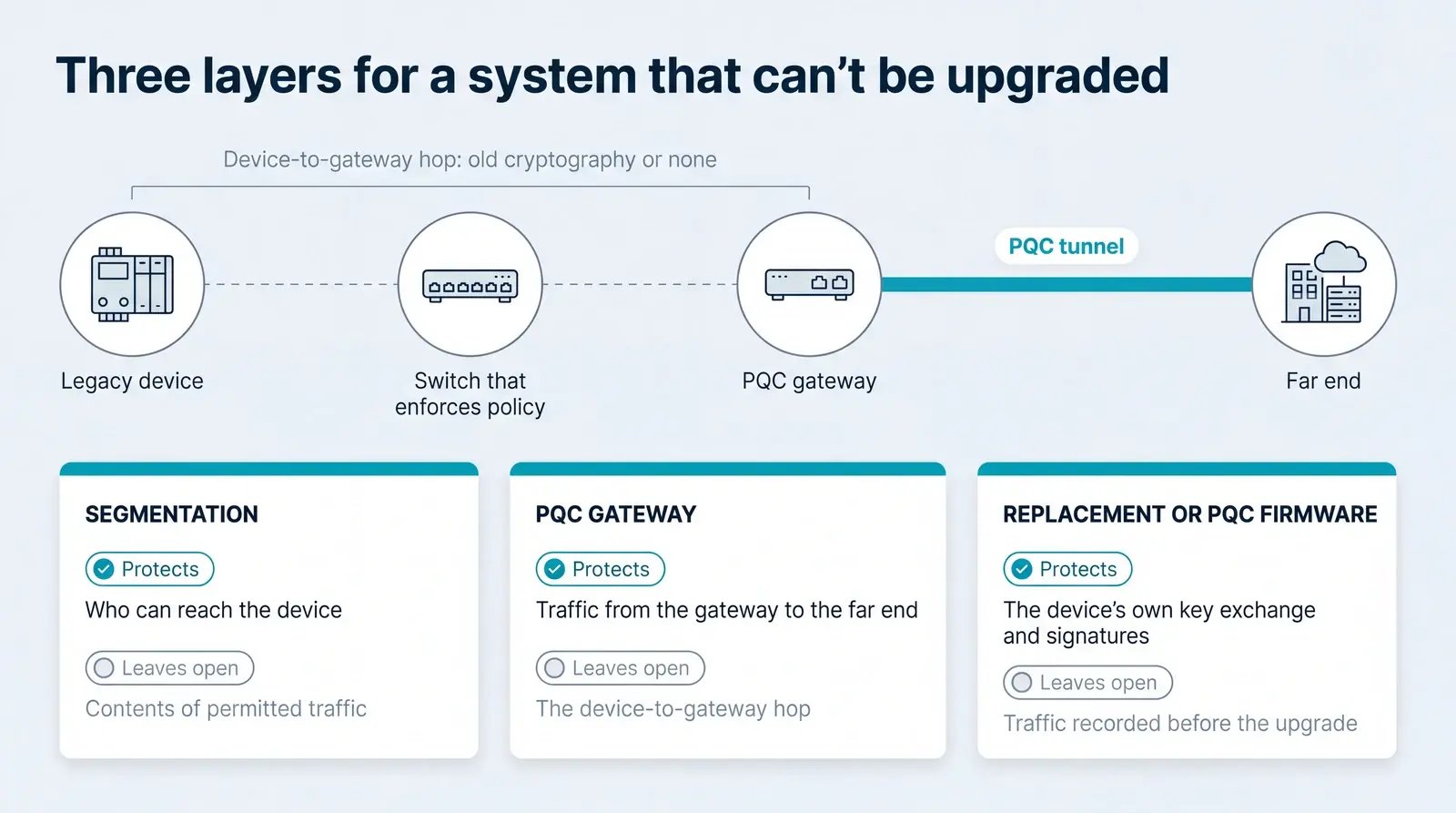
- Mark the flows that need the gateway: traffic that leaves the device’s segment, or carries data that must stay confidential for years.
- Place the gateway as close to the device as you can. OMB M-26-15 gives the same advice for equipment that terminates PQC connections: “Ideally, such terminators should be located architecturally as close to the endpoint as feasible.” Keep it out of the real-time control loop: an inline gateway adds a hop and a point of failure, so decide how it fails before you install it.
- Segment the device so it can reach only the gateway and the flows mapped in the table above: engineering workstations, human-machine interface (HMI) or supervisory control and data acquisition (SCADA) servers, historians and peer controllers. Simulate the policy long enough to see a full production cycle, including maintenance and changeover windows, before you enforce it.
- Check both controls: the protected flows actually pass through the gateway, and no other host can send traffic to the device or to the gateway port it uses. When the device and the gateway connect to the same switch, that switch has to enforce the policy. If it can’t, the hop between them is as open as an unmanaged switch. Segmentation limits who can reach that hop. It doesn’t encrypt it, so anyone with access to the switch or a mirror port can still read the traffic.
- Record both control IDs, the gateway configuration and the segmentation policy, in the exception register with the replace-by date.
Which PQC gateways and encryptors work for systems that can’t be upgraded?
PQC gateway products fall into three groups. The examples below come from each vendor’s own documentation as of November 2026. They are examples, not a ranking or an endorsement. Before you buy, confirm protocol support, throughput, FIPS 140-3 validation status, and whether the product uses ML-KEM alone or a hybrid key exchange.
- Firewalls and VPN concentrators you already run, upgraded for PQC key exchange. Often the cheapest route, because the hardware is already in place. Palo Alto Networks documents post-quantum IKEv2 VPNs based on RFC 9242 and RFC 9370, and Fortinet documents PQC for IPsec keying and agentless VPN in FortiOS 8.0. Check that your model and license support it; Fortinet notes that enabling PQC “can impact tunnel setup rates across most vendors.”
- Software gateways and overlays. Software that sits in front of a legacy system and carries its traffic over PQC-protected TLS or tunnels. QuSecure describes QuProtect R3 as software-only, with a gateway data plane, and markets it for PLCs, historians and the OT/IT boundary without firmware changes. SSH Communications Security’s NQX and Arqit’s NetworkSecure provide what the vendors describe as quantum-safe encryption for data in transit.
- Inline network encryptors. Dedicated appliances that encrypt links between sites. Thales says its High Speed Encryptors include PQC “out-of-the-box” and run at up to 100 Gbps (confirm the rate with PQC on), and Senetas makes network encryptors it describes as quantum-safe.
Every one of these protects traffic between the gateway and the far end. None of them controls which hosts on your network can reach the device behind the gateway, which is the job segmentation does.
How do these options apply in OT and hospitals?
How does quantum risk affect operational technology (OT) and industrial networks?
In OT, the bigger quantum concern is usually integrity: forged firmware, code or commands. CISA says confidentiality attacks “are not as impactful for OT (vs. IT) communications.” The exception is OT traffic carrying long-lived intellectual property, such as recipes and process data, which is still a confidentiality concern and belongs in a PQC-protected tunnel when it leaves the plant. For equipment that cannot change, CISA prioritizes segmentation (see IT/OT segmentation for manufacturing).
What should a hospital do to prepare for quantum risk to patient data?
A hospital should prepare for quantum risk to patient data by treating it as a long-lived confidentiality problem: records stay sensitive for years, so quantum-vulnerable traffic recorded today can be decrypted later.
- Inventory every networked medical device.
- Get a dated PQC roadmap in writing from each manufacturer.
- Rank devices by the confidentiality lifetime of the patient data they handle.
- Log each device without a roadmap as an exception with an owner and a replace-by date.
- Segment each device to the clinical systems it must reach.
- Tunnel patient-data flows that leave the device segment through a PQC-capable gateway.
Forged firmware or commands on a medical device are a patient-safety risk as well as a privacy one. The medical device security guide covers the groundwork.
What should an exception register for quantum-vulnerable systems record?
An exception register for quantum-vulnerable systems should record each system’s owner, cryptography and use, data lifetime, reason it can’t migrate, containment and replacement date.
Illustrative example; not a real device or customer.
| Field | Example |
|---|---|
| System and owner | Infusion pump fleet, Model X; director of clinical engineering |
| Business service | Medication administration, inpatient units |
| Algorithm and use | RSA key exchange to the pump server (confidentiality); ECDSA firmware signing (authenticity), as separate lines |
| Data sensitivity and confidentiality lifetime | Patient identifiers and dosing records; life of the medical record |
| Reason it can’t migrate | No PQC firmware; successor needs clinical validation and capital |
| Compensating controls | Segmentation policy [SEG-xxxx], simulated then enforced; PQC-capable tunnel from pump server to the electronic health record (EHR) system |
| Allowed communication paths | Pump to pump server; pump server to EHR; vendor support via jump host |
| Review date | [Quarter end] |
| Replace-or-retire-by date | [Date], aligned to the capital plan |
| Vendor roadmap reference | Manufacturer letter dated [date]: no PQC firmware planned for Model X |
A tunnel can address key exchange; only new firmware or hardware addresses signatures. An entry without a replace-or-retire-by date is a permanent exception.
Which post-quantum migration deadlines apply?
Post-quantum migration deadlines depend on jurisdiction and sector, and every roadmap below runs to 2035.
| Milestone | Who it applies to | Date | Source |
|---|---|---|---|
| Discovery and initial plan; highest-priority migrations; full migration | UK organizations (guidance) | 2028; 2031; 2035 | UK NCSC, March 20, 2025 |
| Phase 1 strategy, planning and discovery; Phase 2 pilots and early migration | US federal civilian agencies (not national security systems) | 2026 to 2027; 2027 to 2028 | OMB M-26-15, June 24, 2026 |
| Phase 3 PQC key establishment for high-value assets, high-impact systems and highly sensitive data; mitigate as much quantum risk as feasible | US federal civilian agencies | 2028 to 2030; December 31, 2030 | OMB M-26-15, June 24, 2026 |
| Phase 4 signature migration; Phase 5 full migration | US federal civilian agencies | 2031; 2035 | OMB M-26-15, June 24, 2026 |
| New acquisitions CNSA 2.0 compliant; equipment and services that cannot support CNSA 2.0 phased out (each “unless otherwise noted”) | US national security systems | January 1, 2027; December 31, 2030 | CNSSP 15, as summarized in NSA’s CNSA 2.0 FAQ (version 2.1, December 2024) |
| Custom applications and legacy equipment updated or replaced; legacy equipment not refreshed regularly “will require a waiver and a plan to bring it into compliance” | US national security systems | 2033 | NSA CNSA 2.0 advisory, September 2022 |
| First steps and national roadmaps; high-risk use cases; medium-risk complete, low-risk “as much as feasible” | EU member states | End of 2026; end of 2030; end of 2035 | EU PQC Workstream roadmap v1.1, June 2025 |
| Initial plan; high-priority systems; remaining systems | Government of Canada non-classified IT only | April 2026; end of 2031; end of 2035 | Canadian Centre for Cyber Security ITSM.40.001, June 23, 2025 |
| 112-bit RSA and elliptic-curve cryptography (ECC) deprecated; quantum-vulnerable public-key algorithms disallowed | NIST-approved cryptography | After 2030; after 2035 | NIST IR 8547, final, October 27, 2026 |
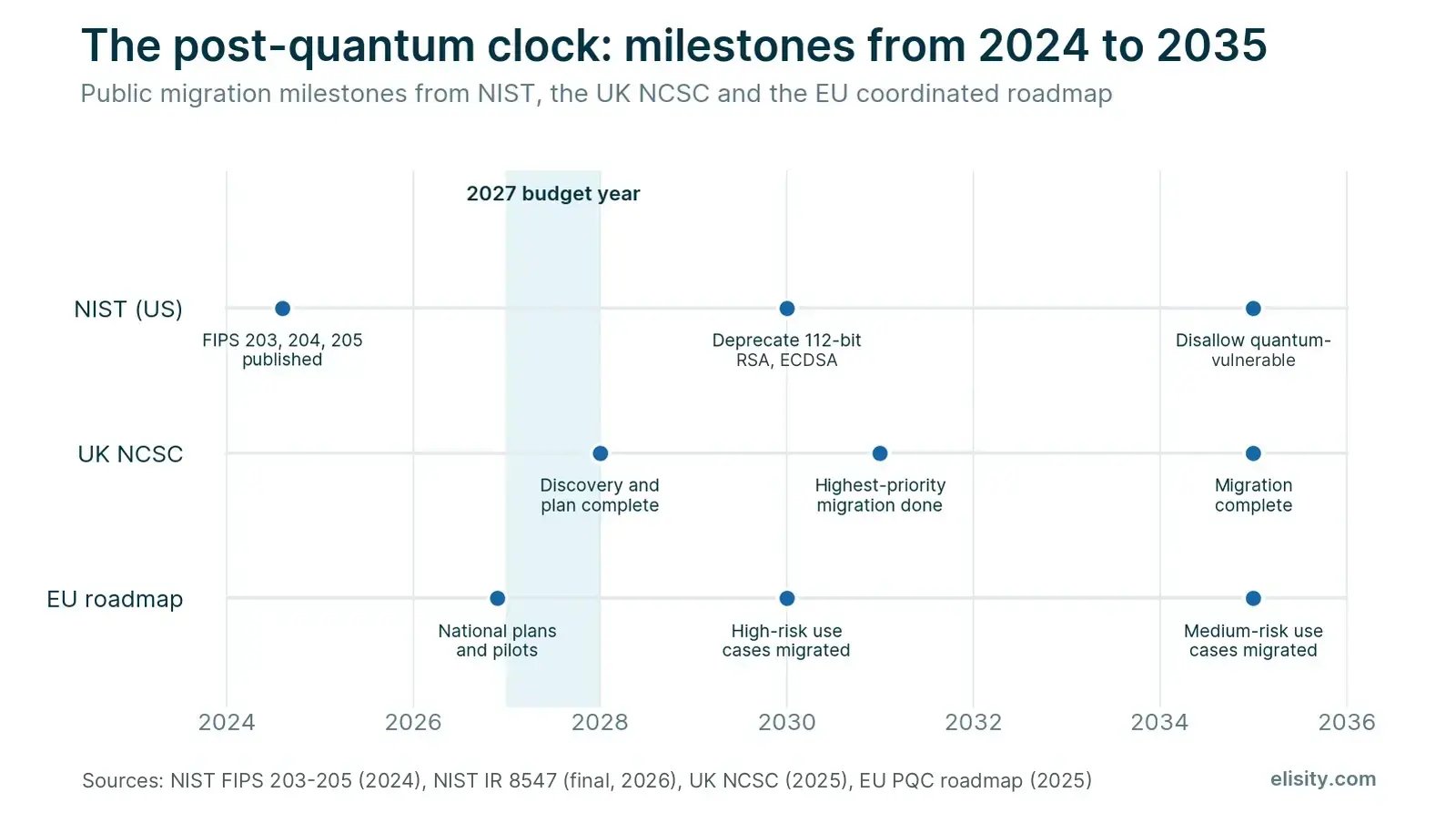
Data that must stay confidential longer than the time left before a quantum computer can break it is already exposed, because traffic recorded now can be decrypted later.
How much should you budget for systems that can’t be upgraded?
For the whole PQC program, including systems that can’t be upgraded, Gartner says that “currently Gartner’s best estimate is that this is a multiyear effort between now and 2030, with an expected budget impact between 1% and 5% of the total IT budget” (Gartner research (Elisity reprint), September 17, 2026). Give each remedy its own budget line.
| Budget line | Type | What sets the amount |
|---|---|---|
| Replacement capex | One-time, often in OT, clinical or facilities capital plans | Units, successor price, installation, validation, downtime |
| PQC-capable gateways and tunnels | One-time and recurring | Protected flows, throughput, support |
| Segmentation policy work | One-time design, recurring upkeep | Assets and flows in scope, simulation time, change windows |
| Exception register upkeep | Recurring | Entries, review cadence, owner hours |
Replacement often sits in another department’s capital plan; pull those dates forward. The post-quantum section of the 2027 budget guide covers the full program.
Where does Elisity fit?
Elisity provides the segmentation layer. It is a security platform for users, devices, workloads and AI agents: IdentityGraph identifies each asset and what it communicates with, you simulate policy against observed traffic, and the Dynamic Policy Engine enforces it at supported enforcement points in your existing network infrastructure, anywhere that infrastructure carries the asset’s traffic, from where a device connects to the data center, including traffic bound for the cloud applications it talks to. No Elisity software agent runs on the IoT, OT and medical devices it protects, which matters because those devices often can’t be upgraded.
Elisity enforces allow-or-deny policy and does not encrypt, decrypt or alter traffic, and it is not inline: the Virtual Edge sits outside the traffic path, so Elisity adds no hop between the device and its gateway. It works alongside a PQC gateway rather than replacing one: Elisity limits the device to its gateway and the peers it needs, and the gateway protects the traffic that leaves. For a PQC gateway, where policy is enforced matters. To control who can reach the device-to-gateway hop, an enforcement point has to sit between the device and the gateway, which in a plant is usually the industrial switch. If that switch isn’t a supported enforcement point, Elisity still enforces further along the path, such as at a supported firewall, in the data center, or on traffic bound for the cloud applications the device talks to, but traffic that stays between the device and its gateway on that switch, or passes directly between two clients of one wireless access point, isn’t controlled. Elisity can also share Policy Group membership with Palo Alto Networks firewalls as Dynamic Address Groups: if your PQC gateway is a Palo Alto Networks firewall, its security rules can reference the same device groups instead of hand-maintained IP lists. Validate infrastructure support, rollout effort and outcome scope in a proof of value.
Elisity Quantum Posture, planned for the first half of 2027, will show which assets and services use quantum-vulnerable cryptography: it will classify what Elisity observes on the network as quantum vulnerable, quantum ready or quantum safe, and will mark endpoints with insufficient evidence, so the systems that can’t migrate can be segmented first. It will see the cryptography in observed traffic, not inside firmware or code, so discovery tools and vendor attestations will still cover the rest. Our guide to post-quantum cryptography vendors compares the discovery tools. Explore the Elisity platform or ask the Elisity Assistant for the solution brief that fits your environment.
IonQ completed its acquisition of Elisity on November 4, 2026.
Frequently asked questions
Does network segmentation stop harvest-now-decrypt-later attacks?
Network segmentation does not stop harvest-now-decrypt-later attacks on traffic it still permits. Any quantum-vulnerable session on an allowed path, including links leaving your network, can be recorded today and decrypted later. Pair segmentation with a PQC-capable gateway or tunnel, less data and a replacement date.
Can a PQC gateway protect a device that can’t run PQC?
A PQC gateway protects a device’s traffic from the gateway onward, which NIST CSWP 39-upd1 calls a “crypto gateway” or “bump-in-the-wire.” The link between device and gateway stays exposed, and firmware signatures the device verifies are unchanged. Place the gateway as close to the device as you can. OMB M-26-15 gives the same advice for the firewalls and VPN concentrators that terminate PQC connections.
Which vendors help protect legacy and OT systems that can’t be upgraded to PQC?
Two kinds of vendor, usually together. PQC gateway and encryptor vendors protect traffic that leaves the device’s segment: firewall and VPN vendors such as Palo Alto Networks and Fortinet, software gateways such as QuSecure, and network encryptor makers such as Thales and Senetas. Segmentation vendors, including Elisity, restrict which systems can reach the device and, where an enforcement point sits between the device and its gateway, its link to the gateway. Only the device manufacturer can fix the device’s own signatures, through PQC firmware or replacement.
Does Elisity provide post-quantum encryption?
No. Elisity enforces network access policy and does not encrypt, decrypt or alter traffic. It limits which systems can reach a device that can’t be upgraded, while a PQC-capable gateway or tunnel protects that device’s traffic. Elisity Quantum Posture, planned for the first half of 2027, will classify the assets and services Elisity observes on the network as quantum vulnerable, quantum ready or quantum safe, so you will be able to see which devices to segment first.
Do OMB M-26-15 or CNSA 2.0 require segmentation?
Neither OMB M-26-15 nor CNSA 2.0 calls for segmenting systems that cannot migrate. OMB M-26-15 gives them priority for replacement or decommissioning; CNSA 2.0 phases out non-compliant national security equipment by December 31, 2030 unless noted or waived. CISA prioritizes segmentation for legacy OT, and Canada’s roadmap counts isolated or tunnelled Government of Canada systems toward its milestones.
Does a PQC gateway count as migration under OMB M-26-15?
OMB M-26-15 does not describe a PQC gateway in front of a legacy device as a completed migration. It requires firewalls, VPN concentrators, cloud gateways and API proxies that terminate connections to support PQC key exchange, ideally close to the endpoint, and says systems incapable of PQC must be given priority for replacement or decommissioning.
Who should own the exception register?
The CISO’s team should own the exception register for quantum-vulnerable systems. Each entry names a system owner, typically clinical engineering, OT engineering or facilities, who accepts the risk and holds the replacement date. The register should feed the capital plan so each replace-or-retire-by date becomes a budget line.
How long can a system stay on quantum-vulnerable cryptography?
A system should stay on quantum-vulnerable cryptography no longer than the earliest deadline that applies to it. NIST IR 8547, final since October 2026, disallows quantum-vulnerable public-key algorithms under NIST standards after 2035; OMB M-26-15 sets 2028 to 2030 for key establishment in high-value federal systems; CNSA 2.0 phases out non-compliant national security equipment by December 31, 2030. Long-lived data shortens the window.
Sources
- Canadian Centre for Cyber Security, ITSM.40.001, Roadmap for the migration to post-quantum cryptography, June 23, 2025.
- CISA, Post-Quantum Considerations for Operational Technology, October 2024.
- NIST, CSWP 39-upd1, Considerations for Achieving Crypto Agility, December 19, 2025, updated June 29, 2026.
- UK NCSC, Timelines for migration to post-quantum cryptography, March 20, 2025.
- OMB, M-26-15, Execution of the Migration to Post-Quantum Cryptography, June 24, 2026.
- NSA, CNSA 2.0 and Quantum Computing FAQ, version 2.1, December 2024.
- NSA, Announcing the Commercial National Security Algorithm Suite 2.0, September 2022.
- EU PQC Workstream, Coordinated Implementation Roadmap for the Transition to Post-Quantum Cryptography, v1.1, June 2025.
- NIST, IR 8547, Transition to Post-Quantum Cryptography Standards (final), October 27, 2026.
- Gartner, CISO Agenda Priority: Transition to Postquantum Cryptography Before It’s Too Late (And Too Expensive), Mark Horvath, Sarah Almond, Thomas Lintemuth, September 17, 2026 (Elisity reprint).
Gartner does not endorse any vendor, product or service depicted in its research publications. Gartner research publications consist of the opinions of Gartner’s research organization and should not be construed as statements of fact. GARTNER is a registered trademark and service mark of Gartner, Inc. and/or its affiliates in the U.S. and internationally and is used herein with permission. All rights reserved.
About the Author
Charlie Treadwell is Chief Marketing Officer at Elisity, where he works with CISOs in critical infrastructure on network segmentation and post-quantum readiness. He writes about the federal and industry rules behind those programs, from CISA and NIST guidance to HIPAA, TSA directives and IEC 62443, and his articles cover microsegmentation, OT and medical device security, and Zero Trust. Read more of his articles or connect with Charlie on LinkedIn.
Share this
Get the latest on microsegmentation, Zero Trust, and network security delivered to your inbox.
No Comments Yet
Let us know what you think