






Share this
by Mike Korenbaum on Nov 25, 2026, 5:25:18 PM
Quick answer. Zero Trust for AI agents applies never trust, always verify, assume breach and least privilege to autonomous agents. Anthropic’s May 2026 guide makes identity checks at the receiving service the primary control and network segmentation the backstop. On the network, that means closing the east-west paths agent hosts do not need, finding shadow AI from observed traffic, and pre-approving how a compromised host gets contained.

AI agents are moving out of the pilot stage. They read mailboxes, query databases and call internal services at machine speed, with whatever access someone granted them at setup. Each one is a new actor on the network. Ask most security teams which systems their agents run on, or what those systems could reach if one of them were compromised, and the answer is often a guess.
Attackers changed too. AI tools help them find weaknesses and turn a published fix into a working exploit faster than most change processes can respond. A control that only slows an intruder down was worth something when the intruder was a person who got tired or bored. Software does not get bored.
Then there is the AI nobody approved. Employees connect AI tools to company data on their own, and machines that never went through a review start talking to AI services. None of this risk stays inside the agent. It lands on the users, devices and workloads the agent touches, which is why a flat network full of trusted zones is the wrong place to start. Anthropic’s Zero Trust for AI agents guide, published in May 2026, says the same thing, and it is specific about what it asks of the network.
Zero Trust for AI agents, in four lines
- The pressure: “Frontier AI models are compressing the timeline between vulnerability and exploit from months to hours” (Anthropic)
- The premise: “trust nothing, verify everything, assume breach has already occurred” (The principles behind Zero Trust)
- The design test: “does this make the attack impossible, or just tedious?”
- The network’s part: “network paths that do not exist rather than paths that are merely inconvenient”
What does Anthropic’s Zero Trust for AI agents framework say?
On May 27, 2026, Anthropic, the maker of Claude, published Zero Trust for AI agents, a framework for deploying autonomous AI agents in the enterprise. It opens on the same pressure: “Frontier AI models are compressing the timeline between vulnerability and exploit from months to hours.” The answer it gives is Zero Trust, summed up as “trust nothing, verify everything, assume breach has already occurred” (The principles behind Zero Trust). It grounds that premise in NIST SP 800-207 and the NSA’s Zero Trust Implementation Guides, then reshapes it for agents.
Three principles carry the framework:
- Never trust and always verify. “Every access request undergoes authentication and authorization regardless of origin.”
- Assume breach. “Segment by identity, implement fine-grained access controls, and ensure that compromising one system doesn’t grant access to others.”
- Least privilege. “By constraining what each identity can access, organizations contain the blast radius of any single compromise.” For agents, the guide extends this to least agency, a term it credits to OWASP, and puts the rule simply: “Least Agency and deny by default, at all times” (Agent implementation workflow).
It adds a design test for every control: “does this make the attack impossible, or just tedious?” The reason: “Agentic attackers have unlimited patience and near-zero per-attempt cost.” Among the controls that survive the test, the guide lists “network paths that do not exist rather than paths that are merely inconvenient.”
The guide does not mention Elisity, and Elisity did not build its platform to it. Both draw on the same Zero Trust principles: the guide restates them for AI agents, and identity-based microsegmentation applies them on the network.
How do Zero Trust principles for AI agents apply to the network?
Never trust: location earns nothing
Elisity bases policy on identity and context rather than location or IP address. It consumes identity and risk context from the systems that already hold it, and from what it observes on the network, and uses that context to place users, devices and workloads into policy groups. Policy between groups decides which systems may talk to which.
Assume breach: stop the sideways move
Stopping lateral movement is Elisity’s core outcome. When a host that runs an agent is compromised, what it can reach is limited to what policy allows between its group and the others. Elisity enforces that policy at supported enforcement points in the network infrastructure you already own, outside the agent’s runtime, with no endpoint software and no network redesign. Where the enforcement point is the access switch a device connects to, two systems can be kept apart even when they share a switch and a VLAN.
Assume breach also means planning the response before it is needed. When a host is suspected, the security team can move it into a restricted policy group, either from Cloud Control Center or programmatically from a SOC or SOAR workflow, and contain it without touching the endpoint.
Least privilege and least agency: decide what agents may reach
The goal is a consistent decision about what AI agents should be allowed to reach. Approved agents should be treated as internal actors whose access must be justified by their work and reassessed as that work or its risk changes. Elisity detects AI agents, sanctioned and unsanctioned, and tags the devices and workloads they run on into policy groups. That assignment is not a one-time label. Policy group membership adjusts dynamically as the context for a device or workload changes, using the identity and risk context Elisity receives from its connector partners and the telemetry it observes on the network. If the context for the host an agent runs on changes, such as a new risk score from an endpoint security connector or new activity in network telemetry, its policy group, and with it what it can reach, changes to match. For the step-by-step method, see how to enforce least privilege access for AI agents at the network layer.
Impossible, not tedious: ask whether the path exists
On the network, the test asks: between two groups of systems with no business reason to talk, is the path closed, or just inconvenient? In Elisity, the policies between two groups can deny all traffic in each direction (Deny All), which removes the route. Before that takes effect, the policy can run in Simulation Mode, which logs the traffic it matches without changing forwarding, so the team sees the impact first. Closed paths and identity checks at the receiving service work together: the guide keeps identity at the receiving service as the primary control precisely so that a system both groups may reach cannot become the pivot.
How do you detect shadow AI on the network?
Shadow AI is the AI nobody approved: tools and agents that employees connect to company data without IT or security review. The guide calls it “a particular risk at this stage, where employees adopt LLM tools without IT awareness, bypassing every control in this framework” (Applying Zero Trust to agentic AI services). You cannot govern what you never see.
Elisity’s AI-agent detection covers both sides. Sanctioned agents and workloads are identified from telemetry from the organization’s approved AI providers. Unsanctioned use is discovered from network telemetry that shows the devices and workloads attempting to reach AI services.
That telemetry, and the tagging of every asset attempting connections to AI services, gives the security team a starting point built from observed traffic rather than a survey. From there the team classifies each one as sanctioned or unsanctioned and puts mitigating controls in place: a refinement of the Elisity policy for that group, or a compensating control further upstream at the firewall.
Where does Elisity fit in Zero Trust for AI agents?
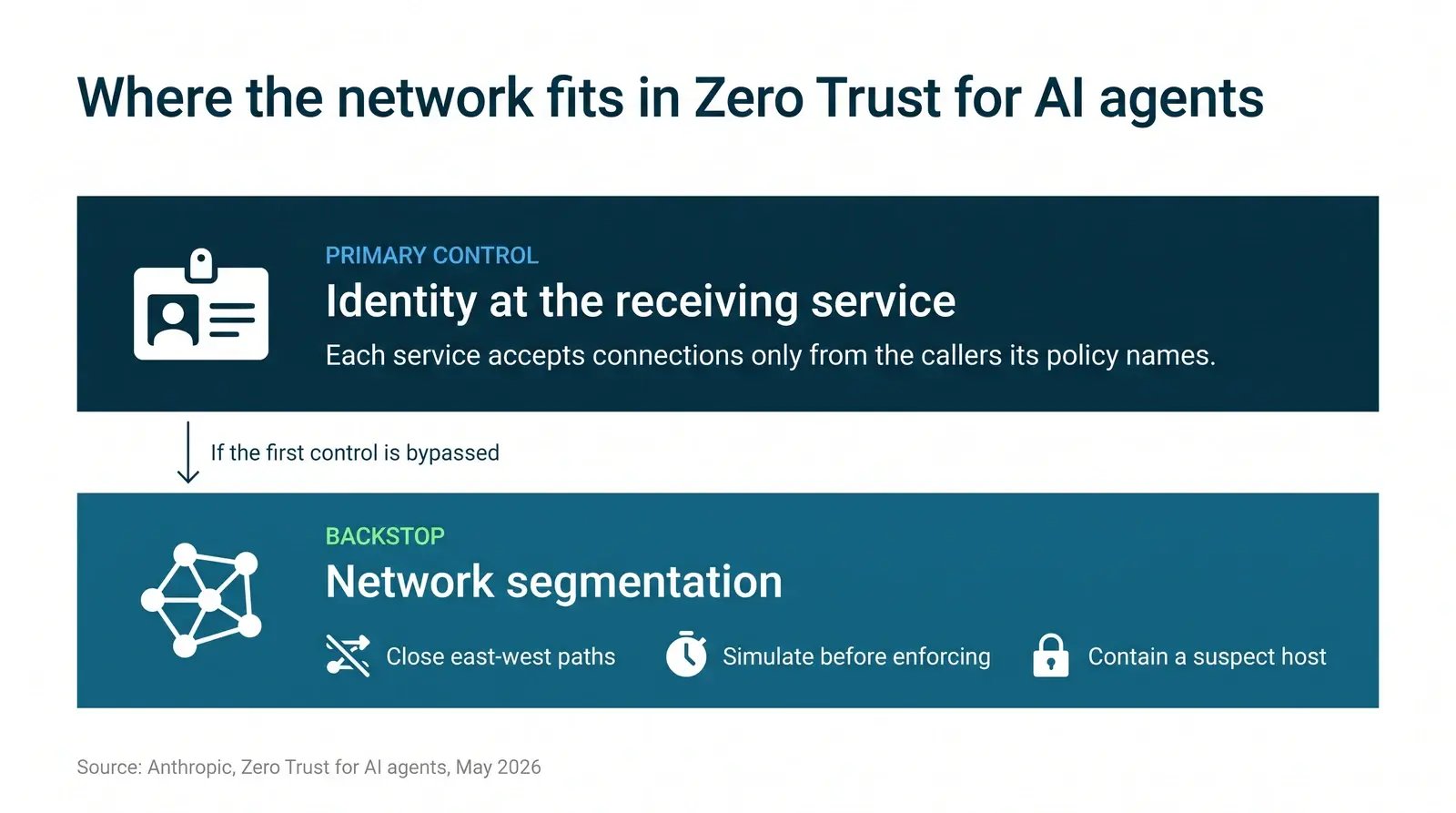
The guide is plain about the order of controls: “Identity-based isolation is the primary control. Network segmentation can still reduce blast radius and noise, but it is a backstop” (Applying Zero Trust to agentic AI services). Its reason: “an attacker who can reach a segment boundary will pivot through it if the services on the other side accept any caller from that network.” The fix for that sits at the receiving service, where each service accepts connections only from the callers its policy names. That is application-level authentication, and it belongs to identity and platform teams.
The guide’s entry-level tier still asks for the network control, calling for “Identity-based isolation of agent workloads, backed by network segmentation” and saying to “Block unnecessary east-west traffic.” That is Elisity’s part, and it follows the same Discover, Classify, Segment, Monitor and Contain sequence Elisity lays out in AI agent network security with microsegmentation:
- Discover and classify. Detect AI agents and the devices and workloads reaching AI services, sanctioned and unsanctioned, and tag them into policy groups.
- Segment. Close the east-west paths agent hosts have no business using, with policy simulated before it is enforced. Where the access switch is a supported enforcement point, that reaches down to systems that share a switch and a VLAN.
- Monitor and adjust. Re-evaluate policy group membership as the context for a device or workload changes, from connector partners and from observed network telemetry.
- Contain. Isolate a suspect device or workload. Elisity’s REST API lets a SOC or SOAR workflow tag the asset and move it into a restricted policy group, whatever quarantine means for that team: locked down from the network entirely, or limited to the set of services needed to remediate it.
One boundary to plan for: an agent that runs entirely in a provider’s cloud, and whose traffic never crosses your network infrastructure, is outside what network policy can observe or enforce. That case belongs to the identity and application controls the guide puts first.
This division of labor is how Elisity describes its role in securing AI agents. AI agents can act across applications, infrastructure and services from many providers. Securing that activity requires identity systems, threat detection, application permissions and segmentation controls to work together. Elisity’s role is the segmentation control that makes the other systems’ context enforceable. As James Winebrenner, CEO of Elisity, puts it: “We have built Elisity around collaboration: bringing together the context our customers’ security tools provide and turning it into enforceable segmentation policy.”
What should security teams do this quarter to secure AI agents on the network?
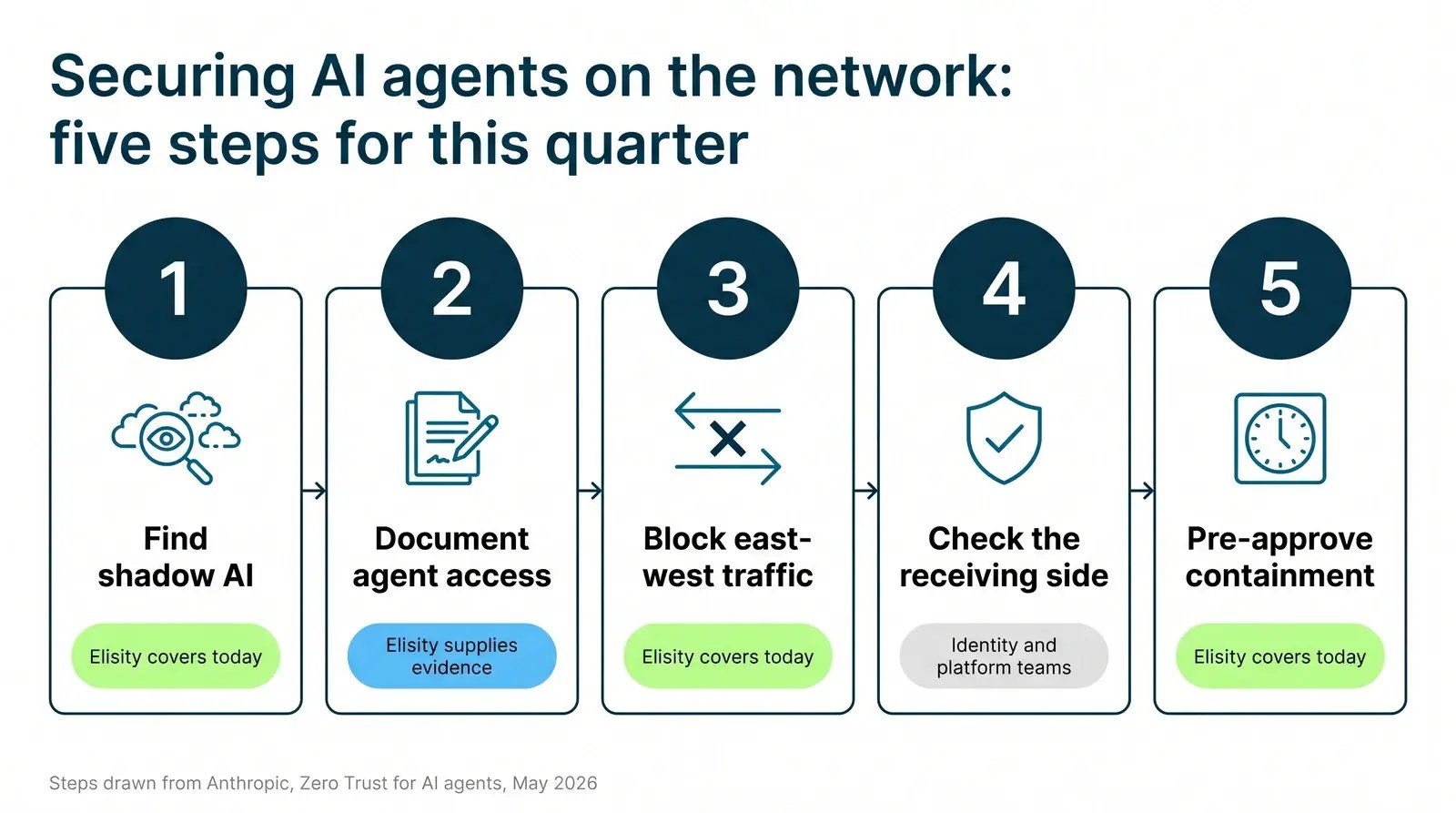
The guide tells teams to start at its Foundation tier, raised to account for faster attackers, and says its Enterprise tier is the target for most organizations with significant deployments. Four steps map to Foundation directly, and a fifth comes from the guide’s chapter on defensive operations. Elisity covers steps 1, 3 and 5 today and supplies the evidence for step 2.
| Step | What the guide asks for | Elisity’s part |
|---|---|---|
| 1. Find shadow AI | “Address Shadow AI where employees use LLMs without IT approval.” | Covers this today. AI-agent detection lists the devices and workloads reaching AI services and tags each into a policy group. |
| 2. Document agent access | “Document intended agent capabilities and access patterns.” | Shows where agents run and what they talk to. What each agent should reach is a business decision. |
| 3. Block east-west traffic | “Block unnecessary east-west traffic.” | Covers this today. Group agent hosts by identity, simulate the policy, then enforce it. |
| 4. Check the receiving side | “have services accept connections only from explicitly named callers.” | Outside Elisity’s role. Application-level authentication sits with identity and platform teams. |
| 5. Pre-approve containment | “Decide in advance who can authorize these, how fast they can be authorized, and what evidence is required.” | Executes the containment today. Who approves it is your governance decision. |
- Find the AI nobody approved. (Elisity covers this today.) Foundation governance asks teams to “Address Shadow AI where employees use LLMs without IT approval.” Start with evidence: which devices and workloads are reaching AI services today. Elisity’s AI-agent detection supplies that list and tags each asset into a policy group.
- Write down where agents run and what they should reach. (Elisity shows where agents run; what they should reach is a business decision.) The Foundation tier asks teams to “Document intended agent capabilities and access patterns.” Elisity shows which devices and workloads run agents and what they talk to today. Deciding what each agent should reach is a business-context call for the owners of that work. Compare the two and look for communication no policy covers.
- Block unnecessary east-west traffic around agent hosts. (Elisity covers this today.) Group the systems agents run on by identity, simulate the policy, then enforce it.
- Ask the receiving-side question. (Application-level authentication; outside Elisity’s role.) For each internal service your agents call, check whether it accepts any caller from its network segment. The guide’s Foundation answer is to “have services accept connections only from explicitly named callers.” That work sits with identity and platform teams; the network boundary narrows exposure while it lands.
- Pre-approve the containment step. (Elisity executes the containment today; who approves it is your governance decision.) “When exploits appear within hours of a patch, response processes that take days are too slow” (Defensive operations at the speed of autonomous threats). For actions like blocking a network path, the guide’s advice is to “Decide in advance who can authorize these, how fast they can be authorized, and what evidence is required.” Build the quarantine into the SOC or SOAR playbook now: which signal triggers it, which restricted policy group the asset moves into, and who approves full lockdown versus remediation-only access.
A standing question
The guide closes by telling architects and engineers to treat the impossible-versus-tedious test “as a standing design review question” (From principles to practice). Bring it to every network path, not only the ones agents use. The principles behind Zero Trust for AI agents are not new. The speed at which ignoring them gets punished is.
To see which of your systems reach AI services today, and what closing the paths around them looks like in simulation before anything is enforced, talk to Elisity about a demo.
Further reading:
- AI agent network security with microsegmentation
- Network policy for devices and workloads running AI agents
- Andy Ellis on how to prevent lateral movement in the age of AI agents
- How to enforce least privilege access for AI agents at the network layer
- The OpenAI and Hugging Face incident: the lateral movement timeline
Frequently asked questions about Zero Trust for AI agents
What is Zero Trust for AI agents?
Zero Trust for AI agents applies the principles of never trust, always verify, assume breach and least privilege to autonomous AI agents. Anthropic’s guide extends least privilege to “least agency,” a term it credits to OWASP, and asks whether each control makes an attack impossible or just tedious.
What role does the network play in securing AI agents?
The guide treats identity checks at the receiving service as the primary control and network segmentation as the backstop that limits blast radius. On the network, that means closing east-west paths agent hosts have no business using and containing a compromised host before it can move sideways.
What is shadow AI?
Shadow AI is the use of AI tools and agents that employees connect to company data without IT or security review. Anthropic’s guide calls it “a particular risk” because it bypasses every other control. On the network, it shows up as devices and workloads reaching AI services that nobody approved.
How does Elisity detect shadow AI?
Elisity identifies sanctioned agents and workloads from telemetry from the organization’s approved AI providers, and discovers unsanctioned use from network telemetry that shows the devices and workloads attempting to reach AI services. Those assets are tagged into policy groups, giving the security team a starting point to classify them and restrict access.
Can Elisity contain a compromised AI agent host?
Yes. A suspect device or workload can be isolated by moving it into a restricted policy group from Cloud Control Center or programmatically through Elisity’s REST API as part of a SOC or SOAR workflow. That group can lock the asset down entirely or limit it to the services needed for remediation.
What is least agency?
Least agency extends least privilege to agentic applications. Anthropic’s guide, which credits the term to OWASP, describes it as restricting “what each agent tool can do, how often, and where.” On the network, the matching control is limiting which systems the device or workload running the agent can reach.
Can AI agents be microsegmented?
Yes, at the device or workload the agent runs on. Elisity places that host in a policy group based on identity and context, and policy between groups decides which systems it can reach. What the agent does inside a connection that policy allows is a matter for identity and application controls.
What controls stop an AI agent from moving laterally?
Two controls work together. Identity checks at the receiving service, where each service accepts only the callers its policy names, are the primary control in Anthropic’s guide. Network segmentation is the backstop: closing east-west paths between groups of systems with no business reason to talk, and moving a suspect host into a restricted policy group.
Does network segmentation replace identity controls for AI agents?
No. Anthropic’s guide says “Identity-based isolation is the primary control” and calls network segmentation “a backstop” that can still reduce blast radius and noise. The two work together: application-level authentication at the receiving service, and segmentation on the network.
Sources
- Anthropic, Zero Trust for AI agents, May 27, 2026.
- Anthropic, Zero Trust for AI agents guide: The principles behind Zero Trust; Security considerations for autonomous systems; Applying Zero Trust to agentic AI services; Agent implementation workflow; Defensive operations at the speed of autonomous threats; From principles to practice.
- NIST, SP 800-207: Zero Trust Architecture, August 2020.
About the Author
Mike Korenbaum is a technology executive with 20+ years of experience leading teams at the intersection of networking, cloud, and security. He has built and scaled global technical-marketing and product organizations, driving innovation across SD-WAN, SASE, and cloud-security platforms, and focuses today on integrating networking, identity, and AI-driven systems to enhance visibility, automation, and operational efficiency at Elisity. Read more of Mike’s articles or connect with Mike on LinkedIn.
Share this
Get the latest on microsegmentation, Zero Trust, and network security delivered to your inbox.
No Comments Yet
Let us know what you think