


.svg)
.png)




Share this
by William Toll on Mar 4, 2026, 4:30:08 PM
Why Healthcare Cybersecurity Vendor Selection Matters in 2026
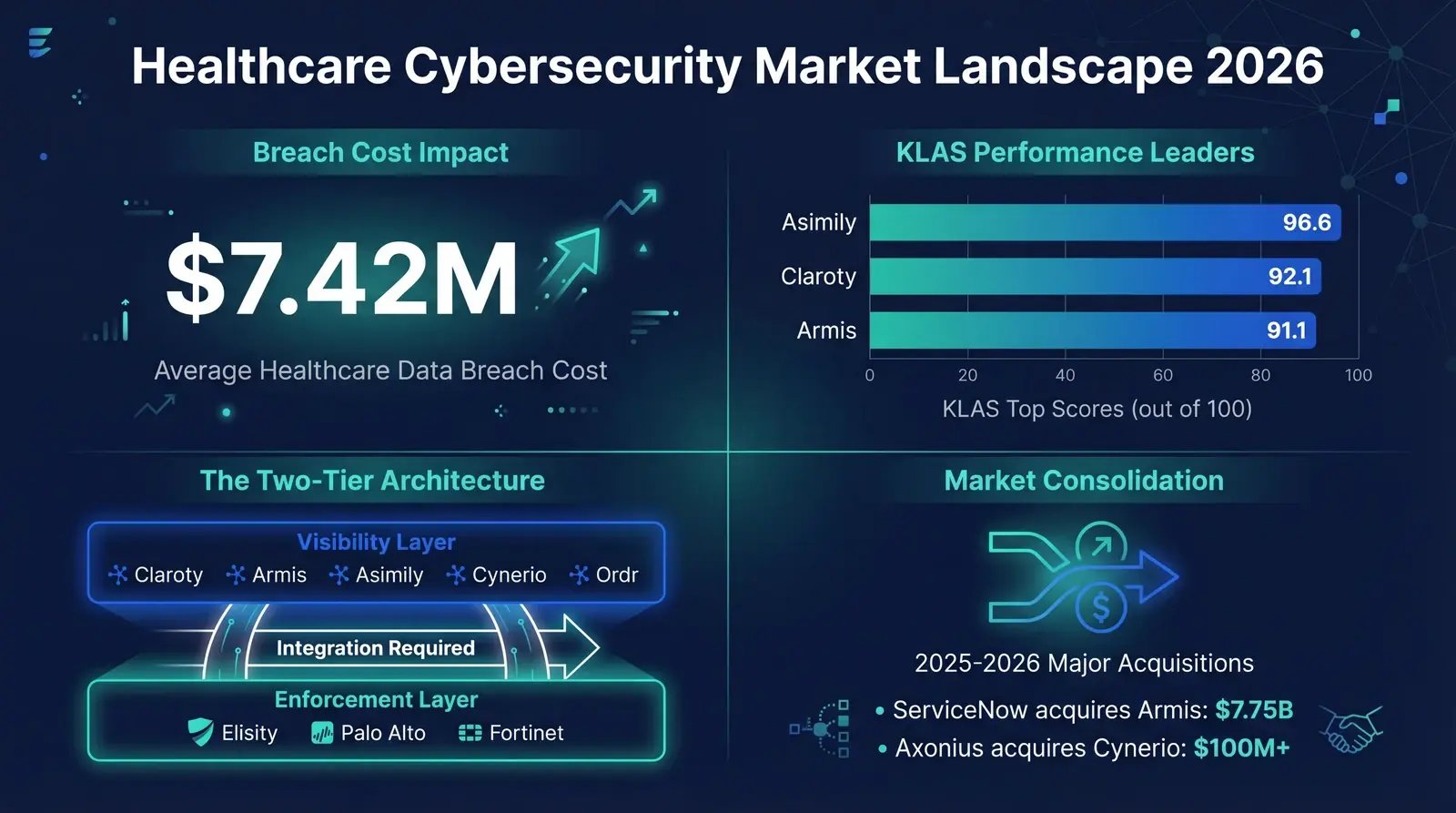
Healthcare data breaches now cost an average of $7.42 million per incident, making healthcare the costliest sector for breaches 14 years running (IBM Cost of a Data Breach Report 2025). That figure does not capture the full picture. The HHS Office for Civil Rights reports a 239% increase in hacking-related breaches over the past five years, with 72% of healthcare facilities now reporting disruptions to patient care during cyber incidents (Proofpoint/Ponemon 2025). Meanwhile, a recent study in the American Economic Journal found that in-hospital mortality increases 34-38% during active ransomware attacks (Neprash, McGlave, Nikpay, 2026).
If you are a healthcare CISO evaluating the top healthcare cybersecurity companies while managing tens of thousands of connected devices across clinical, Internet of Medical Things (IoMT), and IT environments, choosing the right partners is a patient safety decision as much as a procurement one. The catch is that no single vendor covers every layer of healthcare security, and the roster of healthcare security vendors keeps shifting year to year. You need a clear evaluation framework and an honest assessment of where each vendor excels and where gaps remain.
We evaluated 10 of the top healthcare cybersecurity vendors for 2026, scoring them across discovery depth, enforcement capability, clinical workflow impact, and regulatory alignment. Here is what we found.
Quick Answer: Top Healthcare Cybersecurity Vendors by Category
The healthcare cybersecurity companies and healthcare cybersecurity solutions below cluster into four practical categories. Use this as a fast orientation, then read the full evaluation criteria before you build a shortlist.
Best for IoMT Device Visibility: Asimily (KLAS 2026 score: 96.6) and Claroty (KLAS 2026 score: 92.1) lead in healthcare IoT discovery and risk intelligence.
Best for Zero Trust Policy Enforcement: Identity-based microsegmentation platforms like Elisity enforce policies at the network edge without agents, while Palo Alto Networks provides enforcement through its NGFW ecosystem.
Best for Endpoint and Threat Detection: CrowdStrike Falcon provides 100% detection and protection in 2025 MITRE ATT&CK evaluations, with strong healthcare vertical coverage.
Best for Integrated Visibility + Enforcement: Claroty + Elisity and Armis + Elisity integrations combine device discovery with automated policy enforcement for the most complete architecture. In healthcare deployments, that enforcement layer has come online with campus-wide visibility in roughly 30 minutes to two hours, with no disruption to care.
About This Comparison
This analysis comes from a vendor with direct, first-hand deployment experience across converged healthcare environments, not from a research aggregator. Elisity was named number 13 on the 2025 Deloitte Technology Fast 500 North America, posting 8,860% revenue growth from 2021 to 2024, and was recognized as a Gartner Cool Vendor in Cyber-Physical Systems Security (2025). We evaluate every vendor below, including our own approach, against the same criteria a health system CISO would apply, and we call out where Elisity is not the right fit.
How to Evaluate Healthcare Cybersecurity Vendors
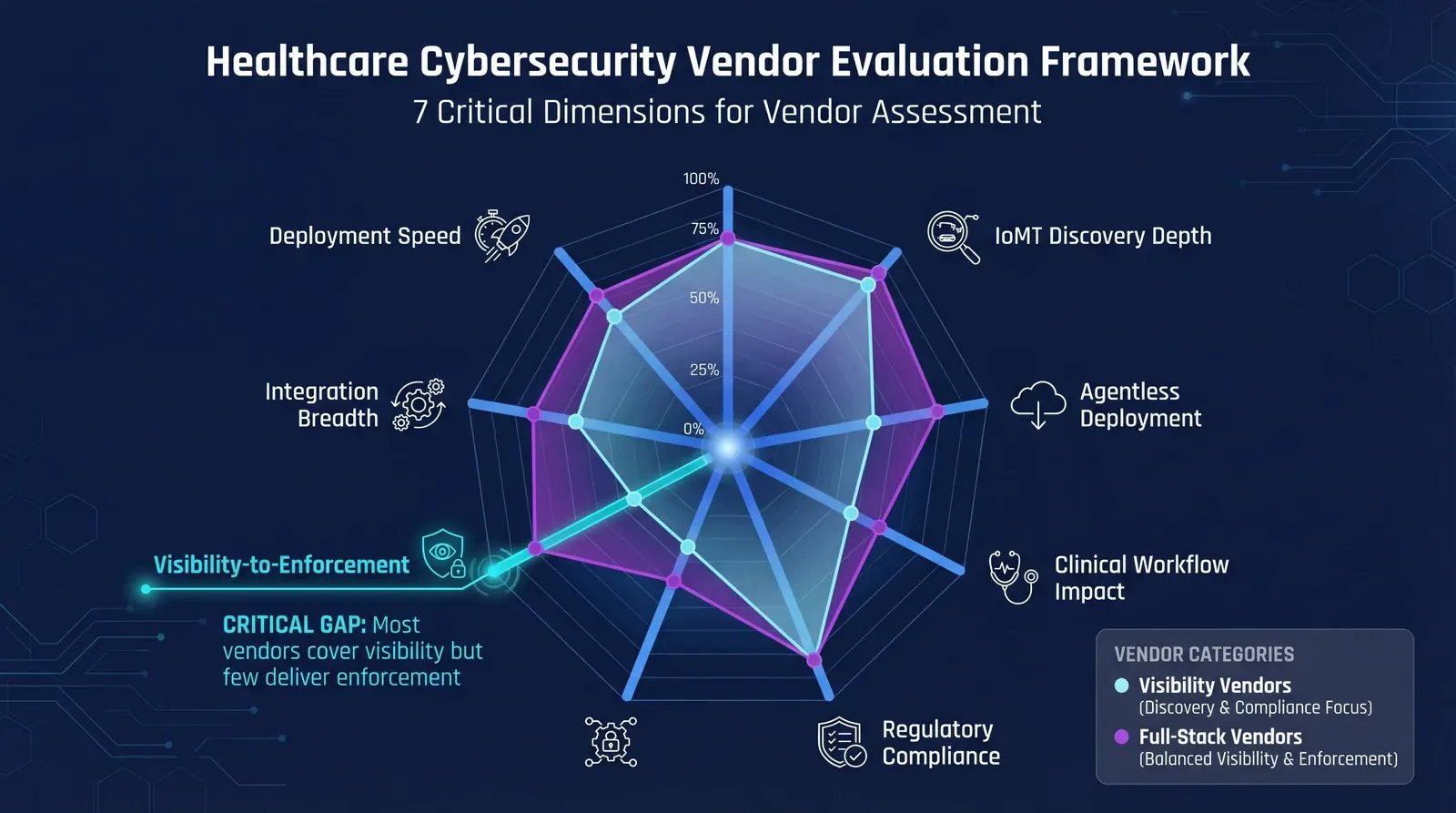
Before comparing individual vendors, it is worth establishing the criteria that matter most for healthcare environments. The evaluation framework below reflects what we have seen healthcare CISOs prioritize when their organizations manage 10,000 to 50,000+ connected devices. For deeper technical detail on microsegmentation architecture for healthcare, see our healthcare microsegmentation guide.
IoMT and Medical Device Discovery Depth
Can the vendor identify and classify infusion pumps, patient monitors, PACS systems, nurse call stations, and building automation alongside traditional IT assets? With 10 to 15 connected devices per hospital bed (CHIME), shallow discovery creates dangerous blind spots. You will want vendors that use deep packet inspection and protocol-level analysis, not just MAC address fingerprinting. This is where medical device cybersecurity companies earn their keep, and it is worth reading the deeper technical detail on IoMT and medical device segmentation before you shortlist.
CVE and Firmware-Level Device Detail vs. Identity/Behavioral Classification Only
Discovery breadth is not the same as discovery depth. Clinical engineering teams doing infusion-pump or imaging-device risk management need model-level and CVE-level firmware detail, not just an identity or a behavioral profile. In practice, some agentless approaches that read telemetry from the infrastructure you already run are candid that they don’t deliver that granularity, and they will point you to a dedicated deep packet inspection platform for that specific job. That’s a reasonable division of labor. But decide up front which tool owns device-level CVE detail, so clinical engineering isn’t left without it. Ask each vendor a direct question: for a given infusion pump, can you tell me the firmware version and the specific CVEs that apply, or only what the device appears to be and how it behaves?
Agentless Deployment Capability
Most medical devices cannot accept software agents. They run embedded operating systems, have FDA-regulated configurations, or simply lack the resources to support additional software. Any vendor requiring agents on endpoints won’t cover your IoMT fleet. That is non-negotiable in healthcare.
The Coverage Math Buyers Should Ask For: IoMT devices such as infusion pumps, patient monitors, and imaging systems generally cannot run an agent. In some healthcare networks, only around 10 percent of the device estate can support one at all. When you compare an agent-based platform against agentless microsegmentation, do not accept a generic “we are agentless where it matters” answer. Ask each vendor for the real percentage of your specific device estate that could ever run their agent, then judge coverage against that number rather than a marketing claim.
Clinical Workflow Impact
Security controls that delay medication dispensing, interrupt telemetry feeds, or block imaging workflows create patient safety risks of their own. The best healthcare cybersecurity solutions operate with near-zero disruption to clinical operations. Ask for deployment references from similar-sized health systems, and don’t skip the question about downtime during rollout.
Regulatory Compliance Alignment
Healthcare organizations face overlapping compliance requirements: HIPAA, the proposed 2025 HIPAA Security Rule updates (which reference network segmentation), HHS 405(d) Cybersecurity Performance Goals, and HITRUST. A mature platform should map its capabilities to a concrete checklist you can hand to your compliance team:
- HIPAA and the proposed 2025 HIPAA Security Rule network-segmentation requirements
- HHS 405(d) Cybersecurity Performance Goals
- IEC 62443 for connected clinical and operational technology
- PCI DSS where payment environments intersect the clinical network
- NIST SP 800-207 Zero Trust Architecture
- CMMC for organizations with federal or research obligations
Health systems increasingly ask healthcare IT security companies to prove this mapping in a single report rather than a slide. One more thing many buyers learn late: organizations with mixed IT, OT, clinical, and pharmaceutical estates are better served by one policy engine that adapts across verticals than by a bolt-on healthcare-specific compliance module that only understands the hospital. If you expect to segment a research lab or a manufacturing site alongside the hospital, weigh that now. See our HIPAA segmentation roadmap for how the framework mapping works in practice.
Visibility-to-Enforcement Architecture
This is the most critical and most overlooked criterion. Many healthcare cybersecurity vendors excel at showing you what is on your network. Fewer can actually enforce policies that prevent lateral movement between those devices. Ask every vendor: once you have discovered a vulnerable device, what happens next? If the answer is “we generate an alert,” that is visibility. If the answer is “we automatically enforce a segmentation policy,” that is enforcement. The best healthcare network security solutions close that loop automatically. Most healthcare organizations we talk to have invested heavily in the first category and are just now realizing they need the second.
Verified vs. Unverified Device Inventory as the Real Starting Metric
Here is a first-hand observation that rarely makes it into vendor datasheets: most large health systems don’t fully trust the device inventory they already have. Multiple sources of truth disagree, spreadsheets are stale, and nobody can say with confidence what is actually on the network. It is an uncomfortable place to start. So the credible early win in the first months is not a finished segmentation policy. It is a defensible answer to a narrower question: which devices are verified and which are unverified? Knowing what is verified versus unverified, before a single enforcement rule is written, is the metric that separates a platform that will actually move your program from one that produces another dashboard. When you evaluate vendors, ask how they establish verified status and how quickly they can tell you what remains unverified across your estate.
Integration Ecosystem Breadth
No vendor operates in isolation. Your healthcare cybersecurity stack should integrate with your SIEM, CMMS, EHR, and existing network infrastructure. You will want to evaluate the depth of integrations (API-level bidirectional vs. syslog-only) and how many out-of-the-box connectors the vendor maintains.
Deployment Speed and Operational Complexity
Traditional network segmentation projects in healthcare have taken 18 to 36 months and required dedicated teams. The market has shifted. Some vendors now deliver meaningful security outcomes that were not possible three years ago in weeks, not years. Ask for typical time-to-value metrics and the FTE burden required to operate the solution post-deployment.
10 Top Healthcare Cybersecurity Vendors for 2026
The list below spans dedicated IoMT specialists, hospital cybersecurity companies with broad platforms, and enforcement-first players. No two solve the same problem, so read each profile for what it does well and where it stops.
1. Claroty (xDome for Healthcare)
Claroty has earned its position as one of the most established healthcare IoT security platforms, earning a KLAS 2026 score of 92.1. The company acquired Medigate in 2022, combining OT security expertise with deep clinical device intelligence. The result is a platform that provides end-to-end visibility across IT, OT, IoMT, and building management systems from a single pane.
Key Strengths:
- Deep protocol analysis for 900+ medical device protocols, covering infusion pumps, ventilators, imaging systems, and clinical lab equipment
- Risk scoring that factors in clinical context, not just CVSS scores, so security teams can prioritize vulnerabilities based on patient care impact
- Pre-built integrations with major EHR platforms and CMMS systems for clinical workflow alignment
- Network segmentation policy recommendations based on observed device communication patterns
Healthcare-Specific Capabilities: Claroty’s Medigate heritage means clinical device classification goes deeper than most competitors. The platform identifies devices down to the firmware version and maps clinical communication flows between devices, EHRs, and gateways.
Limitations: Claroty excels at visibility and risk assessment but relies on integration partners for active policy enforcement. Generating segmentation recommendations and actually enforcing them at the port level on the infrastructure you already run are different capabilities. Organizations with large, flat networks may need a complementary enforcement layer.
Best For: Large health systems (500+ beds) that need deep IoMT visibility and risk intelligence across converged IT/OT/IoMT environments. Pairs well with CrowdStrike for endpoint threat detection or with Elisity for automated policy enforcement.
Healthcare Cybersecurity Market Growth: The healthcare and life sciences cybersecurity market is projected to grow from $27.22 billion in 2025 to $47.85 billion by 2030, a CAGR of 8.2% (MarketsandMarkets). That growth is driven by the explosion of connected clinical devices, tightening regulatory requirements, and the operational devastation of incidents like the Change Healthcare breach, which affected 192.7 million patients and cost approximately $2.9 billion in response (UnitedHealth Group).
2. Armis (Centrix for Medical Device Security)
Armis earned a KLAS 2026 score of 91.1 and has built a strong healthcare presence around its agentless device discovery engine. In December 2025, ServiceNow announced its acquisition of Armis for $7.75 billion, a deal expected to close in the second half of 2026. That acquisition signals a broader convergence of asset visibility and IT service management.
Key Strengths:
- Agentless discovery that identifies devices across IT, IoT, OT, and IoMT without touching endpoints or disrupting clinical workflows
- Asset intelligence powered by a cloud-based knowledge base of over 3 billion tracked device profiles
- Risk-based vulnerability prioritization with automated remediation workflows
- Strong out-of-the-box integrations with Palo Alto Networks, Check Point, and major SIEM platforms
Healthcare-Specific Capabilities: Armis Centrix for Medical Device Security offers clinical device behavior baselining and anomaly detection. It can identify when a device deviates from expected communication patterns, such as an infusion pump initiating connections to external IPs.
Limitations: Like Claroty, Armis is primarily a visibility and risk platform. Active enforcement (blocking traffic, segmenting devices) requires integration with firewalls or network access control infrastructure. The ServiceNow acquisition introduces uncertainty about product roadmap, pricing, and standalone platform availability through the transition period.
Best For: Health systems that want a single asset intelligence platform spanning all device types and are already invested in the ServiceNow ecosystem. The Armis + Elisity integration combines Armis discovery with identity-based policy enforcement for organizations that need both visibility and automated segmentation.
3. Asimily
Asimily leads the KLAS 2026 Healthcare IoT Security rankings with a score of 96.6, the highest among all vendors evaluated. The platform has gained traction among budget-conscious health systems by delivering what KLAS calls the top “money’s worth” rating in the category.
Key Strengths:
- Healthcare-specific risk modeling that correlates device vulnerabilities with exploit likelihood, network exposure, and business criticality
- Automated segmentation policy recommendations generated from observed traffic patterns
- Strong integration with existing network infrastructure for policy enforcement via firewalls and network infrastructure ACLs
- Cost-effective licensing model that appeals to mid-size health systems
Healthcare-Specific Capabilities: Asimily’s risk scoring goes beyond standard vulnerability assessment by factoring in whether a vulnerable device is actively reachable, whether exploits exist in the wild, and how critical the device is to patient care. This context-aware approach reduces alert fatigue by filtering out vulnerabilities that do not represent real risk. That is a meaningful distinction when your security team is already stretched thin.
Limitations: Asimily’s smaller customer base compared to Claroty and Armis means fewer peer references for very large health system deployments (2,000+ beds). The platform’s enforcement capabilities depend on the quality of your existing network infrastructure.
Best For: Mid-size health systems (200-1,000 beds) seeking the highest KLAS-rated IoMT visibility platform with strong ROI. Pairs well with Fortinet or Palo Alto Networks for policy enforcement at the firewall layer.
4. Elisity
Elisity approaches healthcare cybersecurity from the enforcement side of the equation. Where most vendors on this list focus on discovering and classifying devices, Elisity’s identity-based microsegmentation platform enforces Zero Trust policies at the network edge, using the network infrastructure you already run.
Key Strengths:
- Identity-based policy enforcement that segments devices based on who and what they are, not which VLAN they sit on
- Deploys on the Cisco infrastructure you already run, with no forklift upgrades, overlay networks, or endpoint agents
- Policy creation and enforcement in hours, not months, with near-zero clinical workflow disruption
- Elisity IdentityGraph aggregates identity context from multiple sources (Claroty, Armis, CrowdStrike, Active Directory, and others) to build a unified identity for every asset
Healthcare-Specific Capabilities: At Main Line Health, Elisity deployed across the health system’s hospitals and outpatient network, an effort that earned both CIO 100 and CSO50 awards. St. Luke’s University Health Network brought major segmentation live across all 15 hospitals in roughly two months, completing the core work in about 46 days on its existing infrastructure, with no agents and no new hardware. MultiCare Health System, the largest not-for-profit, locally owned health system in Washington State, secured 40,000 devices across 15 hospitals and 230 clinics with the same identity-based approach, deployed in minutes rather than months. Across healthcare deployments more broadly, Elisity teams have brought campus-wide visibility online in roughly 30 minutes to two hours, with no disruption to care. The platform now runs in environments that range from mid-size hospital campuses to health systems with more than 100,000 connected devices each, including a children’s hospital network of roughly 80,000 devices across 22 sites.
Limitations: Elisity is not a device discovery platform. It is an enforcement platform that consumes identity context from discovery partners like Claroty, Armis, and CrowdStrike. Organizations that don’t yet have a device visibility solution will need to pair Elisity with one. Current infrastructure support is deepest on Cisco environments.
Best For: Health systems that already have (or are deploying) an IoMT visibility platform and need to close the gap between knowing what is on the network and actually enforcing policies. Particularly strong for organizations on Cisco infrastructure that want to avoid rip-and-replace projects. See the Main Line Health case study for deployment details.
5. Palo Alto Networks (IoT Security for Healthcare)
Palo Alto Networks brings the scale and breadth of a major security platform vendor to healthcare cybersecurity. Its healthcare IoT Security module integrates with the broader Palo Alto ecosystem, including NGFWs, Prisma Access, and Cortex XSIAM, to deliver device discovery and threat prevention within a unified architecture. What is notable here is the tight coupling: the module identifies medical devices, profiles their clinical workflows, and generates segmentation policies that can be enforced directly through Palo Alto firewalls. If you are already committed to the Palo Alto ecosystem, that is a real advantage.
Key Strengths:
- AI-powered device identification and classification using ML models trained on data from thousands of healthcare deployments
- Built-in enforcement through Palo Alto NGFWs, eliminating the need for separate enforcement infrastructure if you are already a Palo Alto shop
- Integration with Cortex XSIAM for AI-driven threat detection and automated response
- Risk assessment with automated Zero Trust policy recommendations
Limitations: The value proposition is strongest when you are running Palo Alto firewalls throughout your environment. Healthcare organizations with mixed network infrastructure (common in health systems built through acquisitions) may find the enforcement story less straightforward. Pricing for the full Palo Alto stack can be significantly higher than point solutions.
Best For: Health systems already invested in the Palo Alto Networks ecosystem that want a single vendor for device visibility, threat detection, and firewall-level enforcement. Pairs well with Armis for organizations seeking deeper IoMT classification than the native Palo Alto module provides.
The Lateral Movement Problem: The majority of successful healthcare breaches involve lateral movement, where attackers exploit flat network architectures to pivot from a compromised device to high-value targets like EHR databases, PACS systems, or connected medical devices (CISA). Average eCrime breakout time has dropped to just 29 minutes (CrowdStrike 2026 Global Threat Report), giving security teams a narrow window to detect and contain threats. Network segmentation remains the most effective architectural control for limiting blast radius.
6. CrowdStrike (Falcon Platform)
CrowdStrike’s Falcon platform is the most widely deployed endpoint detection and response (EDR) solution across industries, and its healthcare vertical practice has grown substantially. The platform achieved 100% detection and 100% protection in the 2025 MITRE ATT&CK Enterprise Evaluations with zero false positives.
Key Strengths:
- AI-native threat detection engine that identifies and stops threats in real time across endpoints, cloud workloads, and identity stores
- Falcon Discover for IoT provides visibility into unmanaged and IoT devices on the network
- Managed threat hunting (Falcon OverWatch) with healthcare-specific threat intelligence
- Average eCrime breakout time detection well under the 29-minute industry average
Healthcare-Specific Capabilities: CrowdStrike provides healthcare organizations with endpoint protection for managed devices (workstations, servers, clinical PCs) and extends visibility to unmanaged IoT assets. The Falcon platform also covers identity protection with detection for credential-based attacks like Kerberoasting, which was the technique used in the 2024 Ascension Health breach.
Limitations: CrowdStrike’s core strength is endpoint and identity protection, not IoMT device security. It can’t deploy agents on infusion pumps, ventilators, or most medical devices. That’s not a knock on the platform. It’s simply not what the platform was built to do. For IoMT-specific visibility and classification, you will need to pair CrowdStrike with a dedicated platform like Claroty or Armis.
Best For: Healthcare organizations that need top-tier endpoint and identity threat detection alongside their IoMT security investments. CrowdStrike + Claroty covers the endpoint/IoMT visibility spectrum. Adding a network-level enforcement layer completes the architecture for organizations pursuing full Zero Trust segmentation.
7. Forescout (eyeSight + CyberMDX)
Forescout has been a fixture in healthcare network security for over a decade, with its NAC-based approach to device visibility and compliance enforcement. The 2022 acquisition of CyberMDX added dedicated healthcare IoMT capabilities to the Forescout platform.
Key Strengths:
- Broad device visibility across IT, IoT, OT, and IoMT with passive and active discovery techniques
- NAC-based enforcement for network access control and device compliance checking
- Pre-built compliance frameworks for HIPAA, NIST, and Joint Commission requirements
- Large installed base in healthcare, with extensive deployment references
- CyberMDX integration adds deeper clinical device classification, including manufacturer recall awareness and MDS2 data enrichment
Limitations: Forescout’s NAC-centered architecture involves significant deployment complexity. Healthcare organizations consistently report that NAC projects stall due to the operational burden of VLAN reconfiguration, 802.1X rollouts, and exception management. Deployment timelines of 12 to 24 months are common. Not ideal when your board is asking for results next quarter. The KLAS 2026 Healthcare IoT Security report does not include Forescout among the top-rated vendors in that specific category.
Best For: Healthcare organizations that have already invested in Forescout NAC infrastructure and want to extend it with IoMT-specific capabilities. For greenfield deployments, evaluate whether the NAC-based approach aligns with your timeline expectations. Consider Cynerio (now Axonius) or Asimily as alternatives if you are seeking faster time-to-value on device visibility. Which replacement actually fits depends on which module you are retiring, so our comparison of Forescout alternatives compared on what enforces maps eyeSight, eyeControl, eyeSegment and eyeInspect to what performs the enforcement in each case.
8. Cynerio (now part of Axonius)
Cynerio built one of the first healthcare-specific cybersecurity platforms, with particular strength in ePHI protection and clinical network segmentation. In July 2025, Axonius acquired Cynerio for over $100 million, integrating its healthcare capabilities into the broader Axonius asset management platform.
Key Strengths:
- Purpose-built for healthcare from day one, with deep ePHI exposure detection using passive analysis and deep packet inspection
- Patient data security dashboard that identifies systems exposing patient data, risk levels, and exposed interfaces
- Network detection and response with day-one protections against ransomware
- Now backed by Axonius’s broader asset intelligence and enterprise reach
Healthcare-Specific Capabilities: Cynerio’s Patient Data Security module is distinctive in the market. It identifies where ePHI is exposed across clinical systems, maps data flows between devices and external clients, and monitors user access patterns. That is a capability that goes beyond device security into healthcare data governance.
Limitations: The Axonius acquisition introduces product roadmap uncertainty. It is not yet clear how deeply Cynerio’s healthcare-specific features will be preserved versus absorbed into the broader Axonius platform. Organizations evaluating Cynerio should ask for written roadmap commitments. Pre-acquisition, Cynerio’s customer base was smaller than Claroty or Armis, which means fewer peer references for large-scale deployments.
Best For: Healthcare organizations that prioritize ePHI visibility and data flow mapping alongside device security. The Axonius acquisition could strengthen enterprise capabilities over time, but it is worth watching closely. Pairs well with Fortinet for firewall-based enforcement of Cynerio’s segmentation recommendations.
9. Fortinet (Security Fabric for Healthcare)
Fortinet delivers healthcare cybersecurity through its Security Fabric architecture, which integrates FortiGate firewalls, FortiNAC, FortiEDR, and FortiSIEM into a unified platform. The breadth of Fortinet’s portfolio means healthcare organizations can source firewalls, network access control, endpoint protection, and SIEM from a single vendor. That is appealing if you want to simplify procurement, but it comes with tradeoffs on IoMT depth.
Key Strengths:
- Broad security platform spanning firewall, NAC, EDR, SIEM, SD-WAN, and wireless in a single vendor ecosystem
- FortiNAC provides device profiling and network access control for healthcare environments
- FortiGate NGFW delivers inline traffic inspection and enforcement at network boundaries
- Competitive pricing compared to Palo Alto Networks for equivalent feature sets
Healthcare-Specific Capabilities: Fortinet has published healthcare-specific reference architectures that map Security Fabric components to HIPAA requirements. FortiNAC can profile medical devices and enforce access policies, while FortiGate provides segmentation between clinical network zones.
Limitations: Fortinet’s healthcare IoMT classification depth does not match dedicated platforms like Claroty, Armis, or Asimily. FortiNAC shares many of the same deployment complexity challenges as other NAC solutions: VLAN dependencies, lengthy rollouts, and agent requirements for some device types. If you want microsegmentation at the port level, you will need Fortinet’s own access-layer hardware, which means a hardware investment for non-Fortinet shops.
Best For: Healthcare organizations standardized on Fortinet infrastructure that want a single-vendor security stack. Smaller health systems (under 500 beds) that need broad security coverage at a competitive price point. Pairs well with Cynerio for deeper IoMT visibility beyond what FortiNAC provides natively.
10. Ordr
KLAS 2026 score: 89.4. Ordr rounds out the top healthcare IoT security vendors with strong marks for its AI-driven approach to device discovery and automated policy generation. The platform uses deep packet inspection and behavioral analysis to classify connected devices, then profiles them down to make, model, operating system, and clinical function. It is one of the few platforms that also enriches CMMS systems for clinical engineering teams, which makes it popular with biomedical departments.
Key Strengths:
- AI-powered device discovery and classification with automated segmentation policy generation based on observed communication baselines
- Connected device security maturity model that gives healthcare organizations a clear framework for progressing toward Zero Trust
- Natural language query interface (Ordr IQ) that lets security teams ask questions and generate dashboards conversationally
Limitations: Ordr’s market share is smaller than Claroty and Armis, which can limit peer reference availability for due diligence. Like most visibility platforms, Ordr’s enforcement depends on integration with your existing network infrastructure (firewalls, network access control, and the infrastructure you already run). The quality of enforcement varies based on what you are running.
Best For: Healthcare organizations that want AI-driven device security with a clear maturity model for Zero Trust progression. Pairs well with Palo Alto Networks firewalls for policy enforcement or with CrowdStrike for endpoint protection on managed devices.
Healthcare Cybersecurity Vendors: Comparison Table
| Vendor | IoMT Discovery | Policy Enforcement | Agentless | Deployment Speed | KLAS 2026 Score | Best Fit |
|---|---|---|---|---|---|---|
| Claroty | Deep (900+ protocols) | Recommendations only | Yes | Weeks | 92.1 | Large health systems, converged IT/OT/IoMT |
| Armis | Deep (3B+ device profiles) | Via firewall integrations | Yes | Weeks | 91.1 | ServiceNow ecosystem, multi-device-type visibility |
| Asimily | Deep (healthcare-specific) | Via infrastructure integrations | Yes | Weeks | 96.6 | Mid-size systems prioritizing ROI |
| Elisity | Native from Network Infrastructure Telemetry and via integrations | Identity-based microsegmentation | Yes | Hours to days | N/A (enforcement) | Zero Trust enforcement on Cisco infrastructure |
| Palo Alto Networks | Moderate (AI-driven) | Inline via NGFWs | Yes | Weeks to months | N/A | PAN ecosystem customers |
| CrowdStrike | Endpoints + limited IoT | Endpoint-level response | Agent-based (IT assets) | Days to weeks | N/A | Endpoint/identity threat detection |
| Forescout | Broad (CyberMDX integration) | NAC-based access control | Mostly (some agents) | Months (12-24 typical) | N/A | Existing Forescout NAC customers |
| Cynerio (Axonius) | Deep (ePHI-focused) | Via infrastructure integrations | Yes | Weeks | N/A | ePHI data flow visibility |
| Fortinet | Moderate (FortiNAC) | Inline via FortiGate | Mostly (some agents) | Weeks to months | N/A | Fortinet ecosystem, budget-focused |
| Ordr | Deep (AI + DPI) | Via infrastructure integrations | Yes | Weeks | 89.4 | AI-driven maturity model approach |
What We Found Across These 10 Vendors
After evaluating these 10 healthcare cybersecurity vendors, several patterns emerged that are worth calling out. They are not obvious from any single vendor profile, but they become clear when you look across the market.
The Visibility-Enforcement Gap Is Real
The most significant finding is the persistent gap between device visibility and policy enforcement. Six of the ten vendors we evaluated (Claroty, Armis, Asimily, Cynerio, Ordr, and CrowdStrike) focus primarily on discovering, classifying, and risk-scoring devices. They are very good at telling you what is on your network and which devices pose the highest risk. But when it comes to actually doing something about it, most of these platforms generate recommendations that still need to be implemented manually through firewalls, network access control, or the infrastructure you already run.
Only three vendors offer meaningful inline enforcement: Palo Alto Networks (through its NGFW), Fortinet (through FortiGate and FortiNAC), and Elisity (through identity-based microsegmentation on existing network infrastructure). The difference matters because the average eCrime breakout time is now 29 minutes. If your security architecture requires a human to read a discovery alert, open a change ticket, and manually configure a firewall rule, you aren’t enforcing at the speed today’s threats demand.
Market Consolidation Is Accelerating
Two of the ten vendors on this list are in active M&A transitions. ServiceNow’s $7.75 billion acquisition of Armis (expected to close H2 2026) and Axonius’s $100 million+ acquisition of Cynerio (completed July 2025) signal that the market for healthcare cybersecurity companies is consolidating around platform plays. For hospital cybersecurity vendors and their customers alike, this means evaluating not just today’s capabilities but where a vendor’s product roadmap will land post-acquisition. Ask for written commitments on feature preservation and healthcare-specific investment.
No Single Vendor Covers Everything
Not one of these ten vendors delivers leading IoMT discovery, endpoint protection, identity security, and network-level enforcement in a single platform. That’s not necessarily a problem if you plan for it. The healthiest architectures we’ve seen combine two to three complementary solutions: a visibility platform (Claroty, Armis, or Asimily) paired with an enforcement mechanism (Elisity, Palo Alto, or Fortinet) and an endpoint/identity layer (CrowdStrike or Palo Alto Cortex). The quality of integrations between these layers matters as much as the individual product capabilities.
Deployment Speed Has Become a Differentiator
Healthcare organizations have historically accepted 12 to 36-month timelines for network segmentation projects. That tolerance is disappearing. The vendors gaining market share are the ones that deliver measurable security outcomes in weeks, not years. Asimily’s “money’s worth” KLAS rating and Elisity’s hours-to-deployment model reflect a market that is punishing slow implementations. If a vendor cannot articulate time-to-value in weeks, that is a red flag worth paying attention to.
There is an operational-cost dimension buyers often miss. When you size a segmentation project, weigh it against the staffing cost of running legacy NAC and firewall segmentation at scale. Some health systems have cut the team maintaining those manual rule sets from more than a dozen people to a small handful, roughly an eightfold reduction in policy-operations headcount, after moving to identity-based enforcement. That freed-up headcount is often the difference between a program that stalls and one that actually reaches every site.
Compliance Is Tightening, and Vendors Need to Keep Up
The proposed 2025 HIPAA Security Rule updates specifically reference network segmentation as a required control. HHS 405(d) Cybersecurity Performance Goals include segmentation as an “enhanced” objective, with $800 million planned for FY2027-2028 to support roughly 2,000 high-needs hospitals. On the insurance side, 75% of cyber insurers now assess segmentation maturity during underwriting, and 60% of organizations report premium reductions after improving their segmentation posture (Akamai 2025 Segmentation Impact Study). These regulatory and financial pressures mean your vendor choice has direct budget implications beyond the product price tag.
Insurance Impact: 75% of cyber insurers now assess segmentation maturity during underwriting. Organizations that improve their segmentation posture report premium reductions averaging 15-30% (Akamai 2025 Segmentation Impact Study, 1,200 security leaders surveyed). For a health system paying $2-5 million in annual cyber insurance premiums, improved segmentation can directly offset the cost of new security tooling.
Frequently Asked Questions About Healthcare Cybersecurity Vendors
What are the best healthcare cybersecurity vendors for hospitals in 2026?
The best vendors depend on your specific needs. For IoMT device visibility and risk intelligence, Asimily (KLAS score 96.6), Claroty (92.1), and Armis (91.1) lead the market. For Zero Trust policy enforcement and microsegmentation, Elisity deploys on existing infrastructure without agents. For endpoint protection, CrowdStrike’s Falcon platform achieved 100% detection in 2025 MITRE ATT&CK evaluations. Most health systems need at least two complementary platforms: one for visibility and one for enforcement.
How do you evaluate medical device security vendors?
Focus on seven criteria: IoMT discovery depth (can it classify infusion pumps and imaging systems, not just IT assets?), agentless deployment (most medical devices cannot accept agents), clinical workflow impact (near-zero disruption is non-negotiable), regulatory alignment (HIPAA, HHS 405(d), HITRUST), visibility-to-enforcement capability (does it discover and enforce, or just discover?), integration ecosystem breadth, and deployment speed. The KLAS 2026 Healthcare IoT Security report is a valuable independent benchmark for the visibility category.
What is the difference between IoMT security and healthcare cybersecurity?
IoMT (Internet of Medical Things) security focuses specifically on connected medical devices: infusion pumps, patient monitors, imaging systems, and similar clinical equipment. Healthcare cybersecurity is broader, encompassing IoMT security alongside endpoint protection, identity and access management, network segmentation, data loss prevention, and compliance. This is also the difference between medical device cybersecurity companies and healthcare cybersecurity vendors: medical device cybersecurity companies like Claroty, Armis, and Asimily specialize in the device layer, while a healthcare cybersecurity vendor may cover endpoints, identity, or network enforcement instead. A complete healthcare cybersecurity architecture requires IoMT visibility, network-level enforcement, and endpoint/identity protection working together.
Do healthcare cybersecurity vendors need HIPAA compliance?
Healthcare cybersecurity vendors that handle, store, or transmit protected health information (PHI) are considered Business Associates under HIPAA and must comply with the HIPAA Security Rule. Even vendors that do not directly handle PHI should demonstrate alignment with HIPAA requirements, as their tools are used to protect environments where PHI resides. Look for vendors with SOC 2 Type II certification, HITRUST CSF certification, and the ability to generate reports mapped to HIPAA’s administrative, physical, and technical safeguards. The proposed 2025 HIPAA Security Rule updates add network segmentation as a specific referenced control.
How fast can healthcare organizations deploy microsegmentation?
Faster than most legacy segmentation timelines suggest. Traditional NAC and firewall-based projects have run 12 to 36 months, but identity-based microsegmentation shifts the model. In healthcare deployments, teams have brought campus-wide visibility online in roughly 30 minutes to two hours, with no disruption to care, then moved into enforcement from there. The platforms now running in production span mid-size hospital campuses up to health systems with more than 100,000 connected devices each. When a vendor cannot give you a time-to-value figure measured in weeks, treat that as a warning sign.
What compliance frameworks should a healthcare cybersecurity platform map to?
A mature platform should map to HIPAA (including the proposed 2025 HIPAA Security Rule network-segmentation requirements), HHS 405(d) Cybersecurity Performance Goals, IEC 62443, PCI DSS, NIST SP 800-207 Zero Trust Architecture, and CMMC. Health systems with mixed IT, OT, clinical, and pharmaceutical estates are better served by a single policy engine that adapts across these verticals than by a healthcare-only compliance module. Our guide to six microsegmentation compliance frameworks walks through the mapping in detail.
What Healthcare CISOs Should Prioritize Next
The healthcare cybersecurity vendor landscape in 2026 is defined by specialization, not consolidation into a single platform that does everything. The vendors that score highest in KLAS are not the same ones that enforce policies at the network edge, and the best endpoint protection platforms do not cover IoMT devices.
That reality should shape your evaluation approach. Start by mapping your current architecture against the visibility-enforcement gap. If you can see every device on your network but cannot enforce segmentation policies in real time, that is your priority gap. If you can enforce policies but do not have deep IoMT classification, start there instead.
Three strategic priorities stand out for the next 12 months. First, close the visibility-to-enforcement loop, because regulators and insurers are both moving toward requiring demonstrated segmentation, not just visibility. Second, evaluate vendor roadmaps through the lens of M&A activity, since two of the top ten vendors are mid-acquisition. Third, prioritize deployment speed. Healthcare organizations that take 18 months to segment their networks are spending 18 months exposed. The market has moved past that timeline, and your threat landscape has moved well past it.
Further Reading
- Elisity Healthcare Solutions
- Healthcare Microsegmentation Guide
- Main Line Health: How a Healthcare CISO Deployed Microsegmentation in Hours and Won National Recognition
- The Golden Age of Microsegmentation in Healthcare
- Leading Vendors for Securing OT and Industrial Control Systems in 2026
- Securing Medical Devices: A Strategy for Healthcare Organizations
- The Complete Guide to Microsegmentation
- Elisity + Claroty Integration for Cyber-Physical System Security
About the Author
William Toll is the Head of Product Marketing at Elisity. He leads research and content strategy around identity-based microsegmentation, Zero Trust architecture, and healthcare cybersecurity. William’s work focuses on translating complex security architectures into practical frameworks for CISOs managing converged IT, OT, and IoMT environments.
Share this
Get the latest on microsegmentation, Zero Trust, and network security delivered to your inbox.
No Comments Yet
Let us know what you think